


No products in the cart.


Free Shipping Australia-Wide

5 star customer service

Quality Tested Products

Ready to dive into photography? It can feel like a huge leap, but finding an affordable DSLR camera for beginners is one of the smartest and easiest ways to get started. A solid DSLR is the perfect tool for learning the fundamentals, giving you hands-on control and incredible image quality without the hefty price tag of the newest gear on the block.
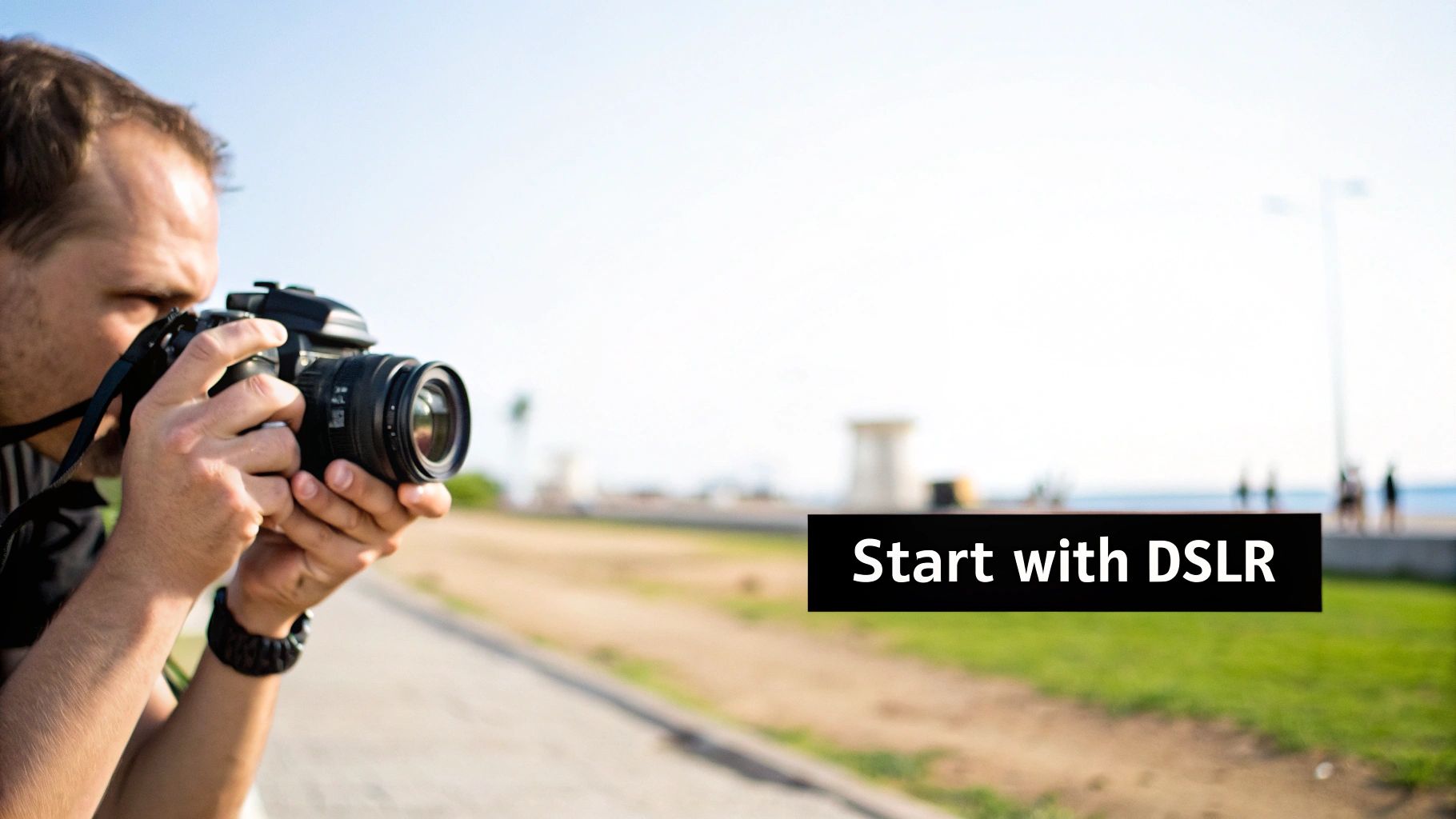
Learning photography is all about building a strong foundation, and a DSLR is the perfect workbench. Sure, smartphones are incredibly convenient, but they tend to hide the core principles of exposure—aperture, shutter speed, and ISO—behind a curtain of slick, automated software. A DSLR, on the other hand, puts those controls right at your fingertips.
This hands-on approach is what truly matters. Twisting a dial to beautifully blur a background or cranking up the shutter speed to freeze a splash of water connects you directly to the creative act. It’s like learning to drive a car with a manual transmission; once you get the hang of it, you understand how the machine works on a much deeper level. That tactile experience builds an intuition that phone photography just can't offer.
The massive shift toward mirrorless cameras has created a golden opportunity for anyone new to photography. While the global DSLR market has seen a drop in new shipments, that trend has flooded the second-hand market with fantastic, low-cost cameras. You can check out more about recent camera market trends to see how this benefits buyers.
In real terms, this means models that were once $500-$800 are now frequently available for under $300. Suddenly, professional-grade tools are more accessible than they've ever been.
A DSLR gives you the creative freedom that phones can't match, setting you up with a solid foundation in photography that will serve you for years to come. This is where you stop just taking pictures and start creating photographs.
This affordability isn’t just about the camera body, either. The ecosystem of lenses and accessories for DSLRs is massive and mature, meaning you have a ton of budget-friendly options to expand your kit as you grow.
For beginners, the advantages of starting with a DSLR are clear and compelling. The table below breaks down the key benefits.
| Feature | Benefit for Beginners |
|---|---|
| Full Manual Control | You learn the "exposure triangle" by feel, building skills that translate to any camera system. |
| Superior Image Quality | The large sensor captures far more light and detail, offering rich, high-quality images a phone can't produce. |
| Purpose-Built Ergonomics | Designed for comfort and stability, the grip and button layout encourage thoughtful, deliberate shooting. |
| Unbeatable Value | Get significantly more performance for your dollar, especially when buying used, allowing you to invest in good lenses sooner. |
Ultimately, a DSLR offers an unmatched combination of control, quality, and value that makes it the ideal starting point for any aspiring photographer.
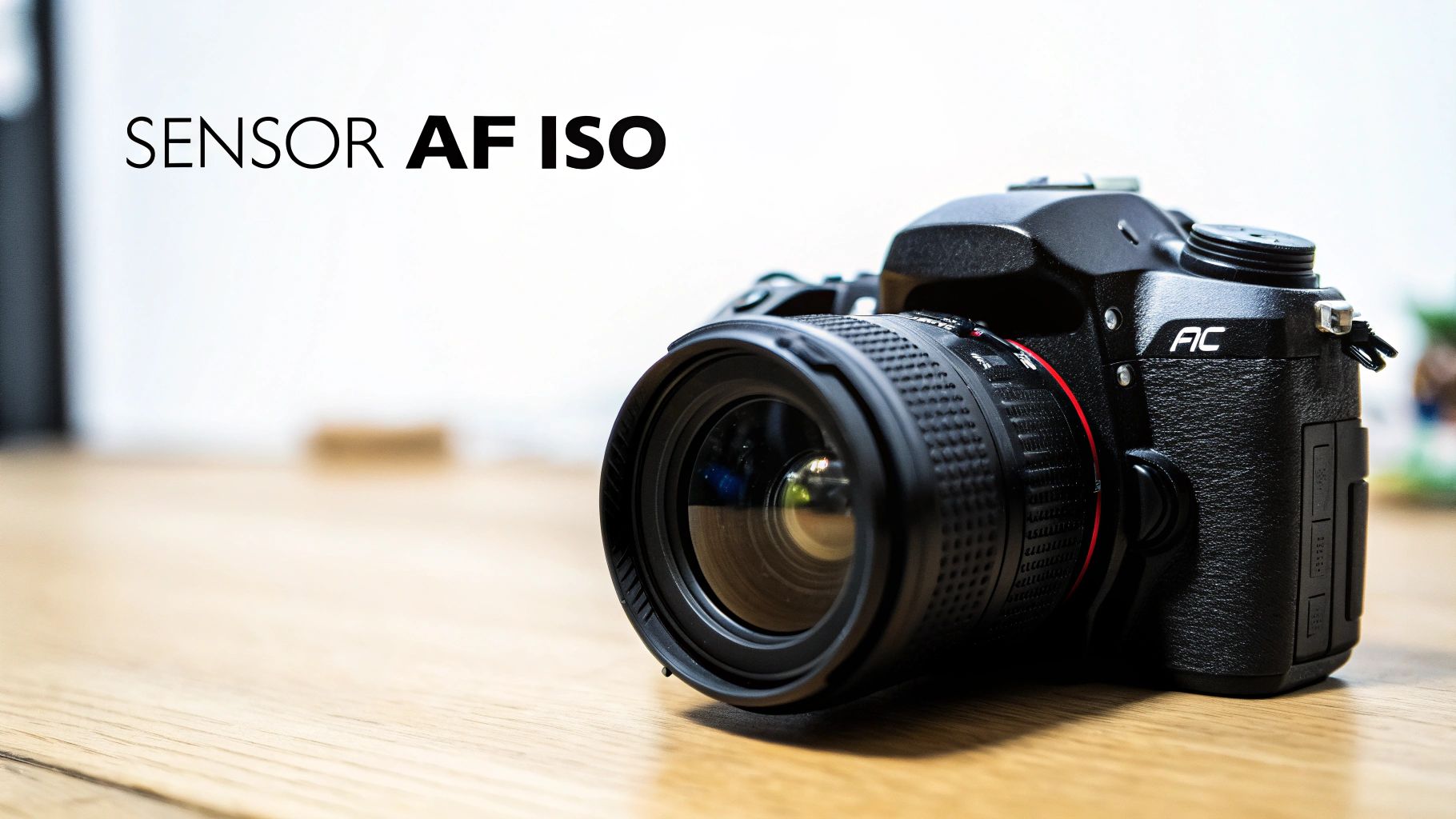
When you first start looking at DSLRs, the spec sheets can feel overwhelming. It's a wall of numbers and tech jargon that can easily send you down a rabbit hole. But here’s the secret: for a beginner, only a handful of features truly make a difference in your day-to-day shooting.
Let's cut through that noise. We’re going to focus on the three pillars that make a DSLR such a huge leap forward from your smartphone: the sensor, autofocus, and ISO. Get these down, and you'll know exactly what to look for.
Think of the camera's sensor as its canvas. A painter with a bigger canvas can capture far more detail and subtlety, right? It's the same idea here. A camera with a bigger sensor gathers more light and information, which is the single biggest reason even an older, affordable DSLR can blow a brand-new smartphone out of the water.
Most beginner-friendly DSLRs come with an APS-C sensor. Don't worry about the name—just know that it's massively larger than the tiny sensor inside your phone.
This extra real estate gives you some incredible advantages:
The jump in quality from a phone to an APS-C sensor is something you have to see to believe. You're no longer just snapping a picture; you're capturing a scene with depth and character that simply wasn't possible before.
If the sensor is the canvas, then the autofocus (AF) system is the camera's reflexes. It’s what locks onto your subject and makes sure it's tack-sharp. A good AF system is the difference between nailing the shot and getting a blurry memory, especially with moving targets like kids, pets, or athletes.
DSLRs use a dedicated autofocus sensor that is impressively fast and reliable. When you half-press the shutter button, you can feel the lens snap to attention. That immediate response lets you capture fleeting moments without the frustrating lag you often get with other devices. It's a core part of the DSLR experience.
Finally, there's ISO. In simple terms, ISO is the camera's ability to electronically brighten a photo, letting it "see" in the dark. Every sensor has a base sensitivity to light, and raising the ISO boosts that signal so you can shoot in low light without needing a flash.
But there’s a catch. Pushing the ISO too high introduces digital "noise," which looks like a layer of graininess over your image. This is another area where that bigger DSLR sensor pays off. Since it gathers more light from the start, it can handle higher ISO settings with far less noise than a smartphone, delivering clean, usable shots in even the most challenging light.
Your budget is one of the most powerful tools in your photography kit. How you spend it starts with one big question: should you buy a new or used camera? There’s no single right answer here, but knowing the pros and cons will help you get the absolute best value.
Buying new is great for peace of mind. You get a manufacturer's warranty and the thrill of unboxing a perfectly fresh piece of gear. No question about it.
But the used market? That's where you can really make your money work for you. For the same price as a brand-new entry-level DSLR, you can often snag a gently used, higher-end model. This simple move could land you a camera with a faster autofocus system, a more rugged body, or other pro-level features that will grow with you for years to come.
Diving into the pre-owned market just takes a little bit of know-how. The most important number to look for is the shutter count. Think of it like the mileage on a car—it tells you how much work the camera has done.
Every time you press the button, a mechanical shutter inside the camera fires. These shutters are built to last for a certain number of "actuations" before they might need service. For a beginner DSLR, a shutter count under 20,000 is fantastic. It means the camera has barely been broken in. While many cameras work perfectly long past their official rating, a lower number is always a safer bet. For a deeper dive, photography forums and expert sites like DPReview have tons of community data on shutter life.
The real secret of buying used isn't just saving a few bucks. It's about getting more camera for your money. A used mid-range body can easily outperform a new entry-level one.
Once you've found a promising used camera, a quick hands-on inspection is a must. Whether you're meeting up with a local seller or buying from a trusted online shop with a good return policy, run through these checks. It only takes a few minutes and can save you a world of headache.
Here’s what to look for:
By arming yourself with this simple checklist, you can confidently find affordable DSLR cameras for beginners that deliver serious performance and incredible value.
Picking a camera body is really just step one. Think of it as the brain of your setup, but the lens? That’s the eye. It’s what actually gathers the light and shapes the world into the images you want to create. For anyone starting out with an affordable DSLR, the gear you pair with it is just as crucial as the camera itself.
Most beginner DSLRs come bundled with a kit lens, usually something versatile like an 18-55mm zoom. It's easy to dismiss these as basic, but don't. They are fantastic learning tools. Treat it like a photographic multi-tool; you can capture a wide, sweeping landscape at 18mm, then twist the barrel to 55mm for a compelling portrait, all without taking a single step. That flexibility is invaluable when you're still figuring out what you love to shoot.
After you've gotten comfortable with your kit lens, the single best investment you can make is a 50mm prime lens. It’s so popular and affordable that it’s earned the nickname "nifty fifty." A prime lens has a fixed focal length—it doesn't zoom. That might sound like a limitation, but it’s a creative blessing in disguise. It forces you to move your feet and think more deliberately about your composition.
But the real secret sauce of the nifty fifty is its wide aperture, typically around f/1.8. This lets it suck in way more light than your kit lens, making it a champion in dimly lit rooms or after the sun goes down.
Even better, that wide aperture is how you get that professional-looking, blurry background (an effect called bokeh) in portraits. It makes your subject stand out from their surroundings, creating images with real drama and pop. For the price, no other piece of gear will give you a bigger jump in creative power.
There's a reason photographers call the 50mm f/1.8 a "gateway lens." It opens up a whole new world of creative shooting, teaching you about depth of field and low-light photography in a way a kit lens just can't.
Building your kit isn't a race to see who can buy the most gadgets. It’s about being smart and getting only what will genuinely help you take better pictures. Beyond a good lens, there are just a few essentials you’ll want from day one.
Start with these core items:
By focusing on these pieces—a versatile kit lens, a powerful prime, and a few key accessories—you'll have a capable and affordable DSLR setup that will grow right along with your skills.
If you've started researching cameras, you've no doubt stumbled into the "DSLR vs. Mirrorless" debate. It can feel overwhelming, but here's the good news: for someone on a budget who's just starting out, the choice is actually much clearer than all the online arguments suggest.
Let's cut through the noise and focus on what truly matters for your first camera.
At its core, the only real difference is how the camera lets you see the scene you're about to capture. A DSLR uses a clever system of mirrors that bounces light directly from the lens into an optical viewfinder. When you put your eye up to it, you're essentially looking through a tiny, bright window straight at your subject. It’s a direct, real-time, unfiltered view.
A mirrorless camera, on the other hand, gets rid of the mirror entirely. It uses an electronic viewfinder (or EVF), which is just a tiny, high-resolution screen. You're not seeing the scene directly; you're watching a live video feed from the camera's sensor.
This difference in viewing experience changes things more than you'd think. With a DSLR's optical viewfinder, what you see is literally what's there. You compose your shot, press the shutter, and then you can check the rear screen to see how the camera interpreted the scene with your settings. It’s a classic approach that really forces you to learn what happens when you change your aperture or shutter speed.
The EVF on a mirrorless camera can show you a preview of your exposure before you take the shot. While that sounds handy, it means the viewfinder is just another screen that’s constantly drawing power from your battery.
For a beginner focused on learning the core principles of photography—and getting the absolute most for your money—an affordable DSLR often comes out on top. The combination of incredible battery life and a huge selection of inexpensive lenses is hard to beat.
When you’re working with a tight budget and need a camera that can take a few knocks, DSLRs have some serious advantages. They’ve been the go-to for professional photographers for decades, and that long history translates into real benefits for newcomers.
Here’s what really makes them shine:
This simple chart helps visualize how you might approach building your first camera kit. The body is just your starting point, which you can easily expand with common, affordable lenses.
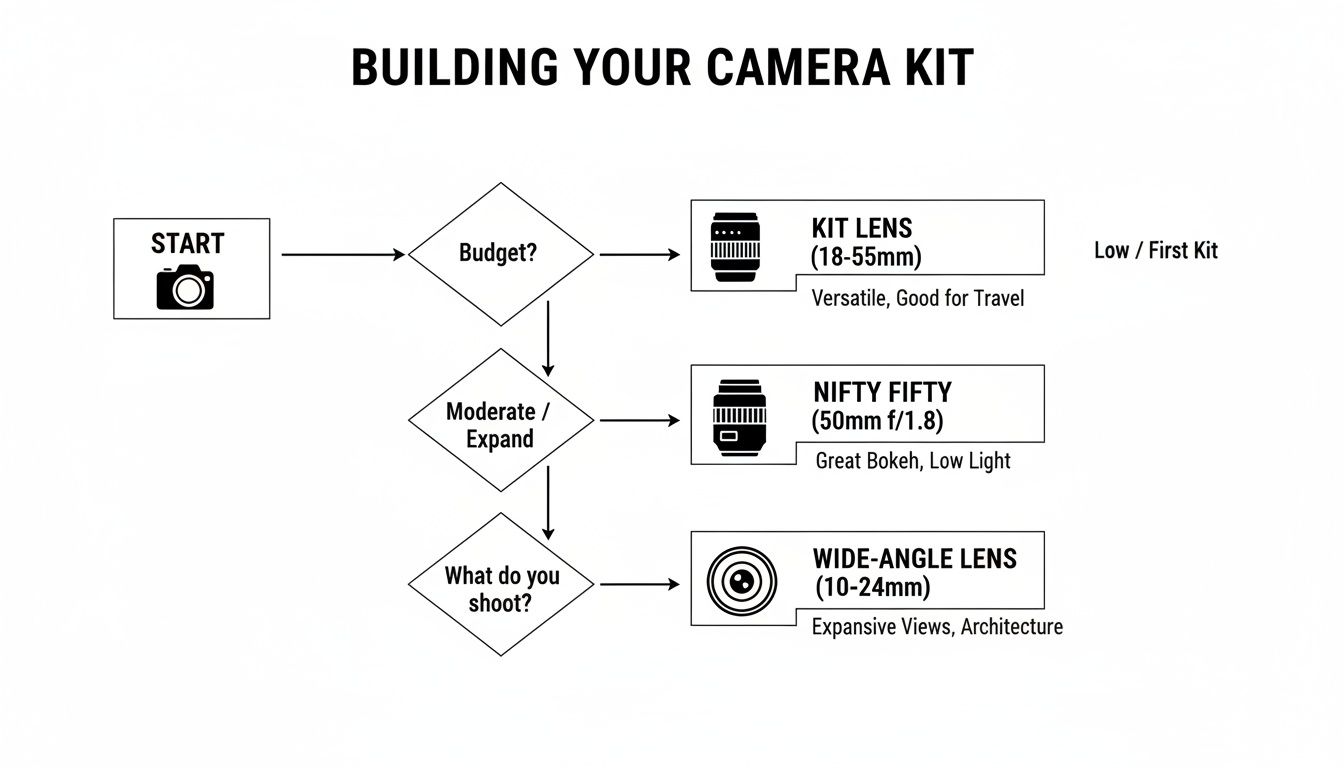
As you can see, the camera body is just the foundation. You can quickly add a versatile kit lens or a classic "nifty fifty" prime lens for creative portraits without breaking the bank.
To put it all into perspective, here's a quick side-by-side comparison.
| Characteristic | Affordable DSLR | Entry-Level Mirrorless |
|---|---|---|
| Viewfinder | Optical (direct, no lag, no power draw) | Electronic (live preview, uses battery) |
| Battery Life | Excellent (often 1000+ shots per charge) | Fair to Good (often 300-500 shots) |
| Size & Weight | Larger and heavier, but often more ergonomic | Smaller and lighter, can feel cramped |
| Lens Selection | Massive and very affordable used market | Smaller selection, newer lenses are pricey |
| Value for Money | Outstanding; a full kit is very accessible | Good, but a full kit costs significantly more |
| Video Features | Good, but often limited to 1080p on older models | Generally stronger, often includes 4K |
While mirrorless cameras are incredible pieces of technology, their main advantages often come at a higher price point. For a beginner looking to master the art of photography on a budget, the rugged build, marathon battery life, and immense value of the DSLR ecosystem make it a fantastic and highly practical place to start your journey.
Alright, you've waded through all the technical details and you're almost at the finish line. Now comes the most important part: turning all that research into a decision that feels right for you. This isn't about finding the "best" camera on paper; it's about finding the best camera for your hands and your vision.
Before you pull the trigger, let’s run through a final mental checklist. Remember, how a camera feels—its ergonomics—is just as crucial as what’s inside. If a camera is a pain to hold, you’ll never be excited to grab it and go shooting.
Think about what you truly want to create and what you actually need to get started. Ask yourself these final questions:
A great camera should feel like an extension of your creativity. Use this checklist to filter your options and find a DSLR that empowers you to start creating, not just taking pictures.
Stepping into the world of photography with your first real camera is a huge thrill, but it’s completely normal to have a few last-minute questions buzzing around. Let's clear up some of the most common things beginners wonder about so you can buy your first DSLR with complete confidence.
It's one of the first things people fixate on. It's so easy to get caught up in the numbers game, assuming that more megapixels automatically means a better picture. But that's not the full picture.
Think of megapixels as the individual specks of color that build your photo. While having more can let you print massive posters, it’s often overkill for everyday shooting. For a beginner, any modern DSLR with 18 to 24 megapixels is more than enough to create stunningly sharp photos for your Instagram feed, family albums, and standard prints.
This question comes up all the time. Can an affordable DSLR double as a solid video camera? You bet it can.
Most entry-level DSLRs shoot gorgeous Full HD (1080p) video. This is the perfect quality for capturing everything from family holidays and travel vlogs to your first creative film projects. Sure, they might not have the flashy 4K video found in pricier, newer models, but the quality is fantastic for learning the fundamentals of videography.
This is a big one. The "kit lens"—usually a versatile 18-55mm zoom that comes bundled with the camera—is often unfairly dismissed. Is it good enough to get you started? Absolutely. It’s an incredibly flexible tool, letting you capture wide, sweeping landscapes one moment and then zoom in for a nice portrait the next.
Think of your kit lens as your photography playground. It’s built to let you experiment with different styles and figure out what you love to shoot before you spend another dime on specialized gear.
Don't feel pressured to buy a bunch of lenses right away. Get to know your kit lens inside and out. When you find yourself constantly wishing for a creamier, more blurred background (that's called 'bokeh'!) or better performance in a dimly lit room, that's the universe telling you it’s time to look at your next lens, like the classic "nifty fifty."
Finally, let's talk about durability. Will an affordable DSLR survive real-world use? Yes! These cameras are built to be trusty workhorses.
Even the entry-level models are constructed from solid materials and designed to feel good and secure in your hands. With just a little bit of care, your first DSLR will easily last for years, capturing tens of thousands of memories and growing right alongside your skills.
At FindTopTrends, we curate the best photography equipment to help you start your creative journey. Discover a wide selection of gear and accessories by visiting us at https://findtoptrends.com.




