


No products in the cart.


Free Shipping Australia-Wide

5 star customer service

Quality Tested Products

The right family board game can feel like magic. It’s that perfect mix of fun, cleverness, and togetherness that makes games like Catan, Ticket to Ride, and Codenames such enduring hits. The secret is that they’re simple enough for everyone to jump in, but offer enough depth to keep teenagers and even grandparents hooked. It’s all about finding that sweet spot for your family's specific blend of ages and personalities.
Consider this your handbook for transforming a regular evening into a fantastic family game night. In a world of screens vying for our attention, board games give us a chance to unplug, look at each other, and truly connect. It's a dedicated time for shared laughter, a little friendly rivalry, and working together to solve problems—the very stuff that great memories are made of.
This guide is designed to help you explore the amazing and sometimes overwhelming world of modern board games to find the perfect match for your crew. We’ll go beyond the old standbys and dive into a universe of cooperative quests, strategic showdowns, and silly party games. Our goal is simple: to give you the confidence to pick games that create genuine, screen-free moments of fun.
At its core, game night is really about connection. It's where you get to see your quietest kid emerge as a brilliant negotiator or watch your competitive teenager team up with their younger sibling to pull off a win. These shared moments are a fantastic, low-pressure way to build some pretty important life skills.
A truly great family game does more than just pass the time. It becomes a catalyst for teaching, bonding, and creating a private world of inside jokes and epic moments your family will talk about for years.
The world of board games today is huge and incredibly diverse, with something for literally everyone. Think of it less like buying a product and more like planning an event. What's the vibe you're going for? A loud, high-energy party atmosphere, or a quiet, focused evening of deep thought?
Once you know the kind of fun you’re after, it becomes much easier to find the right game. We'll show you how to read the box like a pro—from age recommendations to player counts—and explore different game styles to match your family's unique personality. For more ways to blend fun with development, check out these fun learning games for kids that build real skills. Let's get started on finding the best family board games that will have everyone begging for "just one more round!"
Walking into a board game store can be overwhelming. The shelves are packed with colorful boxes, all promising an amazing family game night. So, how do you pick a winner that everyone will love, instead of one that ends in tears or boredom? The secret isn't some magical formula—it's just knowing how to read the box.
Think of the information on the side of the box as your personal cheat sheet. These aren't just dry statistics; they're the clues that tell you whether a game will become a family favorite or a permanent resident of the closet shelf.
The first thing you'll probably spot is the player count, which usually looks something like "2-4 players." This little number tells you a lot about the vibe of the game. A two-player game is often a more strategic, head-to-head experience, while a game that can handle six or more players is designed for a loud, lively party atmosphere.
If you’re a family of four, a 2-4 player game is obviously a great fit. But if you regularly have cousins or grandparents over for game night, you’ll want to look for something that can scale up to 5+ players so nobody gets left on the sidelines.
This flowchart can help you visualize the process of picking the right game.
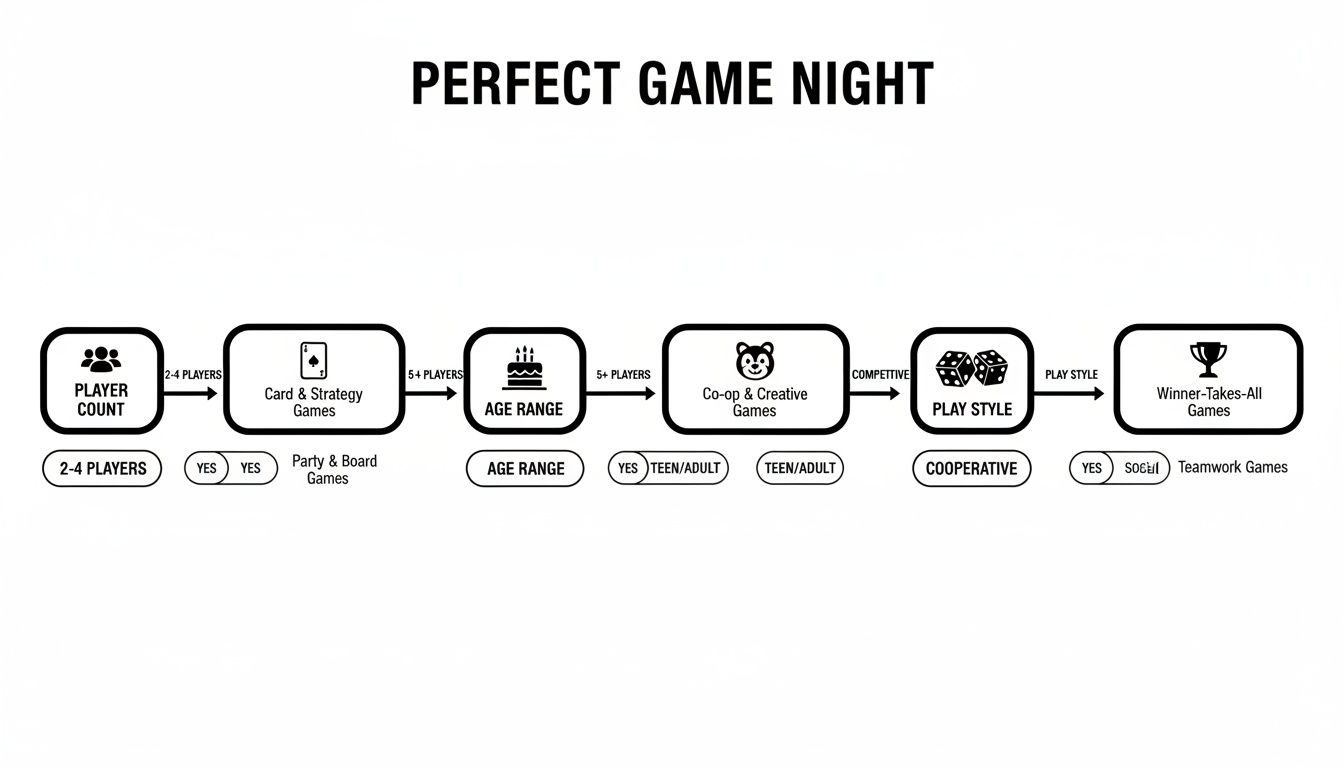
Starting with how many people you have and their general age range is the fastest way to narrow down your options to something that will work for your crew.
Next up, check the estimated play time. A game marked "15-20 minutes" is a perfect pre-bedtime activity or a quick dose of fun when you're short on time. On the other hand, a "60-90 minute" game is more of an event, best saved for a lazy Saturday afternoon when you can really settle in. Matching the game's length to your family's attention span is a game-changer.
The age rating (like "Ages 8+") is less about a child's intelligence and more about their developmental stage. A game rated for older kids might require reading fine print, thinking several steps ahead, or grasping abstract ideas.
Remember, the age on the box is a guideline, not a hard-and-fast rule. You know your child best. If your puzzle-loving 7-year-old is a strong reader, they might be totally ready for an 8+ game, especially if you’re playing alongside them.
Even the simplest games for toddlers, focused on colors and counting, play a valuable role. They introduce the foundational concepts of gaming, like taking turns and following rules. For the littlest ones, you can get more ideas for age-appropriate fun in this great guide on toys for a one-year-old.
Finally, get a feel for the game's complexity. Is it a straightforward roll-and-move game where luck is the main ingredient? Or is it a light strategy game where your decisions actually matter? Luck-based games are fantastic for groups with a wide age range because they level the playing field. Strategy games, however, are where older kids, teens, and adults can really sink their teeth into a challenge.
The modern board game scene isn't just for little kids anymore. Players aged 12–25 make up a huge chunk of the audience—about 38%—and adults between 26–40 aren't far behind at 31%. This means that older siblings and parents are often the ones driving the hobby, which is why finding a game that engages everyone across different generations is more important than ever.
Not all board games are created equal, and honestly, that’s a good thing. Every family has its own unique vibe, and games come in different flavors to match. Getting a handle on these categories is the secret to finding the best family board games that will actually hit the table and get everyone excited for game night.
Think of it like picking a movie. Are you in the mood for a big, splashy adventure, a laugh-out-loud comedy, or something that makes you think? Board games offer that same kind of variety. Let's walk through the four main genres you'll run into on your hunt for the perfect game.
In a cooperative game, the classic player-versus-player dynamic gets flipped on its head. Instead of trying to beat each other, everyone at the table works together as a single team to defeat a challenge presented by the game itself. This simple change can create a really powerful and positive atmosphere.
Suddenly, the goal shifts from individual glory to shared success. Players are bouncing ideas off each other, cheering on big moves, and celebrating (or commiserating) as a group. This makes co-op games a fantastic choice for families with a wide age gap or anyone who just wants to cut down on arguments and build some teamwork skills.
If working together sounds like your family's jam, you’ll find some great options among the best cooperative board games out there. It’s a refreshing break from the usual competitive showdown.
Party games are the social butterflies of the board game world. The rules are almost always simple, they play fast, and the main point is just to generate as much laughter and interaction as possible. They’re built for bigger groups and are perfect for breaking the ice or getting a multi-generational crowd to mix.
These games often lean into creativity, performance, or clever wordplay. Think of games where you might have to bluff, draw, sculpt, or guess ridiculous phrases. The emphasis isn't on deep strategy but on the hilarious, memorable moments you create together.
Party games are less about who wins and more about the funny stories you'll tell afterward. They are the ultimate tool for creating an energetic and inclusive game night atmosphere where anyone can jump in and have a great time.
Strategy games are all about rewarding thoughtful decisions and clever planning. Sure, luck might play a part, but victory usually goes to the player who can put together the best moves. This is a huge category, with everything from simple "gateway" games to incredibly complex brain-burners.
For most families, light-to-medium strategy games are the sweet spot. They introduce core ideas like managing resources, thinking a few steps ahead, and anticipating what others might do—all without being too overwhelming. These are perfect for engaging teens and adults, offering a satisfying challenge that makes a win feel truly earned.
The best educational games are sneaky. They’re designed to teach skills while being so entertaining that kids don't even realize they're learning. These games can cover anything from colors and counting for toddlers to geography, math, or vocabulary for older kids.
For the little ones, a game like Hoot Owl Hoot! can teach color matching and teamwork. As they grow, titles like The Scrambled States of America can make learning geography feel like a real adventure. The trick is that the "learning" is baked right into the fun of the game, making skill-building feel like play, not a chore.
To help you decide, here’s a quick rundown of what each category brings to the table.
| Game Category | Best For... | Key Feature | Example Titles |
|---|---|---|---|
| Cooperative | Families who want to avoid hurt feelings and work together. | All players win or lose together as a team. | Forbidden Island, The Crew, Pandemic |
| Party | Large, multi-generational groups and a focus on laughter. | Simple rules and high player interaction. | Codenames, Jackbox Games, Just One |
| Strategy | Families with older kids or teens who enjoy a good puzzle. | Player decisions are the primary driver of success. | Ticket to Ride, Catan, Wingspan, Azul |
| Educational | Younger children or supplementing school lessons with fun. | Skills are taught seamlessly through gameplay mechanics. | Hoot Owl Hoot!, The Scrambled States of America |
Ultimately, choosing the right category just means knowing your crowd. Whether you're teaming up to save the world or just laughing at a silly drawing, the goal is to have fun together.
This boom in popularity is part of a bigger trend. Family board games have become a household staple as people look for more shared, screen-free activities. The global market for family board games was valued at around $13.1 billion in 2023 and is projected to climb to $22.3 billion by 2032, proving just how much families value this time together.
Creating a fantastic collection of family board games doesn’t have to break the bank. With a bit of savvy shopping and a clear strategy, you can build a library packed with fun that your family will love for years, all without emptying your wallet. The trick is to think of each purchase as an investment in future fun.
Think of building your collection as a marathon, not a sprint. A single, well-loved game that hits the table every month is worth far more than five trendy boxes gathering dust on a shelf. Your goal is to curate a selection that grows with you, offering something for every mood and occasion.
My number one rule? Never pay full price unless you absolutely have to. A little patience goes a long way here. Most online retailers and local game shops run big sales throughout the year, especially around holidays like Black Friday or during the summer. Signing up for their newsletters is a great way to get a heads-up before a sale drops.
Don't overlook the secondhand market, either. People's tastes change, kids grow up, and gamers often downsize their collections, which can mean amazing deals for you.
When you’re working with a budget, replayability is the single most important thing to look for. It’s what makes a game feel fresh and exciting every time you play it. A gorgeous, complicated game you only play once is a poor investment, but a simple $30 card game you play 50 times offers incredible value.
Think of it in terms of "cost per play." A $50 game that gives you dozens of unique, fun sessions is a much better deal than a $20 game that feels totally figured out after two plays.
So, how do you spot a game with high replayability? Look for things like variable setups, different ways to win, or modular boards that change the layout each game. Games with unique character abilities or random event cards also guarantee that no two playthroughs will feel exactly the same. When in doubt, read reviews and see what people are saying about how well the game holds up over time.
Once you start bringing games home, you'll want them to last. Taking good care of your collection doesn't have to be complicated, but it makes a huge difference in preserving the components for years to come. For more great advice on stretching your household funds, check out these helpful budgeting tips for families.
Here are a few simple things you can do to protect your games:
By shopping smart, focusing on games you'll play again and again, and taking a few simple care steps, you can build an amazing library that will be the heart of your family's fun for years to come.
Finding the perfect game is only half the battle. The real magic—the stuff memories are made of—happens when everyone is gathered around the table. The goal of a truly great family game night isn't just about crowning a winner. It's about creating a space where everyone feels seen, heard, and valued.
Ultimately, a successful game night strengthens your family's bond long after the box is put away. It’s about building a positive, fun-loving atmosphere where simply playing together is the real prize.
When you're playing with a mix of ages, think of the official rulebook as more of a guideline than a strict command. For younger kids, rigid rules can quickly turn a fun game into a frustrating chore. That's where a few clever adaptations become your secret weapon for keeping them engaged.
A simple fix is to pair a younger child with an older sibling or parent to play as a team. This lets them be part of the strategy and excitement without feeling overwhelmed. You could also simplify the scoring—maybe ignore a few of the more complex point rules or even give them a small head start. The goal here is participation, not perfection.
Every family has its own unique vibe, so why should every game be played exactly the same way? House rules are simply custom tweaks you all agree on to make a game work better for your group. They’re a fantastic tool for cutting down on squabbles and dialing up the fun.
For instance, if a "take that" card in a game feels a bit too mean-spirited for your crew, you can all agree to take it out of the deck. Or if a game tends to drag on too long, set a timer or agree to play to a lower score to win.
House rules empower your family to take ownership of the experience. By deciding on changes together, you’re not breaking the rules; you’re making the game your own.
A little friendly competition is great, but we all know how easily things can get heated. One of the best ways to keep the mood light is to shift the focus from who wins to the clever moves and funny moments that happen along the way. Celebrate a brilliant play or a hilarious mistake, no matter who made it.
This approach naturally teaches good sportsmanship and reminds everyone that the journey is more important than the destination. And when someone inevitably gets frustrated (it happens!), it’s a great chance to model a little grace. Acknowledge their feelings, offer a word of encouragement, and gently remind them that it's all in good fun.
Here are a few quick tips to keep the competition friendly:
Making game night a success requires as much social planning as it does game selection. While you're preparing for fun, you might also find some great ideas for getting ahead on meals in our guide to family meal prep ideas. By fostering an inclusive and supportive environment, you can ensure your search for the best family board games leads to countless nights of genuine connection.
Stepping into the world of modern board games can feel a little overwhelming, and it's natural to have a few questions. How do you find the right game for your specific family? How do you handle those moments when friendly competition gets a little... less friendly?
Think of this as your personal troubleshooting guide. I've been there, and I've fielded these questions countless times. Whether you're trying to coax a reluctant teen to the table or just wondering where to find the best deals, these answers will help you build a game night routine that's more fun and a lot less frustrating.
This is probably the most important question of all. Matching a game's complexity to your kids' developmental stage is the absolute key to a successful game night. Get this wrong, and you'll see eyes glaze over in minutes. The goal is to find something that challenges them just enough without being overwhelming.
Preschoolers (Ages 3-5): Keep it simple, tactile, and short. Stick with concepts they're already learning, like colors, shapes, and counting. Games like Hoot Owl Hoot! are fantastic for teaching color-matching and working together, while a classic like Candy Land is really just about learning to follow a path and take turns.
Young Kids (Ages 6-8): You can start introducing simple rules and a little bit of light strategy here. Kids this age are ready for games where their choices actually start to matter. A title like Ticket to Ride First Journey is a perfect example—it brilliantly simplifies its famous parent game, serving as a great on-ramp to modern board games.
Pre-Teens and Older (Ages 9+): Okay, now the doors to the wider hobby really swing open. You can finally explore more complex and rewarding experiences. Gateway strategy games like Catan or the beautiful Wingspan offer deep decision-making. On the other hand, clever party games like Codenames are all about quick thinking and teamwork. The key is to find something that respects their growing intellect.
Ah, the age-old challenge. Getting a teenager to willingly join any family activity can feel like trying to solve a puzzle with missing pieces. The secret isn't to force it; it's to invite them into the process. Teens want to feel like their opinions are valued and that you see them as smart, capable people.
Honestly, the most effective strategy is to give them ownership. Instead of picking a game for them, ask them to pick one with you. Let them scroll through BoardGameGeek, watch a few "how to play" videos on YouTube, and give them the final say on the next game your family buys. This simple shift turns game night from a mandatory family chore into something they helped create.
When picking games for teens, steer clear of anything that feels remotely childish. Look for modern strategy games like Azul, tense social deduction games like The Resistance, or hilarious creative party games like A Fake Artist Goes to New York. These games treat them like equals at the table, offering a genuine challenge they can really sink their teeth into.
I hear this one a lot. For some families, a little competition brings out the absolute worst in everyone. If your game nights often end in slammed doors or hurt feelings, cooperative board games are the perfect antidote. These games completely flip the script—it's no longer about beating each other, it's about beating the game itself.
In a cooperative game, everyone is on the same team, working together to achieve a shared goal. That competitive energy immediately gets channeled into collaboration. Suddenly, instead of plotting against your sibling, you're brainstorming with them, planning moves as a group, and cheering for a collective victory (or groaning at a shared defeat).
A couple of excellent examples are Forbidden Island, where you have to work as a team to escape a sinking island with priceless treasures, or The Mind, a mind-bendingly simple card game where you try to play cards in order without saying a single word. Co-op games are one of the best tools out there for teaching teamwork and communication, turning a potential conflict zone into a real bonding experience.
Thankfully, you've got more options than ever for finding great family board games, and each has its pros and cons. Knowing where to look can save you a bit of time and money.
By keeping these tips in mind, you'll be well on your way to finding the perfect games that make your family time something everyone genuinely looks forward to.
At FindTopTrends, we curate the best products to make your family life easier and more fun. Explore our collection to discover top-rated gadgets, home essentials, and more, all in one convenient place. Visit FindTopTrends today to find your next great deal!




