


No products in the cart.


Free Shipping Australia-Wide

5 star customer service

Quality Tested Products

If you’re looking for the best all-around waterproof hiking boot, my money is on the Salomon X Ultra 5 Mid GORE-TEX. It’s the perfect sweet spot between lightweight agility and seriously aggressive traction. But if you’re hauling a heavy pack and need something that can take a real beating, the Lowa Renegade Evo GTX Mid is a legendary workhorse for a reason. Ultimately, the best boot for you comes down to how you hike, whether that’s casual day trips or challenging multi-day treks.
Picking the right waterproof hiking boots is probably the single most important gear decision you'll make. Think about it: they're your only connection to the trail, and they’re responsible for your comfort, stability, and safety out there. A good waterproof boot is your best defense against surprise downpours, soggy trails, and unexpected stream crossings, keeping your feet dry and happy. Wet feet aren't just uncomfortable; they can ruin a trip. A big part of that is knowing how to prevent blisters when hiking, which starts with the right footwear.
This guide is about more than just reciting tech specs. It's about giving you real-world advice to find the boots that will actually keep you dry and supported, no matter where your adventures take you. Remember, great boots are just one piece of the puzzle; knowing what to bring on a hiking trip will set you up for success.
To cut right to the chase, here’s a quick look at our top picks. This table breaks down our favorite boots by what they do best, so you can see at a glance which ones might be the right fit for your kind of hiking.
| Boot Model | Best For | Waterproofing Tech | Key Feature |
|---|---|---|---|
| Salomon X Ultra 5 Mid | Day Hiking & Fastpacking | GORE-TEX | Unmatched agility and grip |
| Lowa Renegade Evo GTX Mid | Backpacking & Rugged Terrain | GORE-TEX | Legendary support and durability |
| Merrell Moab Speed 2 Mid GTX | All-Around Versatility | GORE-TEX | Exceptional out-of-the-box comfort |
| HOKA Kaha 3 GTX | Maximum Cushioning | GORE-TEX | Superior shock absorption |
| Danner Mountain 600 Leaf | Classic Style & Durability | GORE-TEX | Full-grain leather and resoleable |
Think of this as your starting point. Each of these boots excels in its category, and the detailed reviews to follow will help you dig into the specifics to make the perfect choice.
When you see a "waterproof" tag on a hiking boot, it's easy to think they're all created equal. They aren't. The real magic isn't just about blocking water from getting in; it's about letting sweat get out. If a boot can't breathe, your feet will end up clammy and soaked from the inside, which is just as bad as stepping in a puddle.
This two-way street is the whole point of modern waterproofing technology. The goal is to build a fortress against big water molecules like rain and creek water, while leaving an open escape route for tiny water vapor molecules from your sweat. It’s a delicate balancing act, and it’s all down to some pretty clever material science.
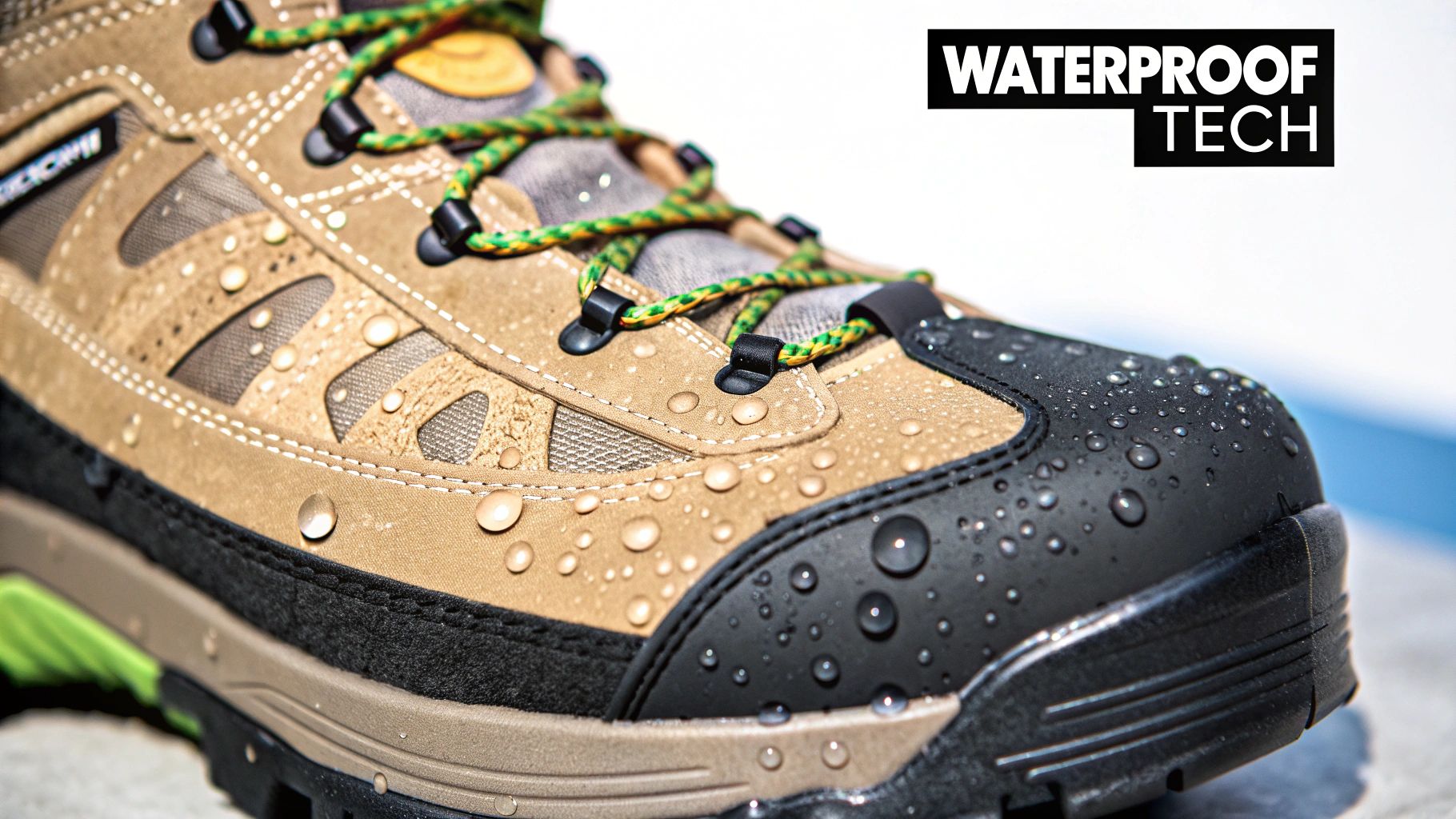
At the heart of any truly waterproof boot is a waterproof-breathable membrane. This is an incredibly thin layer, usually built into a bootie-style sock, that sits between the outer materials and the inner lining of your boot. Picture it as a bouncer at a club—it stops big, bulky water droplets at the door but waves the much smaller sweat vapor right on through.
The undisputed king of the hill here is Gore-Tex. Its membrane, made from expanded polytetrafluoroethylene (ePTFE), is a technical marvel. It’s packed with over 9 billion pores per square inch. Each one of those pores is about 20,000 times smaller than a drop of water, so rain has no chance. But, crucially, each pore is also 700 times larger than a molecule of sweat vapor, giving it an easy exit.
Gore-Tex may be the biggest name, but many brands have developed their own impressive in-house technologies that get the job done right:
Honestly, for most of us out for a day hike or a weekend backpacking trip, the real-world difference between Gore-Tex and a top-tier proprietary membrane is pretty small. What really matters is that the boot has a quality membrane, not just a spray-on coating.
While the membrane is doing the heavy lifting inside, it has a crucial partner on the outside: the Durable Water Repellent (DWR) coating. This is a chemical finish applied to the boot’s exterior—whether it's leather or a synthetic fabric—that makes water bead up and roll right off.
Think of DWR as the boot’s raincoat. Its main job is to stop the outer material from getting soaked through, a state we call "wetting out." When the exterior of your boot is waterlogged, it can't breathe. Simple as that. The soggy fabric blocks the escape path for your sweat. Your feet might technically be dry thanks to the internal membrane, but they'll feel cold and clammy.
This is why you have to take care of your boot's DWR finish. It's just like any other piece of gear. A well-maintained kit, from your boots to one of the best waterproof backpacks, is what separates a good trip from a miserable one in wet weather.
Over time, dirt, scuffs, and even the oils from your skin will break down the DWR. You’ll know it’s time for a refresh when water stops beading and starts soaking in. Thankfully, it's an easy fix with a spray-on or wash-in treatment. If you want to dive deeper into the methods and products for keeping your footwear dry, check out this expert guide to shoe waterproofing for any material. A little proactive care goes a long way in making sure your boots perform just as well on mile 100 as they did on mile one.
The hunger for solid outdoor gear has exploded, and with it, the technology packed into hiking boots. This isn't just a niche hobby anymore; the waterproof hiking boot market was valued at around $2,528 million in 2025. That’s a whole lot of people hitting the trails and demanding footwear that can keep up. You can find some in-depth analysis on datainsightsmarket.com if you're curious about the market's growth.
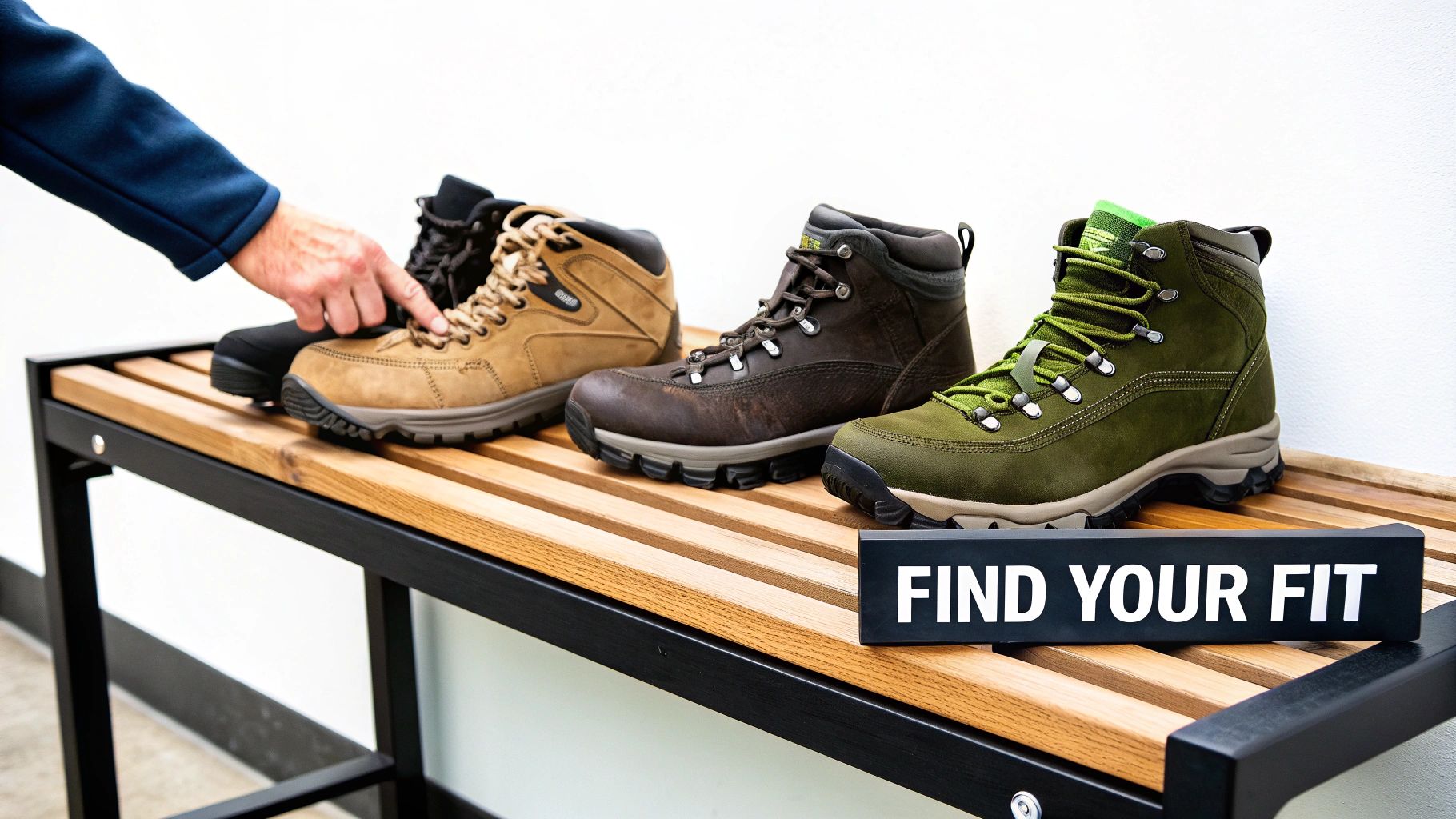
Let's be clear: fit is everything. It's the single most important factor, and it's more nuanced than just picking your street shoe size. No amount of fancy tech can save you from a poorly fitting boot—it's a one-way ticket to hot spots, blisters, and misery.
Remember that your feet swell on a hike, so it's always best to try on boots in the afternoon when they're at their largest. You want about a thumb's width of space between your longest toe and the very end of the boot. Just as crucial is the heel lock; your heel should feel snug and secure, with almost no slipping or lifting as you walk. Too much movement back there is how blisters form.
A boot’s "cut," or the height of its collar, dictates how much ankle support you get. It's not about one style being better than another; it's about matching the boot's design to the kind of hiking you actually do.
A classic mistake is grabbing a high-cut boot for easy day hikes, assuming more support is always better. In reality, the added weight and stiffness can be overkill, leading to tired legs when all that structure isn't needed.
The outsole is where the rubber literally meets the trail, and its grip is your foundation for stability and confidence. This is especially true when you're navigating wet roots, slick rocks, or loose scree. To understand traction, you need to look at two things: the lug pattern and the rubber compound.
Lugs are the deep, patterned grooves on the sole.
The type of rubber is just as critical. You'll see the name Vibram everywhere, and for good reason—they're the industry leader. Their Megagrip compound, in particular, has a legendary reputation for its sticky grip on both wet and dry surfaces. It's pretty much the gold standard. For more tips on what to look for, check out our guide on how to choose hiking boots.
A boot's upper material dictates its durability, breathability, and weight. There’s no single "best" material here; it's all about compromises and finding the right balance for your needs.
Specs on a webpage are one thing, but how a boot actually performs on a muddy, rock-strewn trail is what really counts. This is where we leave the marketing jargon behind and dive into real-world performance. We’re pitting some of the best models from titans like Salomon, Merrell, Lowa, and Keen against each other, looking at the details that matter when you’re miles from anywhere.
We're breaking down these comparisons by specific scenarios. After all, the perfect boot for a quick day hike isn't necessarily the one you’d want for a week-long trek with a heavy pack. Our goal is to give you nuanced, situational advice so you can pinpoint the right pair for your specific adventures.
This demand for high-quality, weatherproof footwear is nothing new, especially in regions with notoriously challenging climates. Europe, for instance, has a long and storied tradition in this space, claiming over 25.50% of the waterproof boots market share back in 2022. This really speaks to a deep-rooted hiking culture that demands gear that can handle anything. You can dig into more of these trends and discover additional hiking shoe statistics over at RunRepeat.com.
This matchup is a classic clash of hiking philosophies. On one hand, you have the Salomon X Ultra 5 Mid GORE-TEX, a lightweight, athletic boot built for moving fast. On the other, the legendary Lowa Renegade Evo GTX Mid stands as the gold standard for rugged, unwavering support.
The Salomon X Ultra 5 genuinely feels more like a trail runner that grew an ankle collar. Its synthetic upper and flexible design encourage a quick, nimble pace, making it a stellar choice for day hikers and fastpackers who want to cover ground efficiently on moderate trails. The aggressive All-Terrain Contagrip® outsole is also incredibly grippy on just about everything, from slick rocks to loose gravel.
The Lowa Renegade, by contrast, is a true backpacking workhorse. Built from tough nubuck leather, it delivers a level of stability and protection the lighter Salomon simply can’t touch. When you're hauling a pack over 30 pounds, the Renegade’s stiffer sole and supportive frame are what keep your feet from getting fatigued over long, grueling days. It’s less about sprinting and more about providing a secure, bombproof platform for serious treks.
Key Differentiator: If you’re mostly doing hikes under 10 miles with a light daypack, the Salomon X Ultra 5 gives you a real edge in agility and immediate comfort. But for multi-day backpacking trips or routes across highly technical, rocky terrain, the superior ankle support and underfoot protection of the Lowa Renegade are essential.
For a lot of folks, the dreaded break-in period is a deal-breaker. Merrell and Keen have practically built their empires on creating boots that feel fantastic right from the first wear. The Merrell Moab line has long been nicknamed the "Mother of All Boots" for its famous comfort, and the new Moab Speed 2 Mid GTX proudly carries on that legacy.
The Moab Speed 2 is exceptionally light and flexible, almost like a sneaker. It uses a cushioned FloatPro™ foam midsole that does a great job of soaking up impact. It hits a sweet spot, offering enough support for day hiking while feeling incredibly comfortable. With a reliable Vibram® TC5+ outsole underfoot, it’s a versatile all-rounder for most trail conditions you’ll encounter.
The Keen Targhee IV Waterproof Mid comes at comfort from a different angle, focusing on a famously generous fit. Keens are well-known for their wide toe boxes that let your toes spread out naturally, which is a game-changer for balance and comfort, especially if you have wider feet. The Targhee IV is a bit burlier than the Moab Speed 2, giving you a more traditional boot feel without the plank-like stiffness of a heavy-duty model.
Deciding between them often boils down to your foot shape and how you hike. The Merrell is the lighter, more athletic choice, perfect for moving quickly. The Keen, on the other hand, offers a more protective feel with that signature roomy fit that its fans swear by.
This final comparison really shows how much hiking boot design has evolved. HOKA has successfully brought its maximalist cushioning from the running world to the trails, while Danner continues to blend classic leather craftsmanship with modern tech.
The HOKA Kaha 3 GTX is all about comfort through cushioning. Its super-thick, rockered sole is engineered to reduce impact on your joints and promote a smooth, rolling stride. This makes it a fantastic option for hikers who deal with foot or knee pain, or for anyone facing long descents on hard-packed ground. The GORE-TEX Invisible Fit membrane also makes it feel surprisingly flexible for such a beefy boot.
On the flip side, the Danner Mountain 600 Leaf GTX offers a more traditional experience with a modern upgrade. The full-grain leather upper has that timeless look and durability, but it's paired with a Vibram® Megagrip outsole and a soft Vibram® SPE midsole for amazing traction and comfort straight out of the box. A huge plus for the Danner is that it can be recrafted—the outsole can be replaced, which can dramatically extend the life of your investment.
Situational Recommendations
To help you see how these boots stack up at a glance, we've put together a detailed comparison table.
This table provides a side-by-side look at the key performance metrics of our top recommended boots, making it easier to see the direct trade-offs between each model.
| Boot Model | Waterproofing | Outsole/Traction | Weight (Pair) | Ankle Support | Best Use Case |
|---|---|---|---|---|---|
| Salomon X Ultra 5 Mid | GORE-TEX | All-Terrain Contagrip® | 1 lb. 14.5 oz. | Moderate | Fast-paced day hikes, lightweight backpacking |
| Lowa Renegade Evo GTX Mid | GORE-TEX | Vibram® Vi-Lite | 2 lbs. 7.7 oz. | Excellent | Multi-day backpacking, heavy loads, rugged terrain |
| Merrell Moab Speed 2 Mid | GORE-TEX | Vibram® TC5+ | 1 lb. 10.8 oz. | Moderate | Day hiking, beginners, varied trail conditions |
| Keen Targhee IV Waterproof Mid | KEEN.DRY | KEEN.RUGGED | 2 lbs. 4.4 oz. | Good | Hikers with wide feet, moderate day hiking |
| HOKA Kaha 3 GTX | GORE-TEX | Vibram® Megagrip | 2 lbs. 2 oz. | Good | Long-distance hiking, joint protection, descents |
| Danner Mountain 600 Leaf GTX | GORE-TEX | Vibram® Megagrip | 2 lbs. 5 oz. | Good | All-around hiking, long-term durability, classic style |
Ultimately, the "best" boot is a personal choice that depends entirely on your feet, your pack, and the trails you plan to explore. This breakdown should give you a solid foundation for making an informed decision.
Think of a good pair of waterproof hiking boots as a long-term investment in your trail comfort and safety. And like any piece of high-performance gear, they need a little TLC to keep them going strong. A few simple maintenance habits can be the difference between a boot that lasts a few seasons and one that carries you reliably for hundreds of miles.
When you just toss your boots in the corner after a long trek, you're letting mud and grit grind away at the leather or fabric. This accelerates wear and tear. A little cleaning, conditioning, and re-waterproofing is all it takes to protect your investment and keep your feet dry.
This is the single most important thing you can do, and it’s also the easiest. When mud cakes onto your boots, it sucks the moisture right out of the leather, eventually causing it to dry out and crack. On synthetic boots, that abrasive dirt slowly degrades the fabric and compromises the boot’s integrity.
Your post-hike cleaning routine can be quick and simple:
This chart can help you see how your hiking style influences your boot choice, which in turn affects the kind of care they'll need.
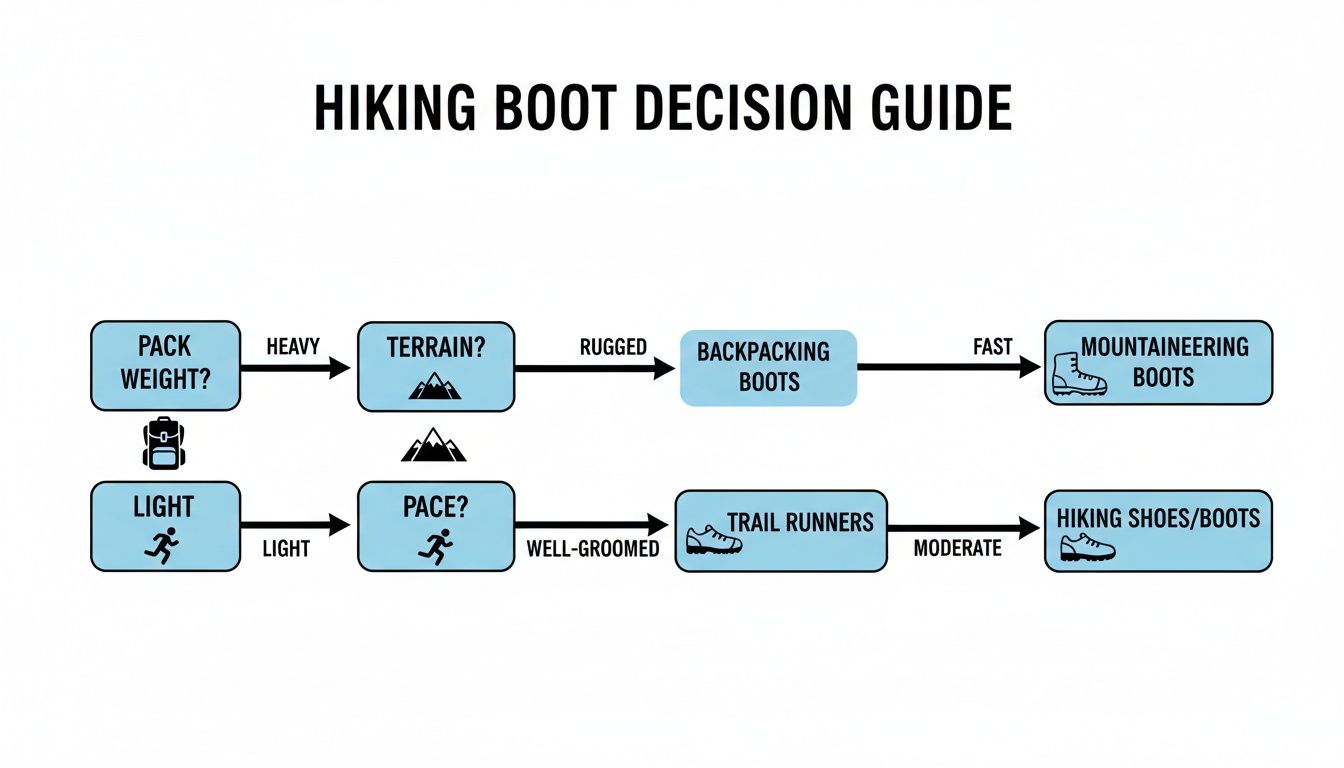
As the graphic shows, a heavy pack often calls for a sturdier leather boot, while fast-and-light day hikes might be better with a synthetic model—and each has different maintenance needs.
How you dry your boots is just as important as how you wash them. Whatever you do, never use a direct heat source. That means no campfires, radiators, or hair dryers. Intense heat can make leather shrink and crack, weaken the glues holding your boot together, and even damage the waterproof membrane inside.
Slow and steady wins the race here. Stuff your boots with newspaper or paper towels to soak up moisture from the inside, then just let them air-dry at room temperature. For leather boots, it's a great idea to apply a conditioner while they're still a bit damp—this helps the leather absorb it, keeping the material supple and preventing cracks.
That magical beading effect you see when water hits a new pair of boots? That’s the DWR coating at work. Over time, friction and dirt will wear this finish away. The telltale sign it’s time for a refresh is when the fabric starts absorbing water instead of repelling it, a problem known as "wetting out."
Bringing it back to life is easy. Once your boots are clean and dry, just apply a spray-on or rub-on waterproofing product made for your boot’s material, whether it’s leather or synthetic. This quick step restores that crucial first line of defense against rain and puddles, and it also allows the internal waterproof membrane to breathe properly. That’s the key to keeping your feet dry from the outside and the inside.
Even after digging into all the details, you might have a few nagging questions. That’s completely normal. Choosing the right pair of boots is a big decision, and getting these last few points sorted is what separates a good choice from a great one.
We’ve pulled together the most common questions we hear from fellow hikers to clear up any lingering confusion. Think of this as a final chat with a seasoned trail guide before you commit.
Not necessarily, but they are most of the time. The biggest tradeoff with any waterproof gear is always breathability. If you’re hiking exclusively in bone-dry, scorching desert conditions where a surprise rainstorm is out of the question, a super-ventilated, non-waterproof boot will feel much better. It lets your foot sweat evaporate faster, keeping you cooler.
But for the vast majority of us who hike in three-season conditions, that waterproof-breathable membrane is a lifesaver. It’s what stands between you and a miserable day when you hit an unexpected downpour, a series of muddy bogs, or a creek that’s running a little higher than usual. For most hikers, waterproof is simply the more versatile and reliable option.
The real benefit of modern waterproof boots isn’t just about blocking rain. It's the confidence you get knowing you’re prepared for whatever the trail throws at you. A sudden squall or a high creek crossing won't end your hike.
That kind of reliability is why they’ve become the standard for any serious hiker.
This is a great question because there are two parts to a boot's waterproofing, and they wear out differently.
First, you have the internal membrane (like Gore-Tex or a similar technology). This liner is built to last the entire usable life of the boot. Unless you puncture it with something sharp or somehow damage it with extreme heat, it’s not going to fail.
Then there’s the Durable Water Repellent (DWR) coating on the outside. This is the finish that makes water bead up and roll right off the fabric or leather. This coating absolutely wears out from dirt, dust, and general abrasion. You’ll know it’s failing when the boot's outer material starts looking dark and soggy in the rain, a problem we call "wetting out." While the membrane inside is still keeping your foot dry, a wetted-out boot feels heavy and stops breathing, making your feet clammy.
Depending on how much you hike, you'll likely need to re-apply a DWR spray every few months to once a year to keep your boots performing their best.
The golden rule here is simple: never wear brand-new boots on a long hike. Seriously. It’s a guaranteed recipe for blisters and a truly awful day on the trail. You have to ease into them and give the materials time to mold to the specific shape of your foot.
Here’s a tried-and-true process that works every time:
For those classic, stiff, full-grain leather boots, this process is non-negotiable and might take a few weeks of consistent wear. Be patient—the payoff is a custom-fit boot that feels like an extension of your foot.
You can make them more water-resistant, but you can't make them truly waterproof. Using products like wax-based creams on leather boots or DWR sprays on fabric ones does a pretty good job of helping them shed light rain and splashes from puddles. It's a solid way to add a bit of protection for an otherwise dry day.
But there are limits. A treated boot still lacks the two key things that make a boot truly waterproof: a sealed internal membrane and seam-taped construction. Without those, water will always find a way in during a sustained downpour or if you have to submerge your foot to cross a stream.
For reliable, all-day dry feet in genuinely wet conditions, there’s no substitute for a boot that was designed from the start to be waterproof.
At FindTopTrends, we are dedicated to helping you discover gear that elevates your adventures. Explore our curated selection of outdoor essentials and find everything you need for your next journey at the FindTopTrends outdoor gear hub.




