


No products in the cart.


Free Shipping Australia-Wide

5 star customer service

Quality Tested Products

The familiar four-season system of color analysis—Winter, Spring, Summer, and Autumn—has long been a starting point for many exploring personal color. However, this simplified model often leaves individuals feeling pigeonholed. It’s like trying to categorize all the world's flowers as simply roses, sunflowers, lilies, and tulips. The vast diversity within each type, not to mention countless other varieties, would be completely overlooked!
This limited framework fails to capture the subtle nuances of human coloring. For example, where does someone with warm-toned skin and cool-toned hair fit within these rigid seasonal boundaries? This can lead to confusion and inaccurate color palettes that don’t truly enhance one's natural features.
Fortunately, the world of color analysis has evolved. Moving beyond the basic four-season framework, analysis now encompasses more complex systems, recognizing up to 16 sub-seasons, including hybrid and flow categories. These expanded models consider not just skin, hair, and eye color, but also contrast level and color intensity, allowing for a more nuanced and personalized color profile. Explore this topic further. Think of it as recognizing the unique beauty of a specific rose variety, rather than just labeling it a "rose."
This shift toward more sophisticated systems stems from the understanding that individual coloring is incredibly complex. Just as no two snowflakes are alike, no two individuals share the exact same combination of skin tone, hair color, and eye color. A one-size-fits-all approach simply isn’t effective.
The development of these expanded systems offers several key advantages. They provide a much more accurate assessment of an individual's coloring, leading to more flattering and harmonious color palettes.
Additionally, they offer greater flexibility and personalization, recognizing that individuals may fall between traditional seasonal categories or possess unique characteristics that defy simple categorization.
This translates into a wardrobe that truly reflects one's personality and enhances their natural beauty. This nuanced approach empowers individuals to confidently choose colors that make them look and feel their best.

A seasonal color analysis quiz can help you discover your most flattering colors. However, clicking randomly through questions won't give you accurate results. Just like preparing for a photoshoot, the right setup is crucial. Professional color analysts stress the importance of preparation before you even begin the quiz.
Natural daylight is paramount for accurate color analysis. Artificial lighting distorts colors, making warm tones appear cool or vice versa. Think of painting a landscape at midday versus sunset—the colors change drastically. Similarly, indoor lighting can skew your perception of your own coloring. Find a spot near a window, but avoid direct sunlight, which can be too intense.
Think of your face as a canvas. Just as a painter prepares their canvas, you need to prepare yours. Makeup can mask your natural coloring. Remove all makeup, including foundation, concealer, and tinted moisturizer, before starting the quiz. Recent tanning or hair coloring can also affect results. Your natural, unaltered state provides the best baseline.
Objectively evaluating your features can be challenging. Many people downplay or overemphasize certain features, leading to inaccurate self-assessment. A good quiz guides you through this process, asking targeted questions about your skin, hair, and eye color. For example, does your skin have golden or pinkish undertones? Are your eyes a clear blue or a muted hazel? Honest answers, even if they differ from your perceived coloring, yield the most accurate results.
Not all seasonal color analysis quizzes are equal. Some use the outdated four-season model, while others use 12 or even 16 sub-seasons. Look for quizzes that go beyond basic questions, delving into contrast levels and the intensity of your features. This provides a more precise and personalized result. For example, knowing you're a "Summer" is helpful, but knowing if you're a Light Summer, a Cool Summer, or a Soft Summer gives you more actionable guidance.

Taking a seasonal color analysis quiz strategically sets you up for success. It empowers you to create a wardrobe and makeup collection that truly complements your natural beauty.
So, you've taken a seasonal color analysis quiz. But what do those results really mean? Knowing if you're a Spring, Summer, Autumn, or Winter is only a starting point. Modern color analysis goes much deeper than the basic four-season model. It recognizes the wide range of individual variations in human coloring. This leads us to explore more detailed categories like sub-seasons, flow seasons, and hybrid types.
Understanding terms like "high contrast" and "color intensity" is essential for applying your quiz results to your everyday style. High contrast refers to a significant difference between your hair, skin, and eye colors. Imagine someone with dark brown hair, pale skin, and bright blue eyes – a classic example of high contrast. Color intensity, on the other hand, describes the richness or saturation of your coloring. Think of the difference between a vibrant emerald green and a soft seafoam pastel. These details provide a far more precise understanding of your best colors than the traditional four seasons alone.
What happens if your quiz results place you between seasons? This is where sub-seasons come in. Within each main season, variations exist. A Summer, for example, might be a Cool Summer, a Light Summer, or a Soft Summer. Each sub-season has a specific color palette designed for its unique characteristics. Some individuals even fall into specialized categories, like "flow" or "hybrid" types, which blend elements of multiple seasons. Understanding these nuances is the key to unlocking the full potential of your color analysis.
You can take our quiz here: Find Your Color Season Quiz.
Taken multiple quizzes with different results? This isn't uncommon. Various factors can contribute to this, from the lighting conditions during the quiz to the structure of the quiz itself. Some quizzes stick with the simplified four-season system, while others use an expanded 12 or 16 sub-season system, such as the one discussed on Style with DC.
To better grasp the differences, let's look at a helpful infographic about skin undertones:
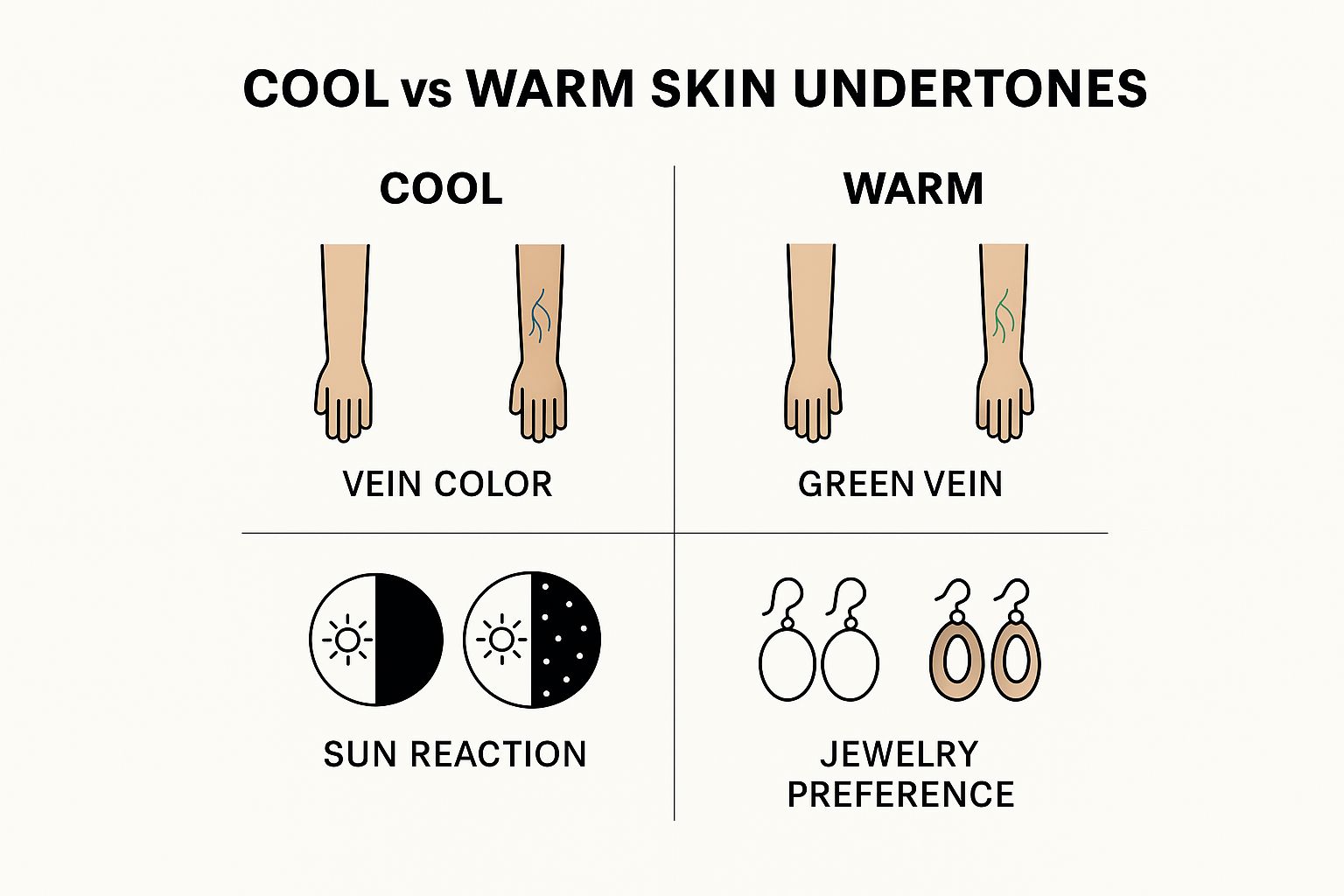
This infographic illustrates how cool undertones are often linked to bluish veins, a tendency to burn in the sun, and a preference for silver jewelry. Conversely, warm undertones are typically associated with greenish veins, a tendency to tan, and a preference for gold jewelry. These distinctions are vital when determining your overall color season.
To further clarify the sub-seasons, the following table provides a comparison of the traditional four-season model and the expanded 16 sub-season system:
Modern Color Season Categories and Characteristics
| Season Type | Traditional Model | Modern Sub-Seasons | Key Characteristics | Best Colors |
|---|---|---|---|---|
| Spring | Spring | Light Spring, Warm Spring, True Spring, Clear Spring | Warm, Light, Bright | Light, warm colors like peach, coral, and golden yellow |
| Summer | Summer | Light Summer, Cool Summer, Soft Summer, True Summer | Cool, Muted, Soft | Soft, cool colors like powder blue, rose pink, and lavender |
| Autumn | Autumn | Soft Autumn, Warm Autumn, Deep Autumn, True Autumn | Warm, Muted, Deep | Warm, earthy colors like olive green, burnt orange, and mustard yellow |
| Winter | Winter | Dark Winter, Cool Winter, Bright Winter, True Winter | Cool, Bright, High Contrast | Cool, bold colors like black, navy, and emerald green |
This table summarizes the key characteristics and best colors for each season and sub-season. Notice how the sub-seasons break down the broader categories into more specific groups. This helps to fine-tune your color palette for the most flattering results.
Ultimately, understanding the subtleties of your color profile allows you to choose colors that truly complement your natural features. It's all about building a wardrobe and makeup collection that helps you look and feel your best.
Taking a seasonal color analysis quiz is a great first step towards a more stylish you. But the real transformation begins when you start building a wardrobe that reflects your unique color palette. This means translating those quiz results into actual clothing choices that make you look and feel amazing every day. This process might seem daunting, but with the right strategies, it can be both enjoyable and rewarding.
Begin by focusing on investment pieces. These are the foundation of your wardrobe: items you'll wear frequently and that have a significant impact on your overall look. Think a well-fitting blazer in your best neutral, a classic coat in a flattering color, or a versatile dress that can be dressed up or down. Choosing these key pieces in colors from your personalized palette ensures your most-worn items always enhance your natural coloring.

You don’t need to discard your entire wardrobe after taking a seasonal color analysis quiz. Instead, assess your current clothes and identify items that align with your new palette. For example, if you discover you're a "Summer," those cool-toned blues and lavenders you already own are perfect. For items that don't quite fit, consider ways to incorporate them strategically. You might pair a less flattering top with a scarf in one of your best colors, shifting the overall focus towards your face.
Moving forward, develop smart shopping strategies. Knowing your color palette empowers you to make informed purchases, avoiding impulse buys that will clash with your existing wardrobe. Consumer behavior studies reveal that approximately 62% of consumers are more likely to purchase clothing in colors they believe flatter them. This statistic underscores the practical influence of color analysis on personal style and buying habits. Find more detailed statistics here. Concentrate on acquiring pieces that coordinate within your palette, creating a cohesive and versatile wardrobe.
Learn to effectively mix and match colors within your palette. Experiment with different combinations to discover which shades work best together. This allows you to create a variety of outfits from a smaller number of pieces, maximizing your wardrobe's potential. You might be interested in: How to master a minimalist wardrobe. This approach simplifies your daily styling choices and contributes to a more sustainable approach to fashion.
Finally, learn how to adapt current fashion trends to work with your color palette. Just because a certain color is trending doesn’t mean it’s right for you. Instead of blindly following trends, look for ways to incorporate elements of the trend in colors that flatter you. This ensures you stay stylish while always looking your best. For example, if neon orange is in vogue, but your palette calls for softer shades, you might choose a muted coral accessory or a print with pops of orange within your best neutrals. This way, you embrace current trends while honoring your individual color profile.
Your seasonal color analysis quiz results unlock a world of makeup and beauty choices designed to enhance your natural features. This isn't simply about matching eyeshadow to your outfit; it's about understanding how colors interact with your complexion. Professional makeup artists use these principles to create stunning looks. Now, you can apply this knowledge to your daily routine.
The first step is understanding your color season's implications. This goes beyond the season itself; it's about the undertones and color characteristics that define your palette. Are your best colors bright and clear, or soft and muted? Are you a warm or cool season? These nuances guide your makeup choices. For example, a Warm Autumn might find earthy tones like terracotta and burnt orange flattering, while a Cool Winter might thrive in jewel tones like sapphire and emerald green.
Foundation and concealer form the base of any makeup look. Choosing the right shade is crucial. Your color analysis provides a roadmap. Instead of guessing at undertones, you'll know whether to choose a warm beige, a cool ivory, or a shade in between. This prevents foundation mismatches and ensures a seamless blend with your skin.
Your color season also dictates which eyeshadow and lip color families will best complement your features. A Light Spring might find pastel pinks and corals brighten their eyes, while a Deep Autumn might find deeper shades of brown and burgundy create a striking effect. Experiment with different shades and intensities within your color palette for a harmonious and flattering look.
Color analysis principles extend beyond makeup. Choosing nail polish and hair color within your season can enhance your overall appearance. A Soft Summer might choose muted pinks or lavenders for their nails, while a Bright Winter might opt for bold red or classic black. Choosing a hair color within your seasonal palette ensures a natural look. You might be interested in: How to master your everyday make up in our january routine.
Finally, learn how to adapt beauty trends to your color palette. Not every trend suits every season. By understanding color analysis, you can modify trends to work for you. This might mean choosing shades within your palette or incorporating trendy textures and finishes in complementary colors. This personalized approach ensures you always look confident and polished, working with, rather than against, your natural beauty.
Even the most well-designed seasonal color analysis quiz can sometimes be misleading. Color analysis professionals often observe recurring errors that prevent individuals from accurately identifying their true color season. Understanding these common pitfalls is essential for achieving reliable results and discovering a truly flattering color palette.
One of the most frequent mistakes is taking the quiz under artificial lighting. This can significantly alter the appearance of colors, making warm tones seem cool and cool tones appear warm. It’s like trying to assess the true color of a gemstone under a colored light source – the results will be skewed. Indoor lighting, especially from fluorescent or incandescent bulbs, can distort your perception of your own coloring. For the most accurate results, always take the quiz in natural daylight, avoiding direct sunlight, which can be too intense.
Another common oversight is taking a seasonal color analysis quiz shortly after dyeing your hair or tanning. Just as an artist wouldn't evaluate a painting while it's still wet, you shouldn't assess your coloring when it's been recently altered. Recent hair color, especially if it differs dramatically from your natural shade, can completely change how colors appear against your skin. Similarly, a tan, whether natural or artificial, can affect your skin's undertones and influence the results. Wait until your tan fades and your hair grows closer to your natural shade for a more precise assessment.
Online quizzes can be a helpful starting point, but they shouldn't be your sole resource. They often employ simplified systems that overlook the nuances of sub-seasons, flow seasons, and hybrid types that are considered in more comprehensive analyses. This can result in generic palettes that don't fully complement your individual coloring. It’s similar to receiving a general health check-up compared to consulting a specialist; the specialist can offer more tailored advice. Consider seeking guidance from a professional color analyst for a more personalized evaluation if you’re unsure about your quiz results.
Several indicators might suggest you would benefit from a professional color analysis. Consistently receiving different outcomes on various quizzes, feeling that no single season accurately represents your coloring, or having difficulty incorporating your quiz palette into your wardrobe are all signs that expert advice could be beneficial. To verify your quiz results, consider real-world testing. Drape fabrics of various colors from your suggested palette against your face and observe how they influence your appearance. Do they enhance your skin’s natural glow or make you look washed out? Do they brighten your eyes or make them appear dull? This practical method will help confirm your quiz results and understand how different colors truly interact with your complexion.
Your seasonal color analysis quiz is just the beginning of understanding and celebrating your unique coloring. This journey involves refining your color knowledge, adapting to changes, and building lasting confidence. Think of it as learning a new language—the quiz provides the basic vocabulary, but fluency comes with practice and immersion.
After taking the quiz, actively engage with your designated palette. Gather fabric swatches or paint chips in your best colors. Hold them against your skin in natural daylight and observe how they interact with your complexion. This process solidifies your understanding of what truly flatters you. For example, a Light Spring might notice how peach and coral illuminate their skin, while a Deep Winter sees their features pop against jewel tones like emerald and sapphire.
Just as our bodies change over time, our coloring can also shift. Hormonal changes, aging, and even hair color can impact which shades look best on us. If you've significantly altered your appearance, consider retaking the quiz or consulting a professional color analyst. This helps ensure your palette remains current and continues to enhance your natural beauty. For example, going gray might shift a Cool Summer towards a Soft Summer palette.
Don’t be afraid to experiment! While your seasonal color analysis provides a framework, it's not a rigid set of rules. Trust your instincts. If a color within your palette doesn't feel quite right, try a different shade or combine it with other flattering colors. Developing a sense of what looks good on you fosters confidence and empowers you to express your personal style within your palette.
To make color-conscious decisions when shopping, review your current wardrobe and identify pieces that align with your palette. For new purchases, bring swatches of your best colors to ensure a perfect match. Gradually build a wardrobe of mix-and-match pieces within your season. This simplified approach to dressing makes getting ready in the morning effortless and enjoyable.
To help you integrate your color analysis into your daily life, take a look at the implementation timeline below:
The following table provides a step-by-step monthly guide for implementing your seasonal color analysis results.
| Month | Focus Area | Action Items | Expected Results | Budget Considerations |
|---|---|---|---|---|
| Month 1 | Understanding Your Palette | Gather swatches, review online resources, try on existing clothes | Increased awareness of flattering colors | Cost of swatches or color cards |
| Month 2 | Wardrobe Assessment | Identify existing pieces that align with your palette, remove clashing items | A more cohesive wardrobe | Potential cost of tailoring or alterations |
| Month 3 | Strategic Shopping | Purchase new items in your best colors, focus on versatile pieces | A wardrobe that reflects your color palette | Cost of new clothing items |
| Month 4 | Experimentation and Refinement | Try different color combinations, assess what feels best | Increased confidence in personal style | Minimal, focused on utilizing existing wardrobe |
| Month 5 | Ongoing Maintenance | Regularly review wardrobe, adjust palette as needed | A consistently flattering and evolving style | Ongoing budget for wardrobe updates |
This timeline allows for a gradual integration of your color analysis into your lifestyle, allowing you to adjust and refine your approach over time.
Understanding your colors offers lasting benefits beyond just looking good. A curated wardrobe saves you money in the long run. By making informed purchases, you avoid impulse buys that end up unworn. Color analysis also simplifies daily dressing decisions. With a cohesive wardrobe, creating flattering outfits becomes effortless.
Remember, color analysis is a personal journey. The quiz provides a starting point, but your own experience and experimentation ultimately shape your understanding of what looks best on you. Embrace the process, enjoy the exploration, and have fun discovering a new dimension of style that celebrates your unique coloring.
To explore trending products in your newly discovered color palette, visit FindTopTrends and unlock a world of style tailored to you.




