Description
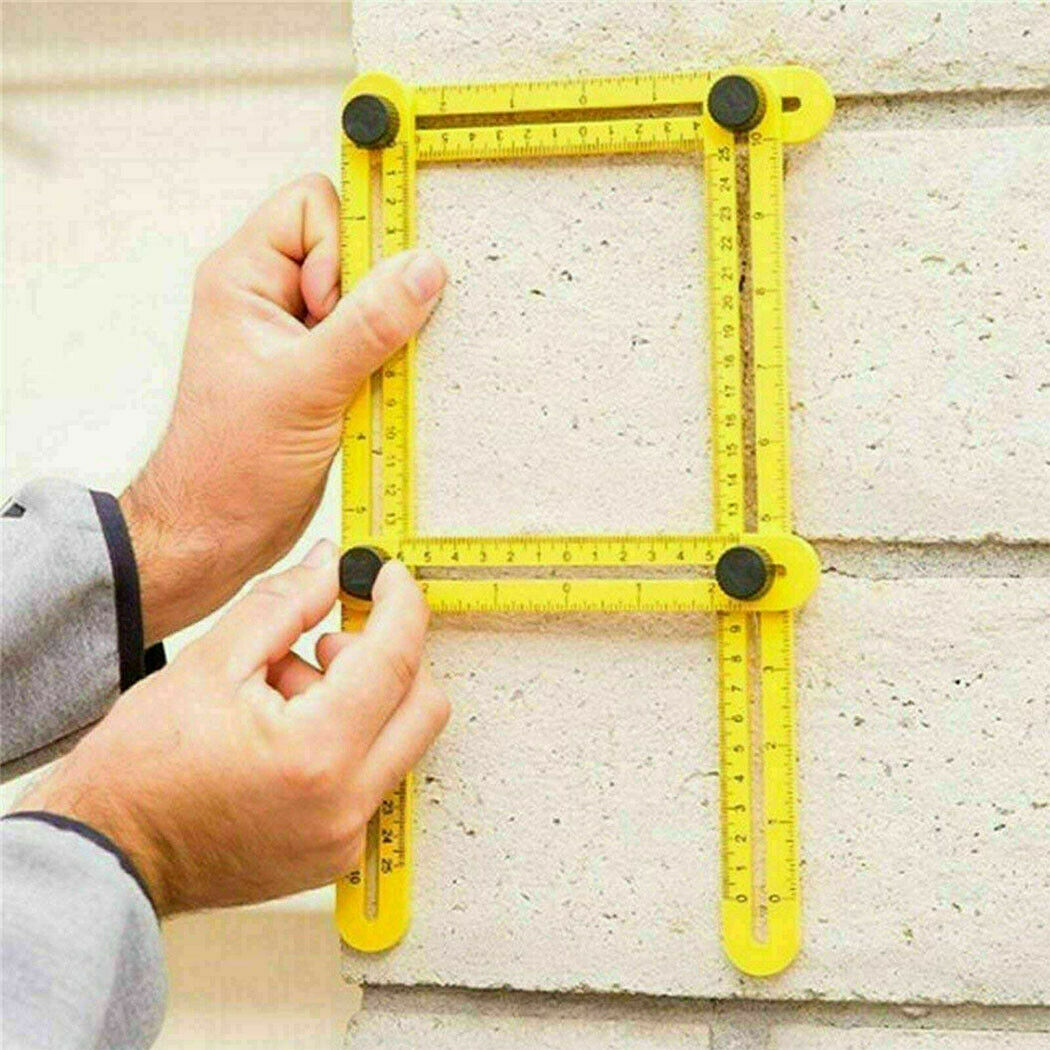
This multi angle ruler is a four-arm template tool that you form to the shape of an awkward opening, lock with a one-handed tightener, and then lay on your tile or board as a cutting stencil. The arms are glass filled nylon and are calibrated in both inches and metric. It is $18.99 at Lets Party. It suits tiles, brick pavers, laminate, timber and sheet material.
The job this exists for is the one that ruins an afternoon: the tile that has to fit around a door architrave, a toilet base, a pipe or a stair nosing. The traditional method is a tape measure, a bevel, a pencil and three attempts, and the first two tiles go in the bin. A shape-copying template removes the arithmetic entirely - you are no longer measuring an angle and transferring a number, you are copying the shape directly onto the material. For anyone laying their own floor, the tool pays for itself on the first pair of tiles it saves.
Specifications
| Material |
Glass filled nylon |
| Arms |
Four-sided adjustable mechanism |
| Calibration |
Dual marked - imperial and metric on every arm |
| Locking |
Single tightening mechanism, one-handed |
| Suits |
Tiles, brick pavers, laminate, timber |
| Dimensions |
Not stated by supplier - see FAQ |
| Angle range |
Not stated by supplier - see FAQ |
What's in the Box
| Included |
1 x multi angle template ruler |
| Not included |
Marking pencil, tile cutter, saw, spare parts |
Why Choose a Template Tool Over Measuring
-
Copies the shape, does not measure it - no angle to read off, no number to write down, no chance of transposing it wrongly.
-
Locks and holds - once tightened the shape stays put while you carry it from the wall to the workbench.
-
Repeats exactly - a locked template marks ten identical pieces the same way, which matters on stair treads and repeating courses.
-
Glass filled nylon - the glass fibre makes the arms stiff enough to hold their set rather than flexing while you trace around them.
-
Both unit systems - every arm carries imperial and metric, so it works with whatever your materials are specified in.
How Does a Multi Angle Ruler Work?
You loosen the mechanism, push the four arms against the sides of the opening you need to fit, and the arms conform to that shape. Tighten the lock and the tool holds it. You then lay the tool onto the tile or board and draw around the inside of the arms, which gives you a cutting line that matches the opening. The important detail is that no measurement happens at any point - the shape is transferred physically, so the two common sources of error, misreading an angle and mismeasuring a length, both disappear. Mark the tile with the tool oriented the same way it sat in the opening; flipping it is the mistake that produces a perfect mirror image of the piece you needed.
What Jobs Is an Angle Template Actually Useful For?
Floor and wall tiling around door frames, skirting, pipes, toilet pans and window reveals is the main one. Beyond that it is genuinely useful for laminate and vinyl plank flooring, where every board at the edge of a room needs scribing to an irregular wall; for cutting timber to fit against a wall that is not square, which is most walls; for brick paving around garden edges and drainage; and for cutting sheet material such as plasterboard or ply into an existing opening. It is also handy for marking repeat angles on a set of pieces without resetting a bevel each time.
Can You Use It to Mark a Curve?
Only roughly, and it is worth being straight about this because the original supplier copy claimed the tool makes "bull's eyes and arches". Four straight arms cannot describe a curve - they can only approximate one as four straight segments. For a shallow arch across a wide opening that approximation may be close enough to then smooth by hand. For a genuine circle, a tight radius or a proper arch, you want a compass, a trammel or a contour gauge with sliding pins, which copies a curved profile properly. Use this tool for what it is excellent at, which is straight-sided irregular shapes, and use the right tool for curves.
Buyers are typically people tiling a bathroom or laundry themselves, anyone laying laminate or vinyl plank flooring, home renovators cutting boards into rooms that are not square, and tradespeople who want a cheap template tool that lives in the ute.
For more of the same, see our Tools and Hardware range and Essentials for everyday items worth having on hand.
Frequently Asked Questions
How big is it?
The supplier has not given us overall dimensions or the maximum opening it will span, and we are not going to estimate them. If the size of the opening you need to template matters, message us before ordering and we will get the figures.
What range of angles does it cover?
Also not stated by the supplier. The mechanism is described as four-sided and forming to the work area, but no angle limits are given. We have asked.
Is it strong enough to use as a straight edge for cutting?
It is a marking template, not a cutting guide. Running a blade along a nylon arm will damage the arm and spoil the tool's accuracy. Mark with it, then cut to the line.
Will it work on curved walls?
Only approximately - see the section above. A contour gauge is the right tool for curves.
Can I use it one handed?
The tightening mechanism is designed for one-handed operation, which is the point when you are holding the tool against a wall with the other hand.
Is it accurate enough for tiling?
For domestic tiling, yes - copying a shape directly is generally more accurate than measuring and transferring it. Always dry-fit the cut piece before fixing it.
Does it come with instructions?
The supplier does not list a printed manual in the contents. The tool is straightforward: form, lock, trace.
Fast Australian Shipping
We ship from within Australia, so orders reach Sydney, Melbourne, Brisbane, Perth, Adelaide, Hobart, Canberra and Darwin quickly rather than waiting on overseas transit. Regional and remote addresses go through the standard Australia Post network.
Material and features are as supplied by the manufacturer. Overall dimensions and angle range have not been provided to us and are deliberately not stated rather than estimated. Always wear eye protection when cutting tile, stone or timber, and follow the safety instructions for your cutting tool.