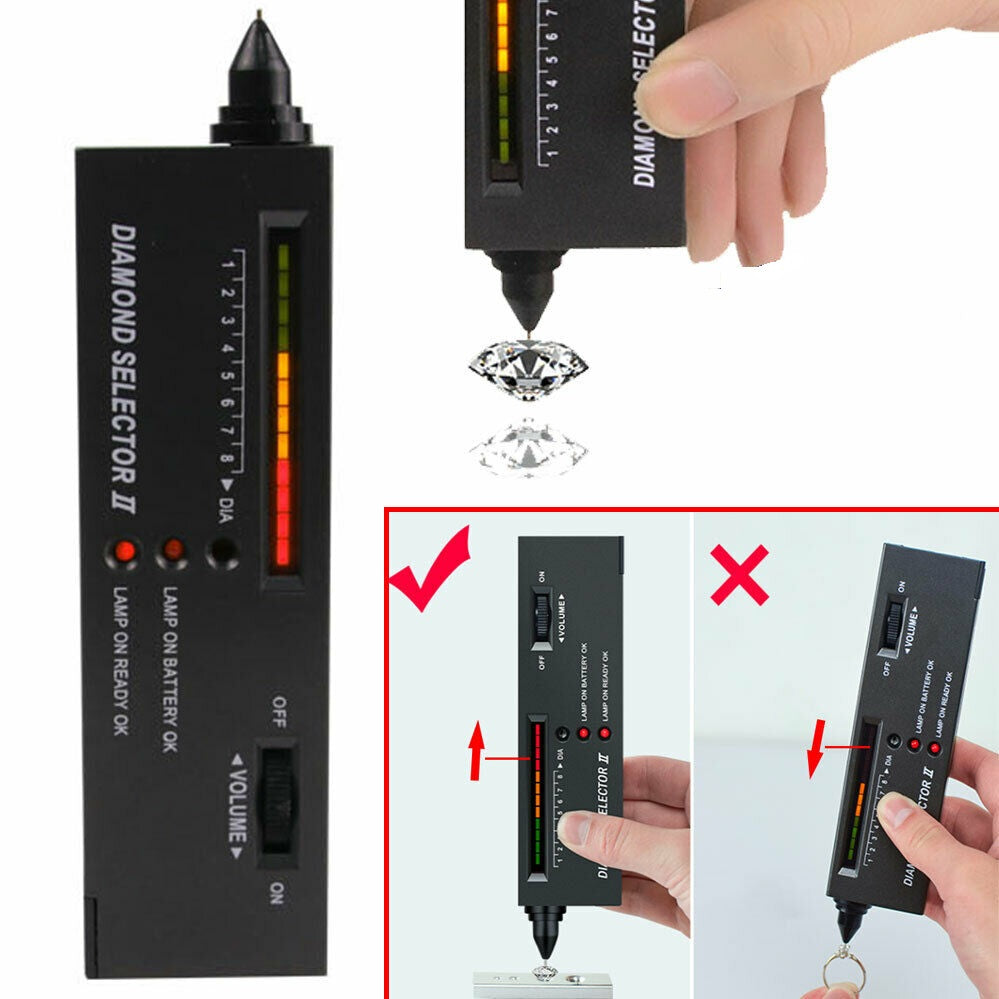
Description
This diamond tester is a handheld thermal conductivity meter that separates diamond from most common simulants such as cubic zirconia, glass and crystal, using a heated probe, an LED scale and an audible tone. It measures 16 x 4 x 2cm, includes a 9V battery, and is $42.99 at Lets Party. Please read the moissanite section below before ordering - it is the single most important thing to understand about this class of tester.
Thermal testers exist because diamond conducts heat better than almost any other material on earth. Touch a heated probe to a stone and diamond pulls heat away from the tip far faster than glass, cubic zirconia or paste, and the instrument reads that difference in a second or two. That makes it a genuinely useful first-pass tool for anyone sorting through inherited jewellery, buying at markets and estate sales, or checking a piece before paying for a formal appraisal. What it is not is a substitute for a gemmologist, and any listing that suggests otherwise is overselling a $42.99 device.
Specifications
| Test method |
Thermal conductivity |
| Indicators |
LCD display and LED scale |
| Audible alert |
Yes - tone on a positive reading |
| Metal alert |
Continuous buzz if the probe touches the setting rather than the stone |
| Sensitivity switch |
Large / small, for stones above or below 8 points |
| Dimensions |
16 x 4 x 2cm |
| Power |
1 x 9V battery (included) |
| Warm-up |
Required before testing |
What's in the Box
| Tester |
1 x handheld diamond tester |
| Battery |
1 x 9V battery |
| Case |
1 x leather pouch |
| Accessory |
1 x testing platform |
| Documentation |
1 x user manual |
Why Choose a Handheld Thermal Tester
-
Fast first-pass sorting - a reading takes a couple of seconds, so a box of mixed jewellery can be triaged quickly.
-
Metal alert built in - the continuous buzz when you catch the setting instead of the stone prevents the most common false reading beginners get.
-
Sensitivity switch - the large/small setting adapts the reading for stones above or below 8 points, so small accent stones do not simply read as nothing.
-
Battery and pouch included - it works out of the box, which is not true of every tester at this price.
-
Non-destructive - it touches the stone with a warm probe and nothing else, so nothing is scratched, heated to damage or marked.
What Can a Thermal Diamond Tester Actually Detect?
It reliably separates diamond from the simulants that were common when this technology was designed. Cubic zirconia, glass, paste, quartz, sapphire, spinel and most coloured stones all conduct heat far more slowly than diamond and will not trigger a positive reading. That covers the great majority of fake stones in older costume and estate jewellery, and it is a real capability - a thermal tester will save you from a cubic zirconia every time. It also tells you nothing about a stone's quality. It does not assess colour, clarity, cut, carat weight or whether a diamond is natural or lab-grown, and a lab-grown diamond is chemically diamond so it reads as diamond, correctly.
Will This Tell Diamond From Moissanite?
No, and this is the limitation you must understand before buying. Moissanite has thermal conductivity close enough to diamond that a thermal-only tester like this one will read moissanite as diamond. That is not a fault in this particular unit - it is inherent to how thermal testing works, and it applies to every thermal-only tester on the market.
This matters far more now than it did when these testers were designed. Moissanite is no longer a rarity; it is a mainstream, widely sold diamond alternative, and it is exactly what someone passing off a ring is most likely to be using. Testers that can separate the two have a second probe measuring electrical conductivity, because moissanite conducts electricity and diamond does not. They are usually sold as "diamond and moissanite testers" or "dual testers". This unit has one probe and one test method, and the supplier makes no claim of moissanite detection.
So: if your concern is cubic zirconia and glass, this tool does that job well. If your concern is moissanite, or if you are about to hand over real money on the strength of the result, this is not the right tool and no thermal tester is. Get the stone checked by a qualified valuer. We would rather lose the sale than have you rely on a positive reading that a moissanite would also produce.
How Do You Use a Diamond Tester Correctly?
Four things account for most wrong readings. Let the unit warm up - the probe has to reach temperature before the scale means anything, and testing during warm-up gives low readings on real diamonds. Clean the stone first; grease and skin oil insulate the surface. Touch the probe to the flat table facet at a right angle, not to the setting or the girdle, and if you hear the continuous metal buzz you have caught the mount and need to reposition. And take note of room temperature - thermal testers are affected by ambient conditions, which is why the manual asks you to observe the indoor temperature and read the corresponding scale position rather than treating the reading as absolute.
Buyers are typically people sorting through inherited or estate jewellery, market and op-shop buyers who want a quick screen before paying, small secondhand dealers and pawn operators, and jewellery makers checking stock. It is a screening instrument for all of them, used ahead of a proper valuation rather than instead of one.
For more measuring and workshop instruments, see our Tools and Hardware range.
Frequently Asked Questions
Does it detect moissanite?
No. See the section above - this is a thermal tester and moissanite reads as diamond on any thermal-only unit. You need a dual thermal and electrical tester for that.
Will it tell a lab-grown diamond from a natural one?
No, and no thermal tester can. A lab-grown diamond is diamond, so it conducts heat identically and reads as a genuine positive. Separating the two requires laboratory equipment.
Is the battery included?
Yes, one 9V battery is supplied with the unit.
What colour is it?
The supplier's specification contradicts itself - the header line says grey and the features list says black. We have asked them to confirm and are not stating a colour until they do.
What is the large/small switch for?
It adjusts sensitivity for stone size, above or below 8 points. Small accent stones need the small setting or they may not register.
Can I test a stone still set in a ring?
Yes, that is the normal use. Aim for the flat top facet and keep the probe off the metal - the metal alert will buzz if you drift onto the setting.
Is a positive reading proof a diamond is real?
No. It is a strong indication that the stone is not cubic zirconia or glass. It is not proof, because moissanite produces the same result. Treat it as a screen, not a verdict.
Fast Australian Shipping
We dispatch from within Australia, so orders reach Sydney, Melbourne, Brisbane, Perth, Adelaide, Hobart, Canberra and Darwin quickly rather than waiting on overseas transit. Regional and remote addresses go through the standard Australia Post network.
Specifications are as supplied by the manufacturer. This is a screening instrument, not a gemmological certification device. It cannot distinguish diamond from moissanite, cannot distinguish natural from lab-grown diamond, and does not assess quality or value. Readings are affected by ambient temperature, stone size and probe placement. Do not rely on it alone for any purchase, sale, valuation or insurance decision - use a qualified valuer.