


No products in the cart.


Free Shipping Australia-Wide

5 star customer service

Quality Tested Products

Every hiker knows that feeling. It’s that sinking dread when an unexpected stream crossing or a sudden downpour soaks your socks. What starts as a minor annoyance can quickly snowball into a major problem, turning a great day out into a miserable, blister-filled ordeal.
That’s where truly waterproof hiking boots come in. They’re your non-negotiable barrier against the elements.
Picture this: you're hours from the trailhead, deep into a beautiful hike. One misstep into a muddy patch sends icy water seeping into your boot. Instantly, your focus shifts from the scenery to the growing squish in your sock. This isn't just about discomfort; it's a real threat to your entire trip.
Wet feet are a breeding ground for trouble. The combination of moisture and friction is the number one cause of blisters, which can literally stop a hiker in their tracks. On top of that, wet socks lose their ability to insulate, leading to cold feet, significant heat loss, and a nosedive in morale.
This is exactly why investing in proper waterproof boots is so critical. It’s not a luxury feature; it’s your frontline defense. The right technology means you can tackle surprise creek crossings, sudden rainstorms, and muddy trails with total confidence. It’s about more than just staying comfortable—it's about:
The importance of this gear is reflected in its market growth. The global waterproof hiking boots market hit $2.528 billion in 2025 and is projected to keep growing as more people look for high-performance gear. Learn more about the market surge for waterproof hiking gear.
Ultimately, a reliable pair of waterproof boots is an investment. It’s an investment in countless future adventures, ensuring your memories are of stunning vistas, not soggy socks and painful steps.
To really get your head around how a good pair of hiking boots keeps you dry through a downpour or a creek crossing, don't think of it as just a single rubber-like barrier. It’s much smarter than that. Think of it more like a high-tech, three-part defense system. Each layer has a very specific job, and if one fails, the whole system can get overwhelmed.
True waterproof performance isn't just about the leather or fabric you see on the outside. It’s a carefully engineered team effort between an external treatment, an internal membrane, and the way the boot is physically held together. Let's pull back the curtain on each of these components to see how they keep your feet bone-dry.
Your boot’s first shield against the elements is the Durable Water Repellent (DWR) coating. This is a chemical finish applied to the exterior—be it full-grain leather, nubuck, or synthetic fabric. Its whole purpose is to make water bead up and roll right off before it even has a chance to soak in.
It’s just like waxing your car. When the wax is fresh, rain forms perfect little droplets and slides off effortlessly. But once that wax wears down, water starts to smear and cling to the paint. A DWR coating functions the same way, providing that crucial, though temporary, first layer of defense. It’s also why you’ll eventually need to reapply it to keep your boots performing their best.
This initial layer is critical. If the outer material gets saturated (a problem hikers call "wetting out"), the boot suddenly feels heavy, cold, and its ability to breathe plummets.
The real MVP inside any waterproof hiking boot is the waterproof membrane. This is a super-thin, high-tech layer bonded to the inside of the boot's upper material. The brand name everyone knows is Gore-Tex, but many bootmakers have developed their own excellent proprietary versions, like Oboz B-DRY or KEEN.DRY.
This membrane is a feat of material science. Picture a barrier riddled with billions of microscopic pores.
This brilliant two-way street is what makes a boot both waterproof and breathable. It blocks liquid water from getting in while actively letting sweat vapor out. This is the secret to avoiding that clammy, swamp-foot feeling that’s a fast track to blisters and misery.
A waterproof membrane is like a one-way security gate for moisture. It’s the bouncer at the door, flat-out denying entry to every water droplet trying to get in, but happily showing sweat vapor the exit to keep things comfortable inside.
This simple concept has a massive impact on your hike, preventing the most common trail issues.
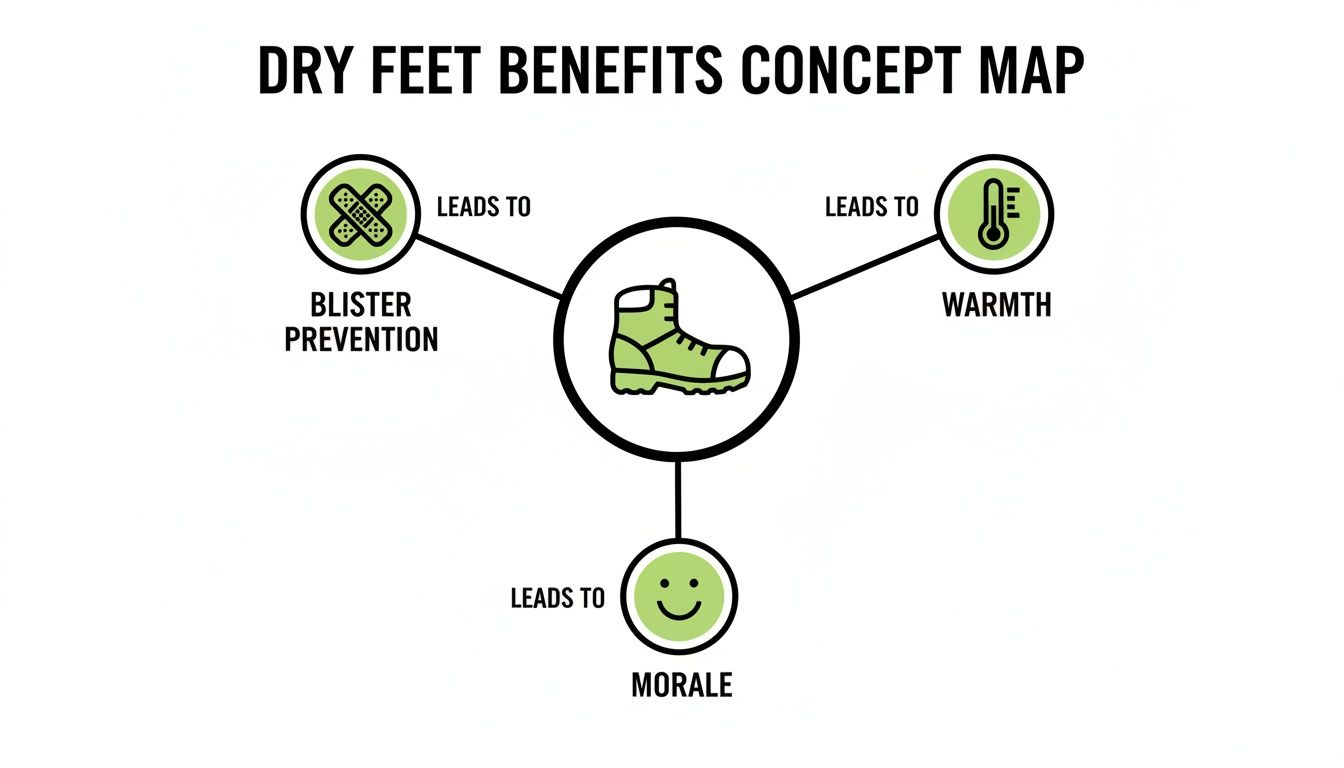
As you can see, keeping your feet dry is the foundation for everything else—preventing blisters, staying warm, and keeping your spirits high when the weather turns foul.
A fortress is useless if it’s full of cracks, and in a hiking boot, the seams are the biggest vulnerability. Every stitch hole from sewing the boot together is a potential tiny doorway for water.
To fix this, manufacturers use seam sealing. This is a process where they apply a special waterproof tape or liquid sealant over every single internal seam, directly on top of the membrane. This closes off all those needle holes for good, creating a completely unified, impenetrable barrier.
Without meticulous seam sealing, even a boot with the best membrane in the world would eventually leak. It’s the final, painstaking step that turns a collection of water-resistant parts into a truly waterproof piece of gear you can trust in any conditions.
So, you’ve got the lowdown on how waterproof boots actually work. Now for the real question: which pair is right for you? Not all waterproof hiking boots are made the same, and the best choice comes down to where, when, and how you plan to hit the trail.
Think of it like choosing a tool for a job. A sledgehammer and a finishing hammer are both hammers, but you wouldn’t frame a house with one and tap in delicate trim with the other. In the same way, the boot that gets you through a snowy mountain pass is probably going to be miserable on a humid, forested path in July.
To get it right, you need to look at three things: the terrain you'll be crossing, the climate you'll be in, and how long you'll be out there. Nailing this match-up is what turns your footwear into a reliable partner instead of a painful liability.
And this isn't just a niche corner of the gear world. In 2023, waterproof hiking footwear was a $1.2 billion market, and it’s expected to climb to $1.81 billion by 2033. This boom is especially noticeable in places like Europe, which snapped up over 25.50% of the market share back in 2022, thanks to hikers exploring its famously rugged—and often very wet—landscapes. Discover more insights about hiking shoe statistics on runrepeat.com.
The ground under your feet is the first thing to consider. A casual walk on a maintained trail with a few puddles is a world away from slogging through a swampy, off-trail wilderness.
Well-Defined Trails with Occasional Water: For most day hikes and weekend trips, a standard pair of waterproof hiking boots will do the trick. Even a low-cut trail shoe with a waterproof membrane offers a great balance of protection and agility for handling surprise rain or shallow streams.
Muddy, Boggy, or Off-Trail Conditions: If your adventures take you through consistently soggy ground—think marshes, riverbeds, or sodden forests—you need to step up your game. Look for mid or high-cut boots that give you more ankle coverage, preventing water from splashing over the top. A tougher DWR coating and more durable outer materials are non-negotiable here.
Rocky Alpine or Scrambling Routes: Up high, waterproofing is still critical for dealing with snowmelt or sudden mountain storms. But durability becomes just as important. You’ll want boots with reinforced rubber toe caps and rands (that rubber strip wrapping around the boot's lower edge) to shield both your feet and the delicate membrane from sharp rocks.
Waterproofing isn't just for rain; it’s your main defense against snow, ice, and slush. But in the summer heat, a "waterproof" boot can quickly turn into a sweatbox if it can't breathe.
A common mistake is assuming "waterproof" also means "warm." While the membrane does trap a bit of heat, its main job is to block water from the outside. A boot designed for a summer downpour won't do much for you in a blizzard without proper insulation.
So, think about when you hike:
Hot and Humid Summers: On warm, rainy days, breathability is king. Look for boots with advanced membranes known for wicking sweat and uppers made from lightweight synthetics and mesh. This combination is your best bet for letting foot vapor escape before it turns into blisters.
Cold Winters and Snowy Conditions: In winter, your boots have two jobs: keep water out and keep heat in. This is where insulated waterproof boots come in. They have an extra layer of synthetic insulation (usually measured in grams) that’s essential for preventing heat loss when you're trekking through snow.
Three-Season Versatility: For spring and fall, when conditions can swing from sunny to freezing rain in a single afternoon, a non-insulated waterproof boot is your most flexible friend. You can easily adapt it by pairing it with lightweight socks on warmer days or thick wool socks when the temperature drops.
Finally, how long you’ll be on the trail makes a huge difference. After a day hike, you can toss your gear in front of a fan. But on a multi-day backpacking trip, your boots have to perform day in and day out, often with no real chance to dry out completely.
For any overnight or multi-day journey where wet weather is even a remote possibility, a truly reliable pair of hiking boots waterproof to the core is essential. This is where spending a little more on a boot with a premium membrane and solid construction really pays off. It’s about the peace of mind that comes from knowing your feet will stay dry and healthy, from the first step at the trailhead to the very last.
Let's be real: no piece of gear is a silver bullet, and that includes waterproof hiking boots. They're fantastic for keeping your feet dry when you're splashing through creeks or caught in a downpour, but that fortress-like protection comes with a few trade-offs. Knowing what you're gaining—and what you're giving up—is the secret to picking the right boot for your adventures.
The biggest compromise you make is on breathability. Think of it like wearing a high-tech rain jacket versus a simple cotton hoodie on a warm day. Even the most sophisticated waterproof membranes, which are designed to let sweat vapor out, just can't match the airflow of a non-waterproof boot. When you seal a boot to block water from getting in, you inevitably trap more heat and moisture on the inside.
This lack of ventilation can become a serious problem in the right (or wrong) conditions. If you're hiking a sun-baked trail in Arizona, your main concern isn't a sudden storm; it's your own sweat. Believe it or not, your feet can sweat out more than a cup of moisture over a full day of hard hiking.
When that sweat has nowhere to evaporate, it just soaks your socks. Suddenly, you've created the exact damp, blister-prone environment you bought waterproof boots to avoid. This is why you'll see a lot of desert hikers wearing ultra-breathable, non-waterproof trail runners that can dry out in minutes.
It all boils down to a simple conflict: a boot built to keep rain out can easily feel like a steam room on the inside. The trick is to match your boot’s waterproofing to the climate you'll actually be hiking in.
Another point to consider is how these boots fit. The materials that make a boot waterproof—the membrane itself, plus the tougher leathers or synthetic fabrics—are inherently stiffer and less forgiving. They don't have the same "give" as the lightweight mesh on a standard trail shoe.
This rigidity means you have zero wiggle room for a bad fit. A waterproof boot that doesn't fit your foot perfectly is a recipe for disaster.
This is why you absolutely must try on waterproof boots while wearing the exact socks you'll be hiking in. A great fit isn't a bonus feature; it's a prerequisite for a good day on the trail.
And please, never, ever take a brand-new pair of waterproof boots out of the box and onto a 10-mile trail. Their tough construction demands a proper break-in period. This isn't just an old-school suggestion; it's a crucial step that lets the stiff materials soften and conform to the specific shape of your foot, working out any potential trouble spots before they can ruin your hike.
Start slow. Wear them around the house for a few hours. Then take them on short walks around the block. Gradually work your way up to longer walks on varied terrain. This process gives both your feet and your boots time to get acquainted, ensuring they work together as a comfortable, reliable team when you finally hit the trail for real.
Think of your waterproof boots like a high-end non-stick pan. Fresh out of the box, everything slides right off. But after a while, with enough use and grime, that amazing performance starts to fade. Your boots are no different.
Every muddy trail, dusty path, and stream crossing takes a tiny toll. Dirt, oils, and simple abrasion slowly clog the microscopic pores of the waterproof membrane and wear down that all-important DWR coating on the outside. This is why a once-invincible boot might start feeling damp and heavy after a downpour—a process we call "wetting out."
The good news? A little bit of regular care goes a long way. You can easily keep that waterproof tech working as intended for years, ensuring your feet stay dry when it matters most.
Cleaning your boots isn't just about making them look good; it's the single most important thing you can do to preserve their performance. When you let grit and mud sit on them, you're essentially letting sandpaper grind away at the fabrics and leathers every time you walk. A clean boot is a happy, high-performing boot.
Follow this simple process after every few hikes, or anytime they look like they’ve been through a battle.
Keeping gear in prime condition is a big deal, especially considering the investment hikers make. Globally, the hiking boots market hit a massive $24.383 billion in 2025, with waterproof models leading the charge. You can discover more insights about hiking boot market trends to see just how popular this tech is.
Even with perfect cleaning habits, that factory-applied DWR coating will eventually wear off. You’ll know it’s time for a refresh when water stops beading up and rolling off the surface. Instead, it will start to soak into the outer fabric, making it look dark and saturated.
That’s your cue to reproof them. This simple step restores that critical first line of defense, making sure water sheds off the boot before it even gets a chance to test the waterproof membrane inside.
Here’s How to Do It:
By making cleaning and reproofing a regular part of your post-hike routine, you’re doing more than just maintaining gear. You’re protecting your investment and guaranteeing your feet will stay dry and comfortable on your next adventure.
Alright, you're ready to buy. Before you pull the trigger on a new pair of boots, let's run through one last check. Think of this as your final pre-hike inspection—a quick, scannable guide to help you apply everything we've talked about and feel good about your choice, right there in the store.
Use these points to cut through the marketing jargon and zero in on what really matters for your next adventure.
Before you even think about trying them on, give the boots a good look. The little details in their construction can tell you a whole lot about how they’ll perform out on the trail.
The fanciest waterproof tech on the planet means nothing if the boot doesn't fit your foot. This is, without a doubt, the most important part of the entire process.
Pro Tip: Always shop for boots in the afternoon or evening. Your feet swell during the day, so trying them on later ensures you get a fit that won't feel cramped and painful a few miles into your hike.
Here’s how to get the fit just right:
Choosing the right waterproof boot isn't just a purchase; it's an investment. You're investing in your comfort, your safety, and all the amazing experiences waiting for you out on the trail.
It's one thing to understand the tech behind waterproof boots, but it's another to know how it all plays out on the trail. Let's tackle some of the most common questions hikers wrestle with before shelling out for a new pair.
Getting these details right means you'll not only buy the best boots for your needs but also know how to get the most out of them.
Ah, the classic question. The honest answer is: it completely depends on where you're hiking.
If your summer adventures are in hot, dry places like Arizona or Utah, a fully waterproof boot is overkill. It'll feel like a swamp in no time. Your own sweat becomes the biggest problem, so you're much better off with a super breathable, non-waterproof trail runner that can dry out in minutes.
But what if "summer" for you means hiking in the Rockies with its notorious afternoon thunderstorms? Or trekking through the damp, humid forests of the Appalachian Trail? In that case, absolutely. A good waterproof boot is your best friend, keeping you dry during surprise downpours and on muddy trails that would otherwise end your hike. The trick is finding a pair that still breathes well enough to handle sweat on the inside.
The most obvious sign, of course, is soggy feet when they should be dry. But you don't have to wait for a ruined hike to find out your boots have a weak spot. You can easily test them at home.
Here's a simple way to check their integrity:
If the inside is damp, you've got a leak—the membrane is likely damaged. But what if the outside fabric looks dark and soaked ("wetting out") but the inside is bone dry? That means your membrane is holding up, but your DWR coating has worn off. It's a clear signal to give them a good cleaning and re-proof them.
When the DWR fails, the boot's outer material gets waterlogged. Even if the inner membrane keeps you dry, a saturated boot feels heavy, cold, and can't breathe. This traps sweat inside, leaving your feet feeling clammy and miserable.
Gore-Tex is the big name everyone knows. They were the pioneers, and their membrane is still the gold standard for many. But plenty of other brands have developed their own fantastic waterproof technologies, and you shouldn't overlook them. You’ll see names like KEEN.DRY, Oboz B-DRY, or XeroTex.
At their core, they all work the same way: a layer with microscopic pores that are too small for water droplets to get in but large enough for sweat vapor to get out. The real differences are often in the fine-tuning—subtle variations in breathability, long-term durability, and how they feel inside the boot.
While Gore-Tex has a legendary reputation, many of these in-house technologies are specifically designed to work perfectly with that brand's boot construction. They often deliver incredible performance and can be a bit easier on the wallet. So, don't get hung up on a brand name; if the boot fits and feels good, the proprietary tech is usually more than up to the task.
Ready to find the perfect gear for your next adventure? At FindTopTrends, we curate the best outdoor and travel essentials to keep you prepared for anything the trail throws your way. Explore our collection of high-performance products and trending deals today.




