


No products in the cart.


Free Shipping Australia-Wide

5 star customer service

Quality Tested Products

When you start comparing action cameras, it really boils down to one thing: what are you willing to pay for? The high-end models from brands like GoPro and DJI pack in seriously impressive image stabilization and ultra-high resolutions, but you'll pay a premium for it. On the other hand, plenty of budget-friendly cameras deliver fantastic results for everyday adventures. The right camera for you is the one that fits what you actually do.
It's easy to get lost in a sea of specs and marketing jargon, but picking the perfect action camera doesn't need to be complicated. The secret is to look past the hype and zero in on what really matters for your situation. Before you even think about megapixels or frame rates, just ask yourself these three simple questions:
Just thinking through these points will immediately shrink your list of options and make the final choice much less intimidating. If you're new to all this, our guide on photography equipment for beginners is a great place to get your bearings.
To give you a head start, the table below breaks down different types of action cameras by how they're most commonly used. Think of it as a quick-reference guide to point you in the right direction before we get into the nitty-gritty details.
This kind of matching is more important than ever. The action camera market is exploding, expected to grow from USD 6.50 billion in 2024 to USD 12.49 billion by 2030. The classic "box" style, made famous by GoPro, is still king, accounting for 44.2% of revenue in 2024 because its tough, go-anywhere design is hard to beat.
| Primary Use Case | Key Features to Prioritize | Example Camera Models | Typical Price Range |
|---|---|---|---|
| Extreme Sports | Superior Stabilization, High Frame Rates, Durability | GoPro HERO Series, DJI Osmo Action | $350 - $550 |
| Travel Vlogging | Front-Facing Screen, Audio Quality, Portability | DJI Osmo Pocket, Insta360 Series | $300 - $500 |
| Family Adventures | Ease of Use, Waterproofing, Good Battery Life | AKASO Brave Series, Older GoPro Models | $100 - $250 |
| Budget Creators | 4K Resolution, Basic Stabilization, Value for Money | Campark, Akaso, DJI Osmo Action SE | $80 - $200 |
Key Takeaway: Don't get fixated on finding the camera with the "best" specs. The right camera is the one that strikes the perfect balance of features, toughness, and price for the adventures you have planned. This table is your starting point.
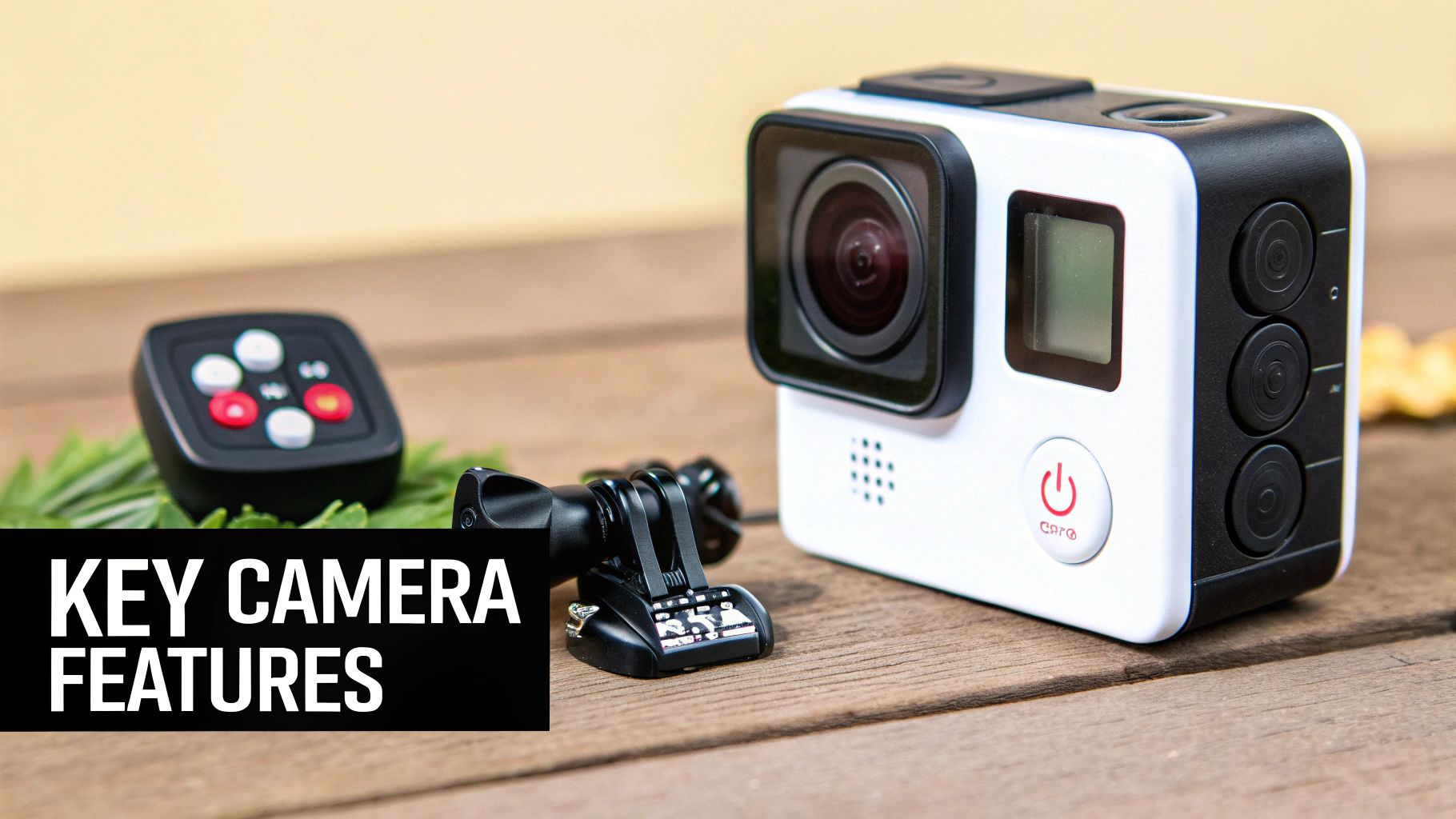
It’s easy to get lost in a sea of technical specs. All those numbers and acronyms on a product page can feel overwhelming, but figuring out which ones really count is the secret to a smart purchase. Let's cut through the noise and talk about what these features mean for the actual video you’ll be shooting.
We’ll kick things off with the two specs everyone talks about: resolution and frame rate. These are the absolute foundations of your video quality.
Think of resolution as the raw detail and sharpness of your video. It's measured in pixels—the more you have, the crisper the image. While 1080p (Full HD) is still a decent baseline, 4K has really become the gold standard. It gives you that clean, professional look that holds up beautifully on modern TVs and monitors.
But the race for resolution is far from over. Ultra-HD cameras now command a 46.8% market share in 2024, and that number is only going up. You can see this push in flagship models everywhere. GoPro’s Hero12 Black, for example, shoots in a stunning 5.3K, while competitors like DJI are perfecting their 4K capture at higher frame rates, focusing on things like heat management so you can record for longer. If you want to dive deeper, you can explore more industry trends and forecasts to see where the tech is headed.
Frame rate, measured in frames per second (fps), is all about how your camera captures motion. It’s what makes your video feel smooth or allows for epic slow-mo. Here’s how it breaks down in the real world:
Real-World Impact: A travel vlogger shooting scenic landscapes might be perfectly happy with 4K at 30fps. But a snowboarder who wants to break down a trick in slow motion needs to be looking for a camera that can handle at least 1080p or 4K at 120fps.
If I had to pick the single most important feature on a modern action cam, it would be image stabilization. Gone are the days of shaky, unwatchable footage. Today’s electronic image stabilization (EIS) uses internal sensors and smart algorithms to digitally smooth out every bump and vibration.
The top-tier systems, like GoPro's HyperSmooth and DJI's RockSteady, are incredible. They can make handheld footage look like it was shot on a professional gimbal. This isn't just a nice little extra; for any kind of activity, it’s a must-have. The difference between stabilized and unstabilized video is night and day—it’s what turns a chaotic clip into a cinematic shot.
Here’s a spec that often gets overlooked: the camera's sensor size. A bigger sensor physically gathers more light, which directly improves video quality, especially when the sun starts to go down. Think dusk, dawn, or deep in a forest.
Action cameras traditionally use small sensors to keep their bodies compact, but we're seeing a shift. Newer models are packing in larger sensors, like 1/1.3-inch or even 1-inch sensors. In low light, these cameras will consistently deliver cleaner, less grainy footage than their smaller-sensor rivals. If you know you'll be shooting anywhere but bright, sunny days, pay close attention to this number.
Finally, don’t get so caught up in video specs that you forget the basics. A camera’s native waterproofing depth (how deep it can go without a case) and its battery life are make-or-break features. A camera that dies after 45 minutes or needs a bulky case just to survive a splash by the pool isn't going to be very useful on a real adventure. Always make sure the practical specs line up with what you plan to do.
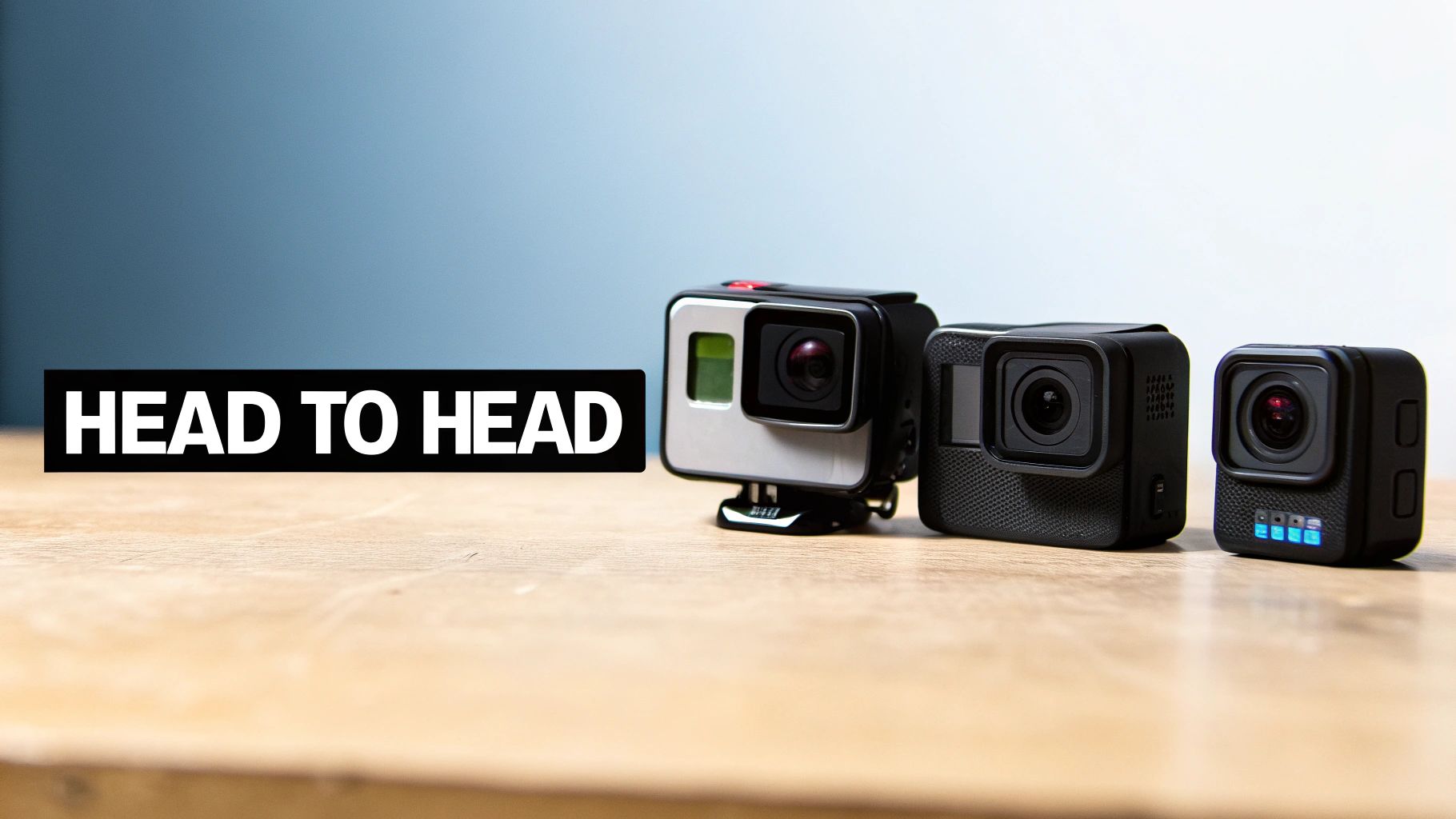
Diving into the world of action cameras often feels like picking a side in an epic rivalry. GoPro, DJI, and Insta360 are the undisputed heavyweights, and each brand has a very different philosophy on how to best capture life in motion. Forget just a list of specs; we're going to break down the real-world differences that will actually matter to you.
This isn't just a friendly competition; it's a battle for a massive market. North America currently makes up 43% of the global action camera scene, a market valued at a whopping USD 2.58 billion in 2023. That kind of money fuels intense innovation. GoPro, the brand that started it all back in 2004, is now up against serious contenders like DJI, whose Osmo line has grabbed a huge slice of the market by pushing boundaries with features like 8K video and clever AI. You can dig deeper into the action camera market and its future trends to see just how fierce the competition is.
Let's get past the boardroom numbers and see how these cameras actually stack up when you're out there using them.
The first thing you’ll notice when comparing footage side-by-side is how each brand treats color. This isn't just a simple setting; it's baked into their identity and tells you a lot about who they're trying to appeal to.
GoPro has built its empire on a signature vibrant, punchy color profile. Its colors pop right out of the camera, delivering exciting footage that’s ready to share with almost no effort. It's the perfect choice if you want to shoot, share, and move on without getting bogged down in editing.
DJI, coming from a drone and pro-videographer background, often leans toward a more natural, sometimes even flat, color profile. This is a deliberate choice made for creators who want total control in post-production. A flatter image holds more data in the highlights and shadows, giving you the flexibility to color grade your footage exactly how you envision it.
Insta360 strikes a nice balance, offering pleasing colors that look great on their own but can still be tweaked. They also rely heavily on AI processing to automatically punch up colors and exposure, a huge plus for creators who value both quality and speed.
Key Differentiator: If you want fantastic-looking footage straight out of the camera, GoPro's vibrant look is a proven winner. But for serious videographers who spend their time in editing software, DJI's flatter profile provides a much better canvas to work from.
Image stabilization has completely changed the game for action cameras, and honestly, all three brands are incredible at it. The differences are subtle but important, especially for specific activities.
GoPro’s HyperSmooth is the veteran in this space, famous for its buttery-smooth, gimbal-like results in even the most chaotic scenarios. It’s absolutely brilliant at eating up the high-frequency chatter you get from mounting a camera on, say, a mountain bike bombing down a rocky trail.
DJI’s RockSteady is right there with it, providing jaw-droppingly stable footage. Where DJI has really carved out its niche is with its horizon-leveling. The HorizonSteady feature can keep the shot perfectly level even if you do a full 360-degree barrel roll, creating some seriously mind-bending and professional-looking clips.
Insta360’s FlowState Stabilization benefits from the company’s 360-degree camera heritage. Because their 360 cameras see everything, the software has a massive amount of visual data to use for stabilization, resulting in flawlessly smooth footage that you can even reframe after the fact.
Audio is so often an afterthought for buyers, but bad audio will ruin a great video every time. Each brand has its own approach to capturing sound.
GoPro cameras generally use a three-microphone setup that does a good job of reducing wind noise. The internal audio is decent for capturing the ambient vibe of a scene, but it really comes alive when you plug in an external mic via their Pro Mic Adapter.
DJI has made massive leaps in audio, especially with the slick integration of the DJI Mic 2. This wireless system delivers crisp, clear audio and cleverly records a backup track internally on the camera—a total lifesaver if your wireless signal ever drops. Even the built-in mics are great for vlogging.
Insta360 also has good on-board audio with solid wind reduction. Their ecosystem for professional audio, however, can feel a bit less polished, often requiring adapters that are clunkier than DJI’s seamless wireless solution.
A camera is more than just a lens and a sensor. The app, the mounts, and the overall user interface are what you’ll be dealing with every single day.
To put it all in perspective, here's how the flagship models from each brand compare on the spec sheet.
Here’s a direct look at the key performance metrics for the top-tier action cameras from the big three. This table cuts through the marketing to give you a clear, side-by-side view of what each one brings to the table.
| Feature | GoPro HERO Series | DJI Osmo Action Series | Insta360 Ace Pro |
|---|---|---|---|
| Video Resolution | Up to 5.3K/60fps | Up to 4K/120fps (some models vary) | Up to 8K/24fps |
| Image Sensor Size | Typically 1/1.9-inch | 1/1.3-inch | 1/1.3-inch |
| Color Profile | Vibrant, saturated, share-ready | Natural or flat (D-Log) for grading | AI-enhanced, good balance |
| Key Feature | HyperSmooth Stabilization | Magnetic Mounting & Mic Integration | Flip Screen & AI Editing Features |
| Waterproofing | 10m (33ft) native | 18m (59ft) native | 10m (33ft) native |
In the end, this comparison shows there's no single "best" camera—only the best camera for what you want to do. Your final decision will come down to whether you value ready-to-share color, total editing control, seamless audio, or the pure fun of AI-powered software.
The best action camera isn't about having the highest resolution or the most features. It's about finding the one that seamlessly fits your life. A spec sheet can tell you what a camera can do, but it won't tell you if it’s a joy or a pain to use on your actual adventures.
Let's move beyond the raw numbers and match you with the right gear for what you love to do. Whether you're chasing thrills down a mountain or just chasing your kids around the park, your needs are different. We'll break down the ideal camera for four common scenarios, focusing on the features that truly matter in the real world.
If you live for mountain bike trails, fresh powder, or the perfect wave, your camera needs to do two things exceptionally well: stay unbelievably stable and be incredibly tough. You’re after a workhorse that can handle high speeds, hard knocks, and pure chaos without giving you a shaky, unwatchable mess.
For this kind of action, stabilization is everything. You absolutely need a camera with a top-tier electronic stabilization system, like GoPro’s HyperSmooth or DJI’s RockSteady. These systems are miracle workers, smoothing out the intense, jarring vibrations common in extreme sports. The result is footage that looks like it was shot on a professional gimbal.
High frame rates are your next best friend. The ability to shoot at 120fps or even 240fps is how you get those epic, super slow-motion shots that make every detail pop. Finally, a rugged build with solid native waterproofing is a must. When thinking about the best camera for specific scenarios, you have to consider how it will hold up in challenging environments—like knowing you can trust the gear you will need for your Kona diving adventure to survive the deep.
As a travel vlogger, you're a storyteller first. Your camera is your constant companion, and it needs to be versatile enough to capture a sweeping landscape one moment and your reaction to it the next. This means portability, great audio, and user-friendly features are what you should be looking for.
A front-facing screen is a total game-changer. It’s the difference between perfectly framed shots and getting back to your hotel only to realize you’ve been talking to the top of the frame for the last hour. Audio is just as critical. While built-in mics are getting better, a camera that easily connects to an external microphone—like the DJI Osmo Action's slick integration with the DJI Mic 2—will give you that crisp, clean dialogue your audience expects.
Quick, easy mounting is another huge plus. DJI’s magnetic mounting system, for instance, is brilliant for swapping your camera between a selfie stick and a backpack strap without having to mess with tiny screws.
Key Insight: For vloggers, the experience of using the camera matters most. A responsive touchscreen, simple menus, and a battery you can count on will save you endless frustration, letting you focus on creating great content instead of fighting with your gear.
When you’re trying to film a family vacation, the last thing you want is a camera with a steep learning curve. Your priorities are simplicity, durability, and reliability. You need something you can hand to anyone, hit one button, and trust that you're getting a great shot.
Look for models with a clean user interface and "auto" modes that actually work, taking care of all the tricky settings for you. A tough, waterproof body is non-negotiable because that camera will be dropped, splashed, and covered in sand. A fun day at the beach shouldn't involve worrying about a fragile piece of tech.
You really don't need the latest and greatest flagship model here. A previous-generation camera or a solid budget-friendly option often provides more than enough quality for capturing family memories in beautiful 4K, all without the premium price tag. The goal is a hassle-free camera that captures the moment without getting in the way of it.
You don’t have to drop $500 to get amazing-looking video these days. If you're creating content on a budget, your mission is to find that sweet spot between performance and price. You want the best 4K video quality you can get without paying for pro-level features you'll likely never touch.
This is where the mid-range and reputable budget brands really shine. They often pack slightly older—but still excellent—sensors and processors from former flagships. It's entirely possible to find a camera that shoots sharp, stable 4K video that looks fantastic on YouTube, Instagram, or TikTok.
The trick is to watch tons of real-world reviews and comparison videos. You're trying to find which models nail the core video performance for the money, even if they skip extras like 8K resolution or fancy color profiles. A camera that masters the fundamentals is always a smarter buy than one that does a dozen things poorly.
Getting a great action camera is just step one. The real fun begins when you start pairing that little powerhouse with the right gear and a few clever shooting techniques. That’s how you’ll transform your footage from just "good" into something truly cinematic.
Moving beyond your camera's "auto" mode is the first big leap. Once you get a feel for a few key settings and pick up some affordable accessories, you'll unlock a whole new level of creative control over every shot you take.
Think of this section as your cheat sheet for creating amazing content right out of the box. We’ll cover the accessories that actually make a difference and some simple, beginner-friendly tips to get you going.
Before you even think about buying more gear, get to know the tools you already have. Your camera’s manual settings are incredibly powerful, and figuring out which ones to use in different situations is what separates a decent shot from a perfect one.
The two most important settings to learn are Field of View (FOV) and frame rate. These two things have a massive impact on the final look and feel of your video.
When it comes to frame rate, it's all about motion. For most everyday filming, shooting at 24 or 30 frames per second (fps) gives you that smooth, natural look you see in movies. But if you're filming fast action or want the option to create buttery-smooth slow-motion later, you'll want to crank it up to 60fps or even 120fps.
Once you've got a handle on the settings, a few key accessories can seriously upgrade your video quality. These pieces of gear help solve the common problems all small cameras face, like weak audio and tricky lighting.
An external microphone is probably the single best investment you can make. The built-in mics on action cameras have gotten better, but they still sound tinny and pick up a ton of wind noise. A good external mic captures crisp, clean audio that makes your videos feel so much more professional.
Next up, grab some Neutral Density (ND) filters. Think of them as sunglasses for your camera. On bright, sunny days, they cut down the amount of light hitting the sensor, which lets you use a slower shutter speed. This is the key to creating that natural, subtle motion blur that makes action footage look so smooth and cinematic. Even a basic understanding of light can be a game-changer; you can get a great intro with this guide on photography lighting equipment for beginners.
Pro Tip: If you're shooting anywhere near water, a simple floating hand grip is a must-have. It keeps your camera from sinking to the bottom of a lake, but just as importantly, it helps you get much steadier shots near the surface.
The final piece of the puzzle is how you mount your camera. The right mount lets you capture angles and perspectives that are impossible to get just by holding it.
For certain activities, you really need a specialized mount. A chest mount is fantastic for getting that immersive, first-person view when you're mountain biking or skiing. A helmet mount gives you a higher perspective that shows off more of your surroundings. And for any deep-water filming, a dive housing is non-negotiable to protect your camera. To really level up your underwater shots, check out these excellent tips for taking stunning underwater pictures.
Don't be afraid to get weird with it. Stick your camera in an unexpected spot—low to the ground, on the end of a ski pole, or pointing backward. Experimenting with different mounts and angles is how you'll discover those unique, engaging shots that make your videos stand out from the crowd.
Let’s be honest, picking the right camera boils down to a simple reality check: what are you actually going to be doing, what features can you not live without, and what’s your budget? The best camera isn't the one with the most impressive spec sheet; it's the one that feels like it belongs on your adventures, capturing memories without being a hassle.
The trick is to be realistic about your priorities. Are you after that silky-smooth, gimbal-like stabilization for mountain biking, or is crystal-clear audio for vlogging your number one concern? Answering that one question will immediately cut your options in half. Trust me, a mid-range camera that nails the two or three things you'll use all the time is a far smarter buy than a flagship model loaded with pro features you'll never touch.
To cut through the noise, think about the core identity of each major brand. GoPro is still the undisputed champ of rugged, ready-for-anything design and delivers that vibrant, punchy footage that looks amazing right out of the camera. DJI, on the other hand, wins on clever, user-friendly features like its dead-simple magnetic mounting system and fantastic wireless mic integration. Then you have Insta360, which is all about its incredibly powerful AI software that makes complex, creative edits almost effortless.
Once you’ve picked your camera, remember that’s just step one. The real magic happens when you start adding accessories.
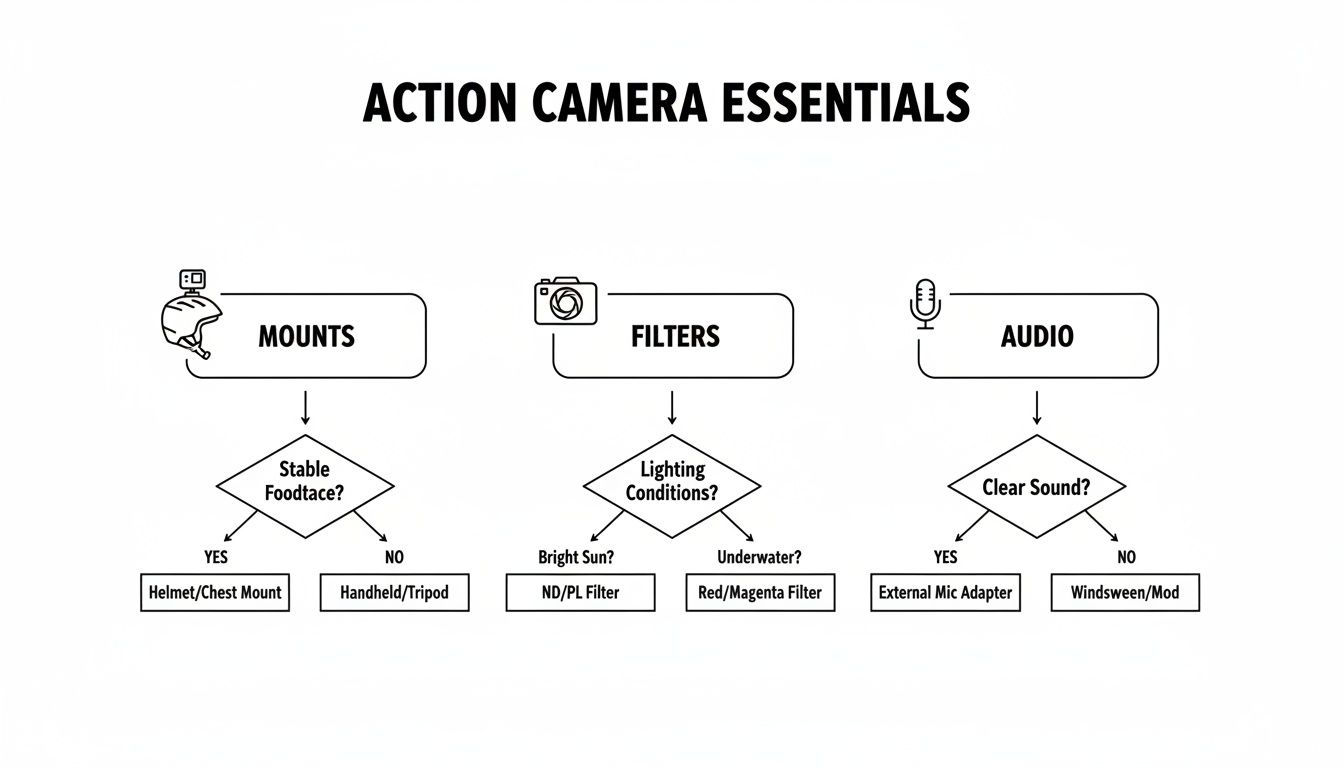
Think of the camera as your canvas. Mounts, filters, and external microphones are the brushes that truly unlock what it can do.
When you make your final choice, it should feel like a confirmation, not a compromise. Whether you lean toward GoPro's bulletproof reliability, DJI's smart innovations, or Insta360's creative freedom, the right camera is the one that makes you want to hit record and get out there.
Before you pull the trigger, it’s always a good idea to compare prices online and save more with expert tips to make sure you’re getting the most bang for your buck on your new gear.
It's easy to get lost in the specs when you're comparing action cameras. Once you've narrowed it down, a few final questions often pop up. Let's clear up some of the most common things shoppers wonder about before they pull the trigger.
Honestly, for most people, the answer is no. It’s tempting to go for the biggest numbers, and resolutions like 5.3K or 8K sound incredible on paper. The real-world advantage of that extra resolution is giving video editors the freedom to crop way into a shot without losing quality. It’s all about reframing in post-production.
For just about everyone else, a good 4K camera is more than enough to capture gorgeous, cinematic footage. If you're sharing videos on social media or watching them on your 4K TV, you'd be hard-pressed to spot the difference. Sticking with a solid 4K model saves you money and, just as importantly, leaves you with smaller video files that are much easier to edit and store.
The Takeaway: Unless you're a pro who lives in the editing suite and needs that cropping flexibility, a high-quality 4K action cam hits the sweet spot. You get fantastic quality, manageable file sizes, and much better bang for your buck.
The world of mounts and accessories is a huge deal, and it's a major point of comparison. GoPro is the undisputed king here, with a massive, mature ecosystem. You can find a mount—from GoPro or a third-party brand—for literally any activity you can dream up. That kind of variety gives you incredible versatility.
On the other hand, brands like DJI have been innovating. Their magnetic quick-release mounting system is a genuine game-changer. Being able to snap your camera from a helmet mount to a selfie stick in seconds, without messing with thumbscrews, is a huge workflow improvement. So, you have a choice: do you want the endless variety of the GoPro system or the slick, modern convenience of something like DJI's magnetic setup?
Not really—they're two different tools for two very different jobs. An action camera is a specialized piece of gear. It's built to be tough, to survive drops and dunks in the water, and to deliver incredibly smooth, wide-angle footage while you're moving. It’s made to go places your phone simply can't.
Your smartphone, however, is the king of convenience for everyday life. It’s perfect for casual vlogging, grabbing a quick clip for social media, and situations where you don't need rugged protection. They're best thought of as partners in your creative toolkit, not competitors.
Ready to capture your next adventure? Explore the latest and greatest deals on top-rated photography equipment at FindTopTrends and find the perfect camera to match your style. Visit us today at https://findtoptrends.com to see our curated collection.




