


No products in the cart.


Free Shipping Australia-Wide

5 star customer service

Quality Tested Products

Ultimately, the best travel coffee maker is a personal choice. It's a balancing act between portability, your favorite brew method, and your power source. For most people on the move, a tough, non-electric option like an AeroPress hits the sweet spot—it delivers fantastic coffee, weighs next to nothing, and is versatile enough for just about any adventure.
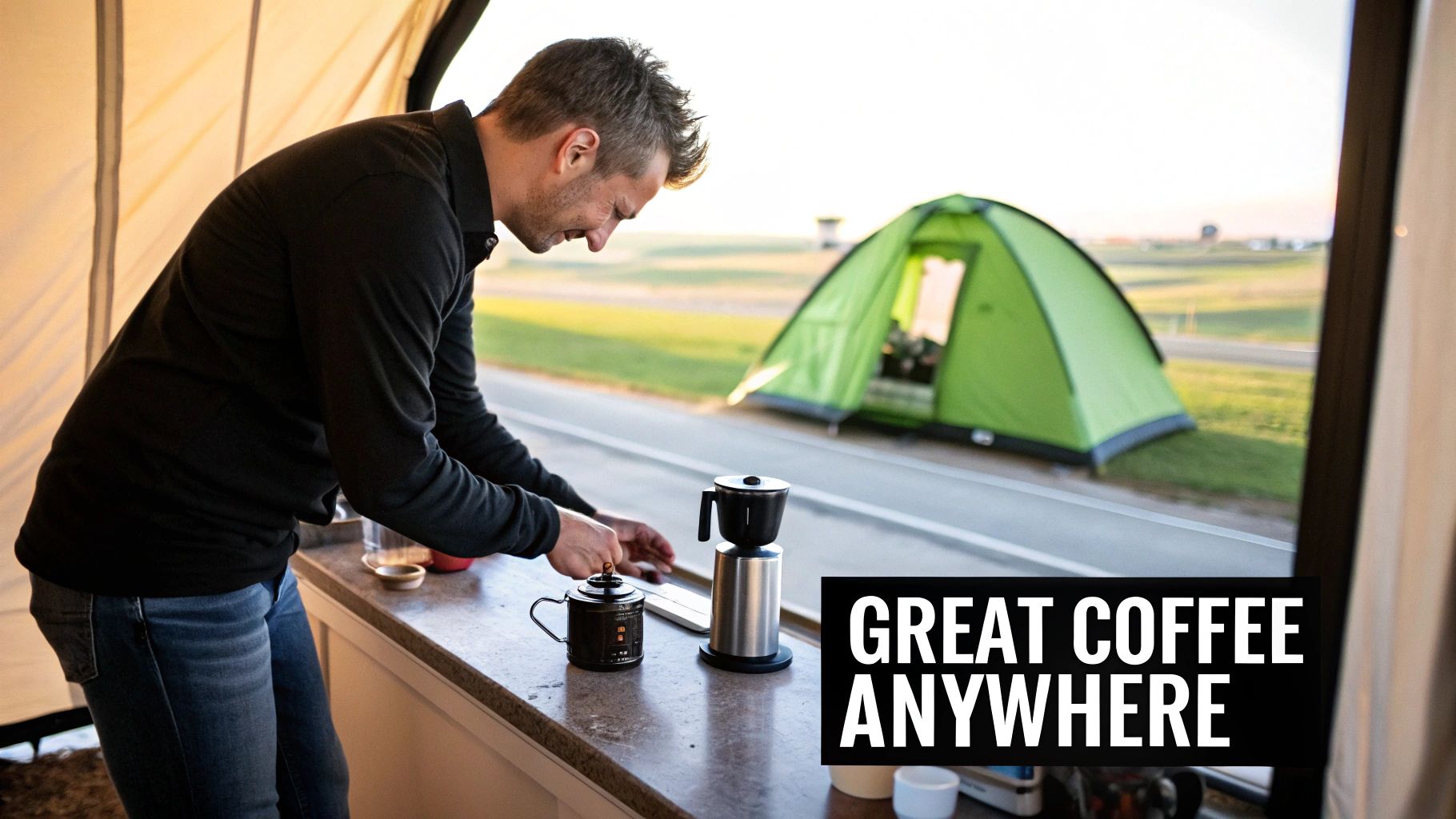
There’s nothing like waking up somewhere new. Whether it's a hotel with a city view, a quiet campsite, or a cozy Airbnb, that feeling is one of the best parts of traveling. But that magic can vanish pretty quickly when you're staring down a sad, stale coffee pod or the prospect of an overpriced, burnt cup from a random café.
A good travel coffee maker is your ticket to a better morning ritual, wherever you find yourself. It’s not just another piece of gear; it’s about taking back control. You get to make your coffee, your way, saving a little money and guaranteeing a delicious start to the day. Suddenly, any spot on the map can become your personal coffee bar.
This idea of having great coffee anywhere isn't just a quirky habit anymore—it's a full-blown movement. More and more travelers are packing their own brewers, and the market has exploded to meet the demand. In fact, the global portable coffee maker market is expected to jump from USD 5.848 billion in 2025 to a whopping USD 10.02 billion by 2035. You can find more details on this trend over at marketresearchfuture.com.
This guide is here to help you find the right brewing companion for your own travels. We’re going to skip the brand promotions and focus on what really matters: understanding the different types of coffee makers and figuring out which features fit your style of adventure.
Forget the instant packets and lukewarm hotel brewers. A great travel coffee maker empowers you to brew a cup that’s just as good as the one from your favorite café back home.
By the time we're done, you'll know exactly how to match a brewer's features to your specific needs. We'll cover everything from manual devices that give you total control to electric models that offer push-button consistency, so you can make the perfect choice.
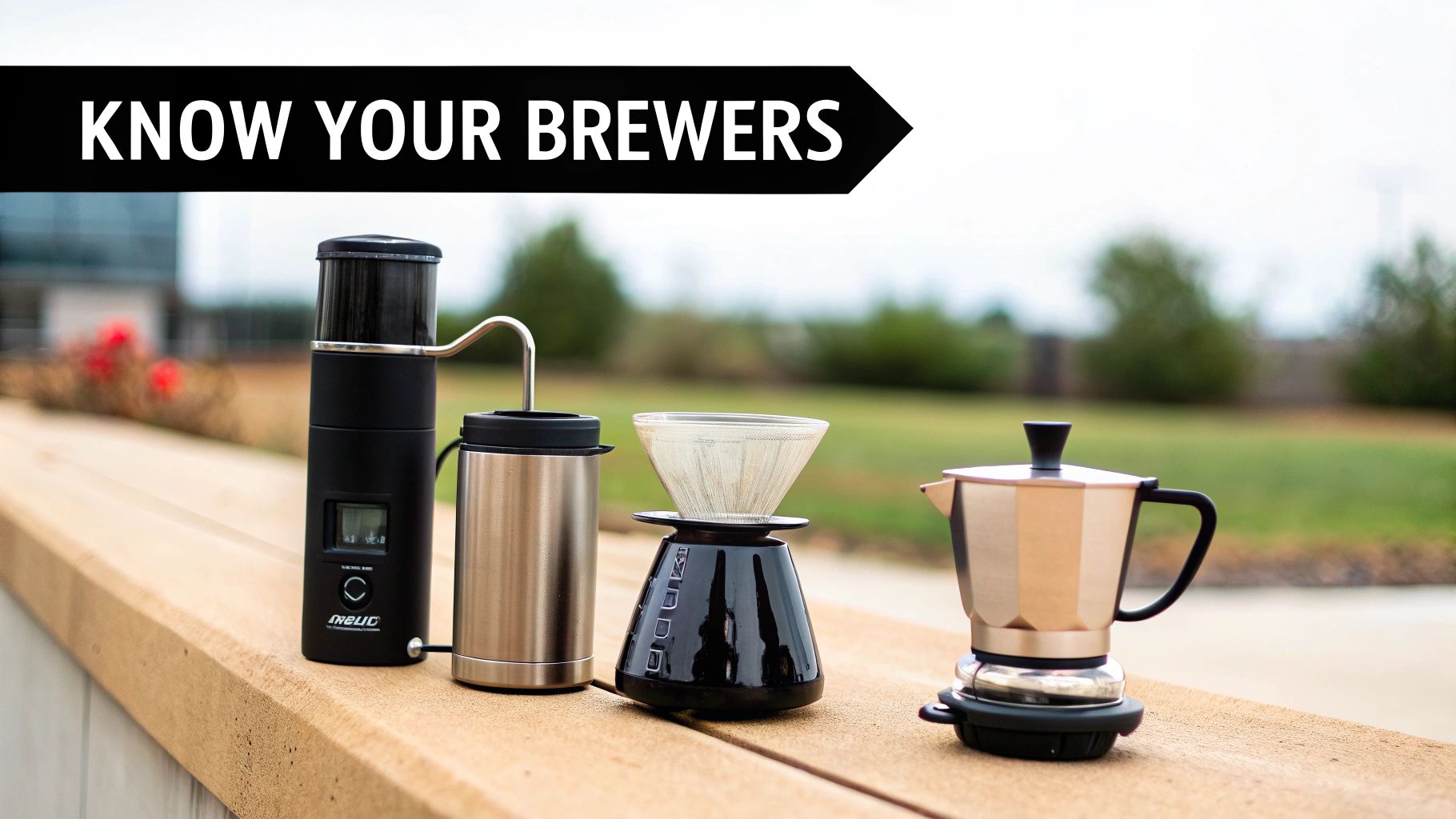
Choosing the right travel coffee maker can feel overwhelming, but it really boils down to one simple question first. Think of it like deciding between a manual or an automatic car. One gives you total, hands-on control over the ride, while the other is all about push-button ease. That’s the first and most critical choice you’ll make in the world of portable coffee.
It’s a great time to be in the market for one, too. More and more travelers are refusing to settle for bad coffee, and that demand is fueling some serious innovation. The portable espresso market alone is set to skyrocket to USD 2.62 billion by 2033. The entire portable coffee maker category is expected to jump from USD 6.10 billion in 2025 to a massive USD 9.66 billion by 2031. A huge part of that growth comes from non-electric manual brewers, which have become an absolute favorite for campers and adventurers.
With all these new options hitting the shelves, let’s break down the two main camps—manual and electric—before diving into the specific styles you’ll find in each.
Manual coffee makers are for the purists. They put you in the driver’s seat, asking you to supply the hot water and a little bit of effort. The payoff? Unbeatable control over your final cup. These brewers are almost always lighter, more durable, and completely free from the need for a power outlet, making them the go-to for camping, hiking, and any off-grid adventure.
If you're an adventurous type, it's worth exploring the different gear out there. Check out the best ways to make coffee while camping to see just how well these manual brewers perform in the wild.
Here are the most common styles you'll run into:
Manual brewers create a direct connection between you and your coffee. The lack of electronics means there’s less that can go wrong, giving you a brewing partner you can rely on, no matter where your journey takes you.
Electric travel coffee makers are all about one thing: making your life easier. They handle the heating, the brewing, or sometimes both, giving you a consistently great cup with just the press of a button. These are a perfect match for hotel stays, road trips, and business travel where you know you'll have access to a power source, whether it's a wall outlet, a car adapter, or even a USB port.
You’ll find a few key players in the electric space:
To help you see the differences at a glance, here’s a quick breakdown of how the two main categories stack up against each other.
| Feature | Manual Coffee Makers | Electric Coffee Makers |
|---|---|---|
| Portability | Lighter and more compact. | Heavier and bulkier due to batteries and motors. |
| Durability | Fewer moving parts, making them very rugged. | More fragile due to electronic components. |
| Power Source | None needed—just hot water. | Requires an outlet, battery, or USB power. |
| Control | Full control over every brewing variable. | Automated for consistency, with limited control. |
| Best For | Camping, hiking, backpacking, off-grid travel. | Hotels, business trips, road trips, RVs. |
| Ease of Use | Requires practice and a bit of technique. | Simple, one-button operation. |
Ultimately, choosing between manual and electric is your first major step. This decision will define your coffee ritual on the road, so think carefully about where you’ll be traveling and what you value more: hands-on control or automated convenience.
Alright, you've got a handle on the different types of travel coffee makers. That's half the battle. Now, let's get into the nitty-gritty—the specific details that can make or break your on-the-go brewing experience.
Think of this as your personal checklist. We're moving past the big categories and zooming in on the features that actually matter when you're far from home. A feature that’s a game-changer for a backpacker might be totally useless for someone on a business trip. By looking at these key points, you can build a crystal-clear picture of the brewer that’s right for you.
When you’re traveling, every inch and every ounce matters. This is non-negotiable, especially if you're flying and wrestling with carry-on limits or trying to avoid those dreaded baggage fees. What works for a cross-country road trip is a world away from what an ultralight backpacker needs.
The goal is to find that perfect sweet spot. Your brewer should be portable enough that you never think twice about packing it, but not so flimsy that it compromises your coffee.
Here's a pro tip: Think about how a brewer fits with your other gear. Some of the smartest designs actually nest inside a travel mug or have a hollow plunger to store a small manual grinder. That's how you maximize every bit of space.
This is a big one. Your brewer’s power source dictates where and when you can get your caffeine fix. It’s the great divide between off-grid adventures and hotel-room convenience.
Manual brewers give you total freedom. All you need is hot water and ground coffee, and you're in business. For camping, hiking, or traveling anywhere with questionable electricity, they are the undisputed champions. Their independence is their superpower.
Electric brewers, on the other hand, offer push-button simplicity but come with a leash. You’re tied to a power source, whether that's a wall outlet, your car’s 12V socket, or a fully-juiced USB power bank. They are fantastic in controlled environments like hotel rooms, offices, or RVs where you know you'll have power.
How much coffee do you really need to function? The answer to that question will point you to the right device. Most travel brewers are built for a single serving, usually making somewhere between 8 to 12 ounces. For solo travelers, this is perfect.
But if you’re traveling with a partner or just need a giant mug of coffee to face the day, a single-serve brewer will feel frustratingly small. In that case, look for something like a larger travel French press or a specialty brewer like the AeroPress XL, which is built for bigger batches. Just remember, a brewer’s capacity is directly tied to its size, so you’re always making a trade-off between volume and portability.
Travel gear takes a beating. It gets tossed into bags, bounced around in cars, and exposed to the elements. The materials a coffee maker is made from tell you everything you need to know about how well it will hold up.
Cleaning a coffee maker in your kitchen sink is one thing. Trying to clean it in a tiny hotel bathroom or with a limited water supply at a campsite? That’s a whole different ballgame.
This is the feature everyone forgets about until it’s too late. Brewers with fewer, simpler parts are a dream to manage on the road. The AeroPress, for instance, is famous for its self-cleaning plunger that pushes out a dry puck of coffee grounds, leaving almost no mess. A complicated machine with lots of nooks and crannies will become your enemy real fast.
When you're weighing your options for various compact kitchen appliances, a simple cleaning process is a huge plus. For more tips on this, check out our guide to compact kitchen appliances.
Let's be honest, the "best" travel coffee maker doesn't actually exist. What works perfectly for one person is just dead weight in another's bag. It’s all about matching the brewer to your specific travel style—you wouldn't wear hiking boots to a business meeting, right?
To get this right, think about the kind of traveler you are. Once you identify your "travel persona," the features you truly need will jump right out at you. Suddenly, you're not just staring at a confusing list of specs; you're seeing a clear picture of what will actually work for you on the road.
Do you feel most at home with a backpack on, miles from the nearest power outlet? If that's you, then your top priorities are durability and independence. You need a coffee maker that can take a beating in your pack and doesn't need a plug or batteries to function.
Your best bet is a manual brewer made from tough stuff like stainless steel or shatterproof, BPA-free plastic. Simplicity is your friend out there—fewer moving parts mean fewer things that can break or get lost. Think of a sturdy French press, a Moka pot that works on a camp stove, or the virtually indestructible AeroPress.
For those who travel for work, every minute and every inch of carry-on space is gold. Your ideal brewer needs to be fast, compact, and mess-free. You want something that delivers a fantastic cup of coffee in a hotel room without any fuss or hogging precious luggage space.
This is where some electric options really shine. A portable espresso machine can pull a café-quality shot in just a couple of minutes. On the other hand, an ultra-light manual brewer, like a collapsible pour-over dripper, is perfect to pair with the hotel's kettle for a clean, simple brew.
This simple decision tree can help you narrow down your options based on your core travel needs.
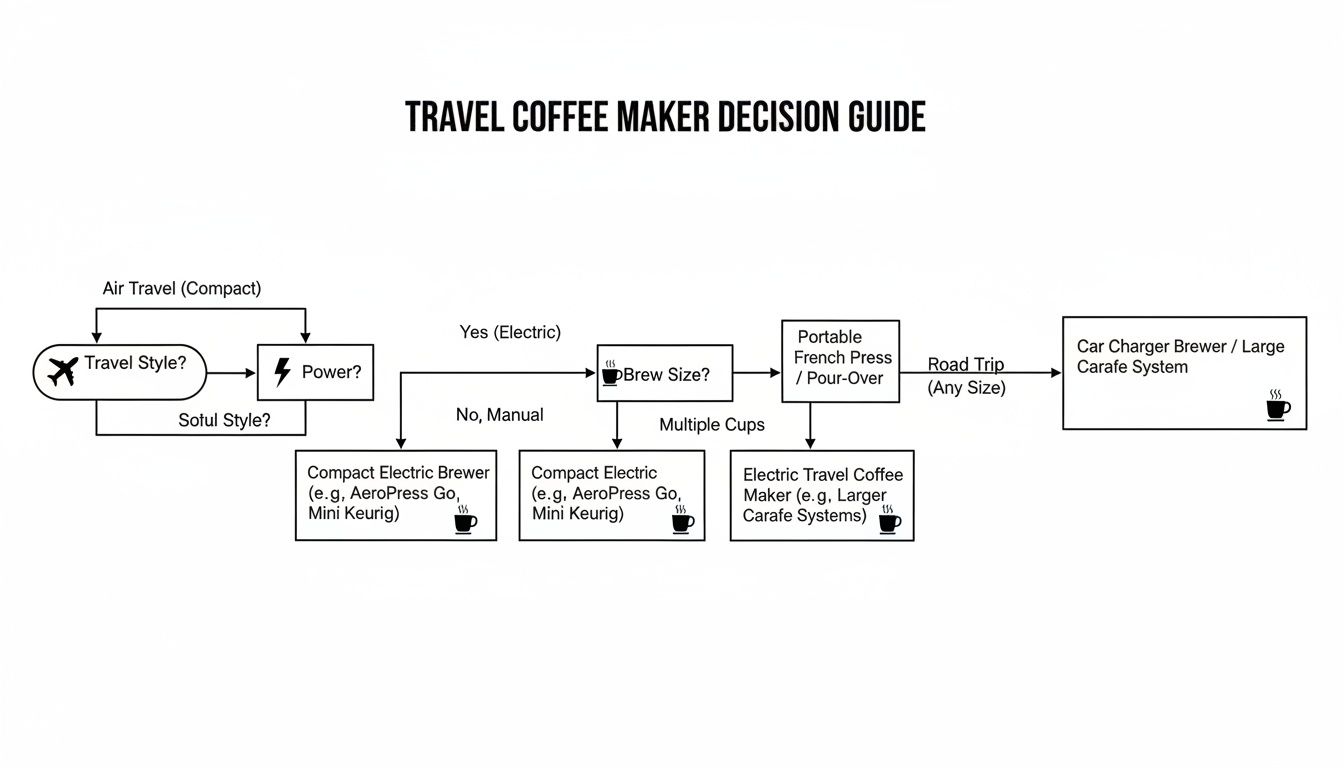
As you can see, asking yourself just three quick questions—about your travel style, power access, and how much coffee you need—can instantly rule out entire categories and point you toward the right tool for the job.
If your idea of a great trip involves hitting the open road with a loose itinerary, you need convenience and flexibility. One morning you might be brewing at a scenic overlook, the next at a rest stop, and the day after in a budget motel. Your perfect coffee maker has to be easy to use and adaptable.
This is the category with the most freedom. You could easily use a manual brewer with hot water from a good thermos, or you could plug an electric model directly into your car’s 12V outlet. It's all about finding the right balance for your vehicle and your on-the-go coffee ritual. To round out your kit, check out our guide on other must-have accessories for travel.
By identifying your primary travel persona, you're not just buying a gadget; you're investing in a tool that seamlessly integrates with your adventures, guaranteeing a great cup of coffee no matter where you wake up.
We're not the only ones thinking about this. The demand for specialized brewers is booming, especially in North America. The U.S. coffee machines market alone hit USD 2.7 billion in 2024 and is still growing. In fact, data shows that a whopping 65% of portable coffee maker sales now go to travelers and campers, a number that shot up thanks to the post-pandemic love for outdoor adventures. For savvy shoppers, this means there are more high-quality, affordable options out there than ever before.
Having the right travel coffee maker is only half the battle. Your technique is what really turns good gear into a truly great cup of coffee, especially when you're away from home. Think about it—when you travel, the environment is always changing. The water is different, the altitude might be higher, and you don’t have your usual setup.
Mastering a few simple tricks will help you brew consistently delicious coffee, no matter where you wake up. It’s like being a chef in a new kitchen; you have the ingredients, but you need to learn the quirks of the oven. With a few tweaks, you can turn any hotel room, Airbnb, or campsite into your personal coffee bar.
A great travel brew actually starts before you even lock your front door. Packing smart not only saves precious space in your bag but also makes that first morning brew so much faster and more enjoyable. A little prep work goes a seriously long way.
Here’s a simple hack: pre-measure your coffee beans or grounds. Instead of lugging around a big bag of coffee and a scale, just portion out what you need for each cup into small, sealed bags or containers. This takes the guesswork out of your coffee-to-water ratio and saves you a ton of hassle.
Another pro tip is to think about nesting your gear. Many manual brewers, like the AeroPress, have hollow plungers that are just begging to be used for storage. You can tuck a small hand grinder or your pre-measured coffee right inside. It’s a brilliant way to use that "dead space," especially if you’re trying to pack light for a carry-on trip.
Nobody likes cleaning on vacation, but keeping your coffee maker gunk-free is non-negotiable for good flavor. The trick is to pick a brewer that's easy to clean in the first place and to get into a quick, simple routine.
Right after you brew, give it a thorough rinse with hot water. This quick step prevents coffee oils from building up, getting sticky, and turning rancid—which is a surefire way to ruin your next cup. For a deeper clean without soap, a little bit of vinegar mixed with water or a dedicated coffee equipment cleaner will do the job perfectly.
A clean brewer is the foundation of great-tasting coffee. Neglecting simple maintenance is the fastest way to a bitter, disappointing cup, no matter how good your beans are.
Let's be real: conditions on the road are rarely perfect. The water from the hotel kettle might be screaming hot, or maybe it’s barely hot enough. Your grind might not be quite right. Learning to adapt is the secret to getting a great cup every single time.
You don't need a suitcase full of gear to make amazing coffee while traveling. Many of the same principles apply, and you can learn how to make barista-quality coffee at home without expensive equipment and adapt those techniques. This is especially true for campers, where your heat source is everything. If you're an outdoor adventurer, having the right stove is critical, so check out our guide to the best camping stove for backpacking to complete your mobile café.
We've explored everything from the nitty-gritty of manual vs. electric brewers to finding the right fit for your travel style. To pull it all together, here’s a simple checklist to run through before you make your final choice.
Think of these questions as the last step in your decision-making process. Answering them honestly will help you cut through the noise and feel confident you’re getting the right brewer for your adventures.
Let’s walk through this together. Consider each point to get crystal clear on what you really need before you buy.
1. What’s my main travel style?
2. How much do weight and space really matter to me?
3. Will I actually have a power source?
4. How many people am I brewing for?
5. How much cleanup am I willing to deal with?
Thinking through each of these points takes you from browsing generic options to finding a brewer that feels like it was made just for you.
This isn’t about finding the one "perfect" coffee maker out there. It’s about finding the one that’s perfect for the way you travel. With this final check, you're ready to pick a brewer that will deliver a great cup of coffee, no matter where your journey takes you.
Even with all the options laid out, a few practical questions always come up. After all, choosing the right travel coffee maker isn't just about the brewer itself—it's about how it fits into the realities of being on the road.
Let's clear up some of the most common head-scratchers so you can brew with confidence on your next trip.
Absolutely. The Transportation Security Administration (TSA) gives coffee makers the green light for both carry-on and checked luggage. My advice? Keep it in your carry-on. Baggage handlers aren't known for their gentle touch, and you don't want to arrive with a cracked brewer.
Just be ready for it to get a second look at security. With all its wires, tubes, and chambers, your coffee maker can look a bit suspicious on the X-ray scanner. To make life easier for everyone, I always pull mine out and place it in a separate bin, just like a laptop. It saves time and prevents a TSA agent from having to dig through your neatly packed bag.
This is probably the biggest hurdle for brewing away from home, but it's easier to solve than you think. Where you are dictates the plan.
The real secret to great travel coffee is being resourceful. Whether you're borrowing hot water from a hotel kettle or boiling it over a camp stove, a solid plan for getting hot water is the final piece of the puzzle. Think ahead, and a great cup is always within reach.
When you don't have a full kitchen sink, cleaning becomes a massive consideration. Nobody wants to deal with a complicated, messy brewer in a hotel bathroom or at a campsite.
For my money, the AeroPress is the undisputed champion of easy cleanup. The plunger squeegees the chamber clean as it presses, leaving you with a dry, compact puck of coffee grounds that you can pop straight into the trash. A quick rinse of the plunger, and you're done. It's brilliant.
Simple pour-over drippers are a close second. Just lift the paper filter and grounds out, toss them, and give the cone a quick wipe. On the other end of the spectrum, French presses can be a real pain. Scooping out wet, sludgy grounds is a messy job that requires a lot more water and effort than you usually have to spare while traveling.
Ready to find the perfect gear for your next adventure? FindTopTrends curates the latest and greatest travel essentials, tech gadgets, and more to make every trip unforgettable. Explore our collections today at https://findtoptrends.com.




