


No products in the cart.


Free Shipping Australia-Wide

5 star customer service

Quality Tested Products

When it comes to whale watching, the best all-around choice is a pair of binoculars with 7x or 8x magnification and a 42-50mm objective lens. This combination gives you a stable, bright, and wide view—perfect for tracking these magnificent animals from a rocking boat or a windy shoreline.
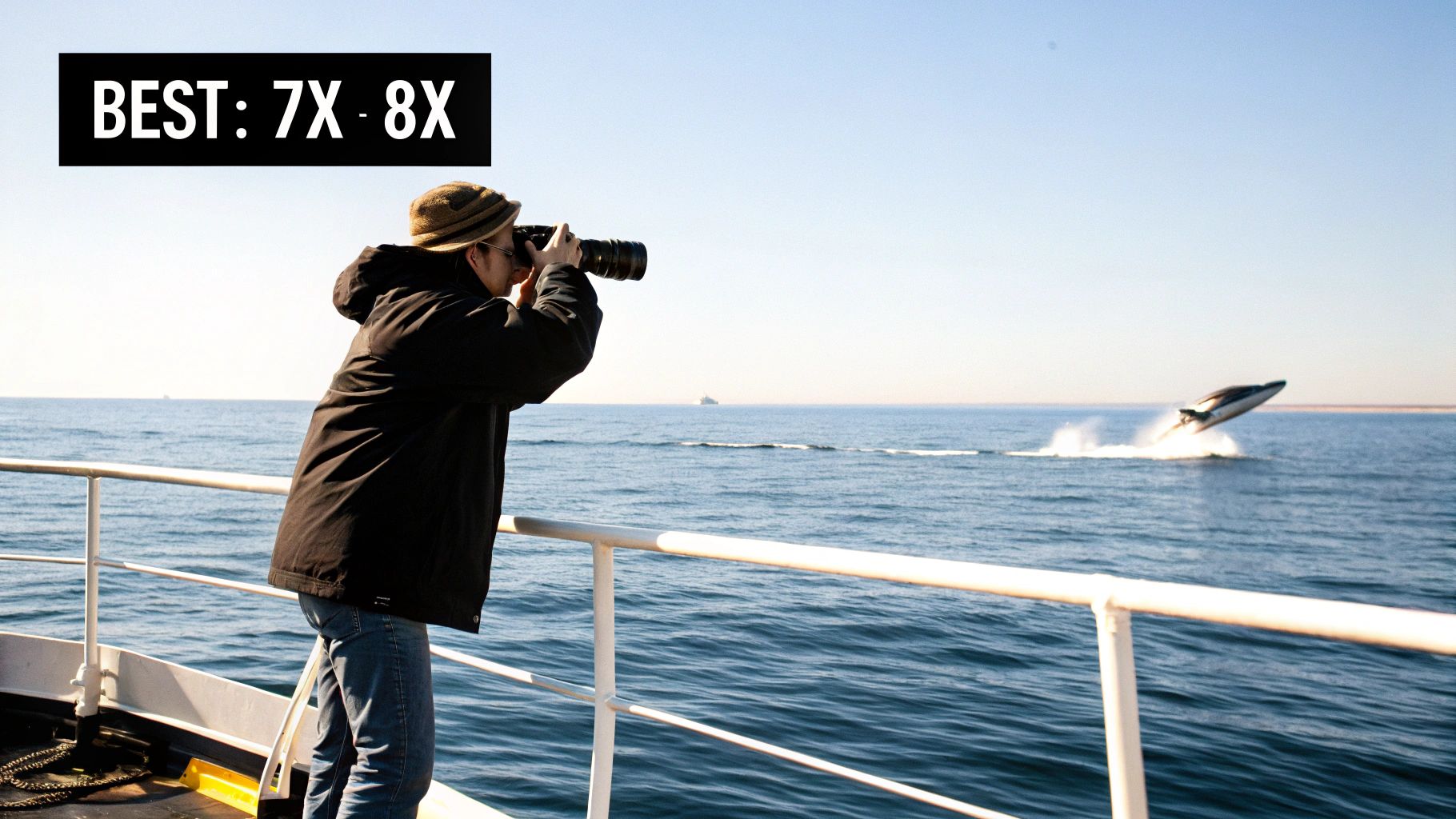
Imagine it: a humpback whale explodes from the ocean, sending a tower of spray into the sky. Without the right gear, that breathtaking moment is just a distant splash. The right pair of binoculars closes that distance, turning a faraway shape into a vivid, personal encounter you’ll remember forever. This guide will cut through the technical jargon and help you find the perfect pair for your next adventure.
Choosing binoculars isn’t just about making things look bigger. It's about finding the perfect balance between magnification, image stability, and brightness. While a super-powerful pair might seem like a great idea, the gentle sway of a boat will magnify every tiny handshake, rendering the view a blurry, unusable mess.
This is exactly why seasoned marine guides and wildlife experts almost always recommend 7x or 8x magnification. It’s powerful enough to bring you closer to the action—letting you see the distinct pattern on a whale's fluke or the mist from its blowhole—but not so powerful that the image is constantly shaking.
Lower magnification also gives you a wider field of view, which is absolutely critical for finding and following animals across the vast ocean surface. Think of it this way:
Of course, great gear is only half the battle. Knowing where and when to go is just as important. If you’re planning a trip to Hawaii, for instance, this ultimate viewing guide for whale season on the Big Island is a fantastic resource for timing your visit perfectly.
A common mistake is buying the most powerful binoculars available. For marine environments, stability and a wide field of view are far more important for a rewarding experience than raw magnification power.
To help you get started, I’ve put together a quick summary of my top recommendations for different needs.
This table gives you an at-a-glance look at the ideal specs for different situations, whether you're on a tight budget or looking for a premium, boat-ready pair.
| Category | Ideal Magnification | Objective Lens (mm) | Key Feature | Example Price Range |
|---|---|---|---|---|
| Budget All-Rounder | 7x or 8x | 42mm | Good light, stable view | $100 - $250 |
| From the Shore | 8x or 10x | 42mm - 50mm | Higher power for distance | $150 - $400 |
| On the Boat (Standard) | 7x | 50mm | Wide, bright, ultra-stable | $200 - $500 |
| Premium/Pro Choice | 7x or 8x | 42mm | Image-stabilized | $500 - $1,500+ |
Use this as a starting point. It shows why these specific combinations are considered the gold standard for any marine wildlife expedition and will help you narrow down your search.
When you first start looking at binoculars, you'll see a pair of numbers stamped on them, something like 8x42 or 7x50. These aren't just random model numbers; they're the key to understanding exactly how that pair will perform out on the water. Getting a handle on what they mean is your first step toward picking the perfect pair for spotting whales.
Think of it this way: the first number is all about magnification (how much closer things appear), and the second number tells you the size of the main lenses. So, in an 8x42 pair, the "8x" means that whale you're watching will look eight times closer than it does with your naked eye. The "42" tells you the big lenses at the front (the objective lenses) are 42 millimeters across.
It’s a simple, elegant system that reveals the two most important things about any pair of binoculars.
The first number, magnification, is all about zoom. It's so tempting to assume that more is always better, right? A bigger number must mean a better view. This is probably the most common mistake people make, especially when buying binoculars for use on a boat.
Sure, a higher magnification like 10x or 12x will make a distant whale look huge. The problem is, it also magnifies every tiny shake of your hand and every single roll of the boat. The result is a shaky, jittery image that's not just hard to focus on but can genuinely make you feel seasick.
When it comes to whale watching from a boat, lower magnification is your best friend. It’s all about a stable, usable image.
If you want to get deeper into the nitty-gritty of magnification and other key specs, our complete binoculars buying guide breaks it all down even further.
That second number is the objective lens diameter, measured in millimeters. This one is all about how much light the binoculars can scoop up. The easiest way to think about it is like a window—the bigger the window, the more light pours in.
This is a huge deal for whale watching. The best action often happens in the dimmer light of the early morning or late afternoon, right when marine life is most active. A larger lens will pull in more of that available light, giving you a brighter, crisper, and more detailed picture.
The catch? Big lenses mean bigger, heavier binoculars. While a 50mm lens will gather a ton more light than a 42mm lens, you’ll definitely feel that extra size and weight after holding them up for ten minutes straight.
For most people, a 42mm objective lens hits the sweet spot. It delivers a bright, clear view without feeling like you're lifting a brick to your face. But if you demand the absolute brightest view possible and you'll be on a stable boat where you can rest your arms, a 50mm lens is the undisputed king.
Ultimately, picking the best binoculars means finding that perfect harmony between magnification and light-gathering for where and how you’ll be watching. An 8x42 is a brilliant, versatile choice, while a 7x50 is built for maximum stability and brightness in the toughest marine environments.
Out on the water, your binoculars are going to get hit with salt spray, humidity, and maybe even a rogue wave. Taking a standard pair of binoculars out there is like bringing a library book to the beach—it’s just asking for trouble. The best binoculars for whale watching are built tough, specifically to handle these unforgiving marine conditions.
First things first: waterproofing and fog-proofing are absolutely non-negotiable. This isn't just a "nice to have" feature; it's a must. Manufacturers make this happen by sealing the optics tight with O-rings and then purging the air inside. They replace it with a dry, inert gas like nitrogen or argon, which does two things: it keeps moisture out and prevents the lenses from fogging up on the inside when you go from a warm car to the cool ocean breeze.
Next, you have to think about the outside. A solid, shock-absorbing rubber armor coating is your best friend. This gives you a secure, non-slip grip, which is a lifesaver when your hands are cold or wet. It also adds a critical layer of protection against the inevitable bumps and knocks that come with being on a moving vessel.
Beyond the basic armor, specialized lens coatings are crucial for cutting through the blinding glare you get off the water. Look for lenses that are multi-coated or fully multi-coated. This treatment reduces reflection and lets the maximum amount of light through, giving you a much sharper, clearer view of that distant whale spout, especially when the sun is high and bright.
To keep all your gear protected from the elements, a good bag is essential. You can check out our guide on the best waterproof backpacks for some solid options. And if you're interested in learning more about the environment you'll be exploring, understanding the marine ecosystem can make your trip even more rewarding.
If you want the absolute best, steadiest view possible from a rocking boat, then image stabilization (IS) technology is a total game-changer. It’s not magic, but it feels like it. Internal sensors and tiny processors work constantly to counteract the motion of your hands and the boat, electronically canceling out the shakes and jitters. The result? A remarkably stable image that makes it feel like you're standing on solid ground.
Technological advancements have significantly enhanced the performance of binoculars for whale watching, with features like image stabilization becoming increasingly common. Premium models are highly sought after by serious whale watchers and professional guides for their ability to deliver a steady view even from moving boats. Discover more insights about these advanced binocular features on Digital Camera World.
Sure, IS binoculars come with a higher price tag. But for that investment, you get a perfectly stable picture that’s simply unmatched, letting you lock onto the fine details of a whale's fluke or blowhole without any distracting motion.
Where you plan to watch whales—from the solid ground of a coastal cliff or the swaying deck of a boat—is the single most important factor in picking the right binoculars. It’s a classic trade-off: do you want more magnifying power, or do you need a more stable image? The best pair for the job is always the one that matches your environment.
Think of it like this: you wouldn't wear hiking boots to the beach or flip-flops on a mountain trail. Your gear needs to fit the "terrain."
When you’re watching from land, stability is your biggest ally. The ground beneath your feet isn't pitching and rolling, so you can get away with much more powerful optics without your view turning into a shaky mess.
This is where higher magnification binoculars, like 10x or even 12x models, really shine. They let you get incredibly detailed, up-close views of distant spouts, fluke dives, and dramatic breaches. To take it a step further, many shore-watchers pair their binoculars with a lightweight tripod. This completely eliminates hand shake, giving you a perfectly still, crystal-clear image to track whales that might be miles offshore.
The moment you step on a boat, the game changes completely. Out on the water, stability is everything. The constant motion of the waves gets amplified by high-magnification lenses, turning what should be an amazing view into a blurry, jittery nightmare that can even make you feel seasick.
This is exactly why a lower magnification of 7x or 8x is the undisputed champion for marine use. These binoculars offer a wider field of view, which not only makes the image feel much steadier but also makes it far easier to find and follow a moving whale on the vast ocean. A stable view is key to actually enjoying the experience.
On a boat, you’ll also want to look for practical features like a grippy, non-slip rubber coating and, of course, proper waterproofing. Salt spray is a given.
The bottom line is simple: On land, you can chase high magnification for incredible detail. On a boat, you absolutely must prioritize a lower magnification for a stable, usable image. Giving up a little power is a tiny price to pay for a view you can actually hold steady.
To make this choice even clearer, let's break it down side-by-side.
| Feature | Shore Watching (Stable) | Boat Watching (Unstable) |
|---|---|---|
| Ideal Magnification | 10x to 12x (or higher with a tripod) | 7x to 8x (maximum) |
| Primary Goal | Maximum detail on distant subjects | A stable, wide, easy-to-track image |
| Field of View | Can be narrower to achieve more power | Wide field of view is critical |
| Stability | Ground is stable; hand shake is the only concern | Constant motion requires lower power |
| Key Accessories | Tripod or monopod for ultimate stability | Neck strap, floating strap, lens caps |
| Must-Have Features | Good lens coatings for bright, clear images | Waterproofing, fog-proofing, non-slip grip |
This table neatly sums up how your needs change depending on whether your feet are on solid ground or a moving deck.
This visual guide also helps drive the point home, illustrating how your location points you toward the right kind of binocular.
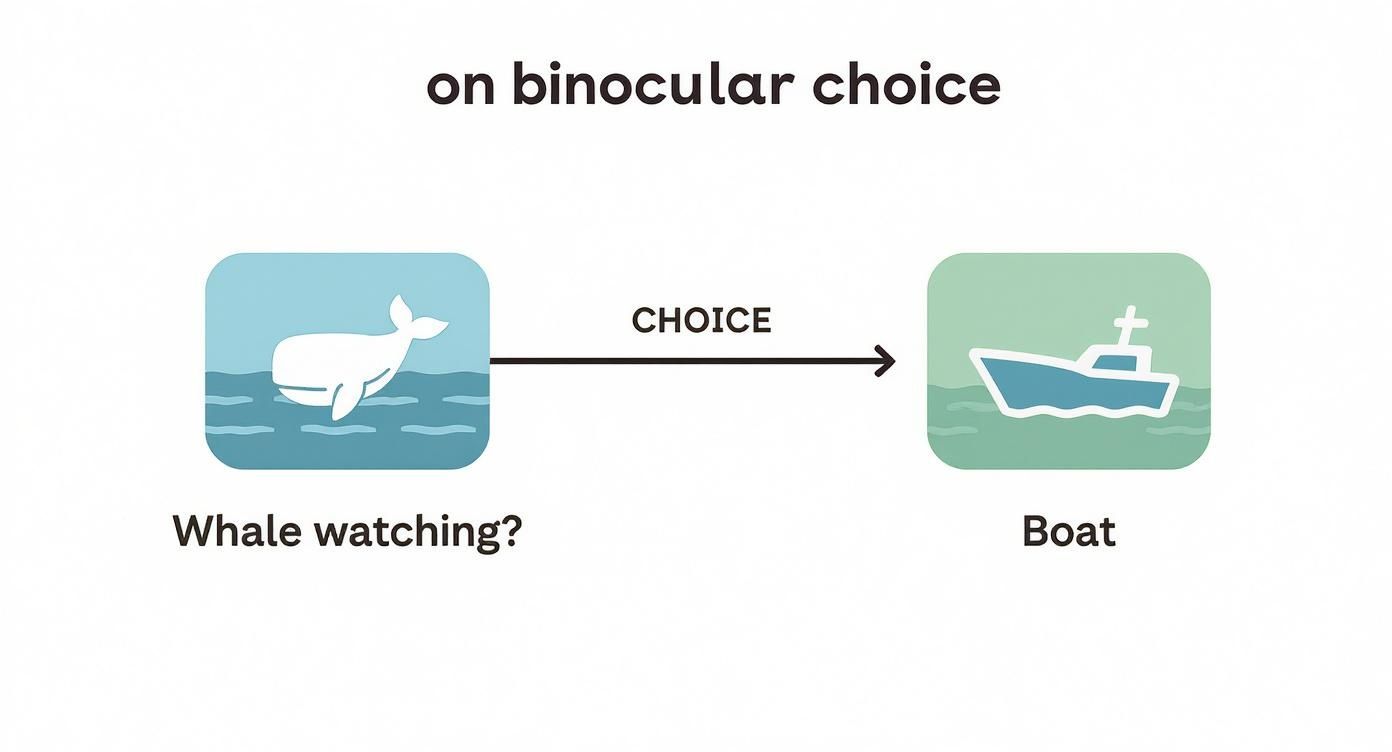
As you can see, the decision really boils down to whether your situation calls for more power or more stability. Getting that right is the first step to an unforgettable whale watching experience.
Finding a great pair of binoculars for whale watching doesn't mean you have to drain your bank account. Thankfully, quality optics are more affordable than ever, putting a spectacular view within reach for just about any budget.
We've picked out some field-tested models that we trust, breaking them down into three different price points. More importantly, we'll connect their features back to what actually helps you spot that fluke or blow out on the water.
Just a few years ago, finding good, cheap binoculars was a real challenge. Not anymore. The market for affordable optics has absolutely exploded, and you no longer have to put up with a dim, blurry view to save a few bucks. The competition is so stiff that you can find some truly excellent pairs for under $200.
For 2025, two models have really stood out for their blend of clarity, toughness, and price: the Vortex Diamondback HD 8x42 (around $150) and the Celestron Nature DX 8x42 (often found for $120). Both hit that sweet spot of 8x magnification and a 42mm objective lens, which is pretty much ideal for watching wildlife on the water. You can find more details in this guide to the best inexpensive binoculars for whale watching at Accio.com.
Our Budget Pick: Celestron Nature DX 8x42
This pair is a real standout. For the price, the view is crisp and bright, the rubber-armored body feels solid in your hands, and they're fully waterproof and fog-proof. Those last two features are non-negotiable for a day at sea.
Once you step up into the $250-$500 range, you'll see a real difference. This is where you get заметно better glass and more advanced lens coatings, which translates to a brighter, sharper picture with colors that really pop. For most serious whale watchers, this is the sweet spot—you get a major performance boost without the premium price tag.
Models in this tier often have something called dielectric prism coatings, which can transmit over 99% of available light through the glass to your eye. That makes a massive difference when you're out during those golden hours at dawn or dusk, which are often the best times for spotting whales.
If you're someone who simply wants the best view possible, the premium tier is where you'll find it. These binoculars deliver an experience that’s hard to describe until you’ve tried it—flawless clarity from edge to edge, rugged construction that feels like it could survive anything, and sometimes, incredible technology like image stabilization.
These aren't just binoculars; they're professional-grade instruments built to perform flawlessly in the toughest conditions and last a lifetime.
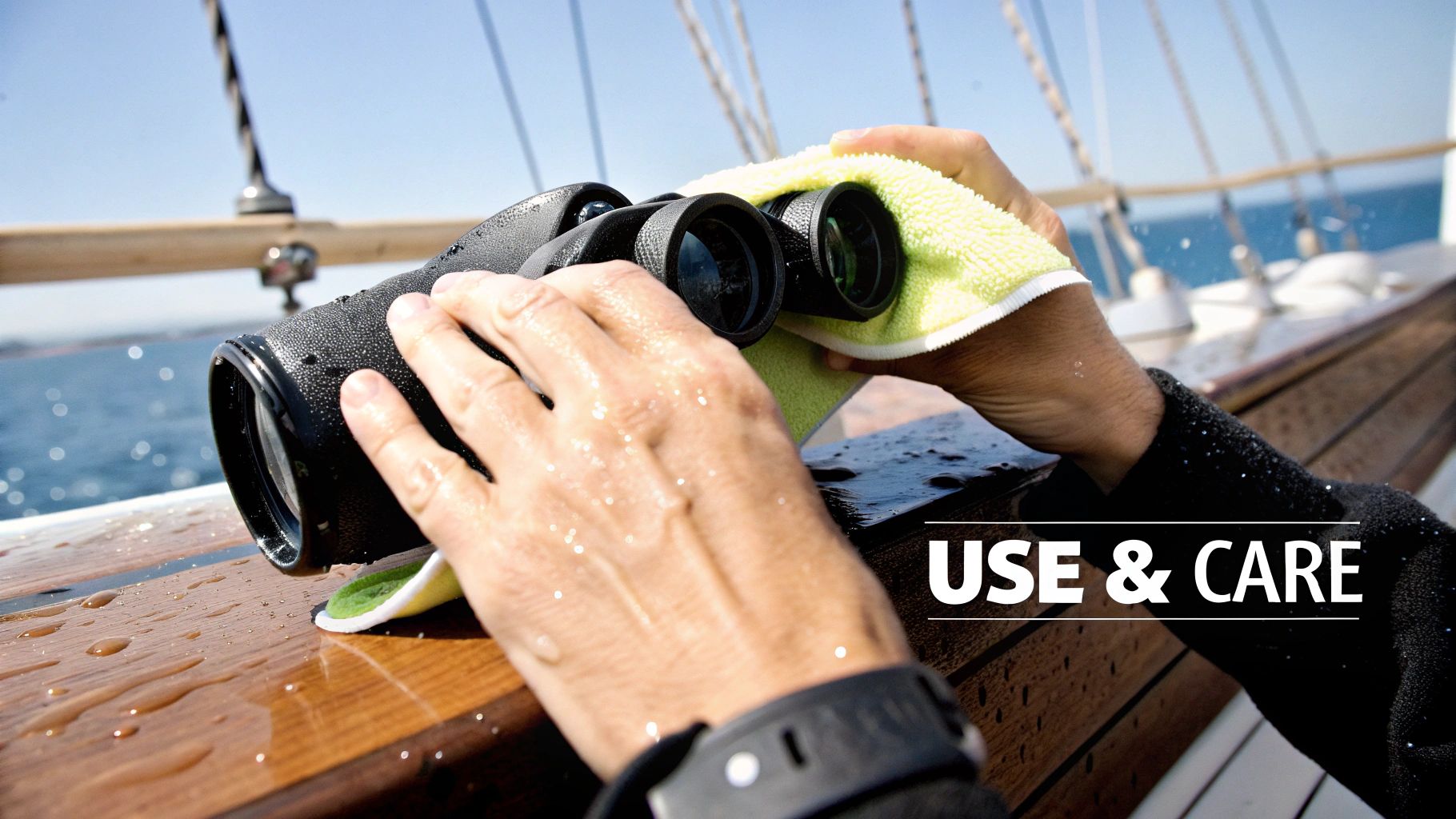
Getting your hands on a great pair of marine binoculars is just the beginning. To really make them work for you—and to protect your investment—you need to know how to set them up properly and keep them clean. It's what separates a good day on the water from a truly spectacular one.
The most important step, and one that most people skip, is setting the diopter. Think of it as a custom focus setting just for your eyes. It accounts for the subtle differences in vision between your left and right eye, which is the key to getting a perfectly sharp image without giving yourself a headache.
Calibrating your binoculars for your own eyes sounds technical, but it’s a one-time setup that takes less than a minute. Once it's done, you're good to go unless someone else borrows them.
Here’s the simple process:
That's it. Your binoculars are now perfectly tuned to your specific eyesight. From now on, all you'll need to touch is the main center focus wheel to follow whales at different distances.
A blurry, double-vision view that causes eye strain is almost always the result of a misadjusted diopter. Taking those 30 seconds to set it right makes all the difference in the world for comfortable, all-day viewing.
The ocean environment is unforgiving. Salt spray is the ultimate enemy of your binocular lenses, as those tiny salt crystals can easily scratch the delicate optical coatings. A little preventative maintenance goes a long way.
This simple routine ensures your gear will perform like new for years to come. That same level of care is crucial whether you're using binoculars or trying to protect the best camera lens for wildlife photography.
When you’re done for the day, pop them back in their case and store them somewhere dry. This prevents any lingering moisture from turning into fog or mold inside the optics.
You've got questions, and that's a good thing. It means you're serious about finding the right gear. Let's clear up some of the most common head-scratchers people have when picking out binoculars for whale watching.
This is probably the number one question I hear. The short answer is: for most people, yes, 10x magnification is too much on the water.
Think about it this way: magnification doesn't just make the whale bigger, it makes the boat's movement bigger too. Every little rock and sway of the vessel gets amplified ten times, turning your view into a shaky, often nauseating mess. It's incredibly difficult to track a moving whale with an image that's bouncing all over the place.
That’s why experienced boaters and marine guides almost universally stick to 7x or 8x magnification. You get a much wider, more stable picture that’s forgiving of the boat’s motion, making it far easier (and more pleasant) to follow that pod of dolphins or a breaching humpback.
One hundred percent. Don't even consider a pair that isn't fully waterproof and fog-proof.
Saltwater is the mortal enemy of sensitive optics. It’s incredibly corrosive, and even a tiny bit of spray or internal condensation can lead to ruined lenses, fungus growth, and a piece of gear that’s headed for the landfill. Proper waterproofing isn't a luxury feature; it's essential insurance for your investment when you're out on the ocean.
You'll see these two terms everywhere, and it can be confusing. Here's the simple breakdown of what they mean for you.
Porro vs. Roof Prisms: A Quick Guide
Porro prisms are the classic, wider-bodied binocular design. They often deliver a fantastic sense of 3D depth and a bright image, sometimes at a lower cost. Roof prisms allow for a more streamlined, compact, and often more rugged and well-sealed body.
So, which is better? Honestly, both can be excellent.
Porros give you that great depth perception, but roof prism models have become incredibly popular for marine use because their straight-through design is easier to seal up tight against the elements. You'll find fantastic options in both styles, but many of the top-tier marine binoculars today lean toward the durable, compact roof prism design.
Knowing the answers to these key questions will help you cut through the noise and focus on what truly matters for a great day on the water.
At FindTopTrends, we curate the best gear to make your adventures unforgettable. Discover your perfect pair of whale watching binoculars on our official website.




