


No products in the cart.


Free Shipping Australia-Wide

5 star customer service

Quality Tested Products

Figuring out which insulated water bottle is right for you really boils down to how you plan to use it. If you’re looking for a tank that does it all, brands like Hydro Flask and YETI are hard to beat. But if you need something you can operate with one hand while driving, a bottle from a brand like Owala might be your perfect match.
Let's cut through the marketing noise and get down to what really matters in an insulated water bottle. Picking a reusable bottle isn't just about staying hydrated anymore; it's a statement about your health and your commitment to sustainability. This guide will walk you through everything from thermal performance—how long it actually keeps your drink cold—to practical details like design and durability.
This isn't just a fleeting trend. The insulated bottle market has exploded from a niche item for hikers into a massive industry, driven by a global focus on wellness and environmental responsibility. The market hit USD 3.31 billion in 2022 and is on track to reach USD 4.95 billion by 2032. You can dig deeper into the insulated water bottle market growth trends to see just how much consumer demand is shaping what’s available.
We'll break down why these bottles have become an essential piece of gear for just about everyone, from weekend warriors to office workers. To kick things off, here’s a quick look at our top recommendations.
This table sums up our top picks, pointing you toward the best bottle for your lifestyle and highlighting the one feature that makes it stand out. It’s the perfect starting point for making a quick, informed choice.
| Bottle Model | Best For | Capacity Options | Key Feature |
|---|---|---|---|
| Hydro Flask Wide Mouth | All-Around Use & Customization | 20, 32, 40 oz | Excellent thermal retention and multiple lid options |
| YETI Rambler | Extreme Durability | 18, 26, 36, 46 oz | Over-engineered for toughness; ideal for rugged use |
| Owala FreeSip | Convenience & Easy Sipping | 24, 32, 40 oz | Patented dual-opening spout for sipping or swigging |
| Stanley Quencher H2.0 | High-Capacity & Travel | 30, 40, 64 oz | Ergonomic handle and tapered base fits most cupholders |
| Zojirushi Cool Bottle | Ultralight Insulation | 16 oz | Extremely lightweight design without sacrificing cold retention |
Think of this as your cheat sheet. Now, let’s get into the nitty-gritty details of what makes each of these bottles—and others like them—tick.
Forget the marketing hype. When we set out to find the best insulated water bottles, we knew we had to put them through the wringer with real, repeatable tests. A great bottle has to do more than just look good—it needs to keep your drink cold (or hot) for hours on end and survive the bumps and drops of everyday life.
Our process is simple but thorough. We test everything from how long a bottle holds its temperature to how well its lid prevents leaks. We want to give you recommendations you can actually trust, based on how these bottles perform in the real world.
The whole point of an insulated bottle is keeping your drink at the right temperature. This magic happens thanks to double-wall vacuum insulation. Think of it as one steel bottle sitting inside another, with all the air sucked out of the gap between them. That vacuum is a fantastic barrier against heat transfer, keeping the outside temperature from affecting what's inside.
To see which bottles lived up to their claims, we ran two core tests:
Here's a look at how our top contenders stacked up in our thermal tests.
We meticulously tracked the temperature changes in our top picks to give you a clear, data-driven look at their performance. The chart below shows how well each bottle maintained both cold and hot temperatures over specific time intervals.
| Bottle Model | Starting Temp (Cold) | Temp After 12 Hours | Temp After 24 Hours | Starting Temp (Hot) | Temp After 6 Hours | Temp After 12 Hours |
|---|---|---|---|---|---|---|
| Hydro Flask | 34°F (1.1°C) | 38°F (3.3°C) | 49°F (9.4°C) | 185°F (85°C) | 162°F (72.2°C) | 141°F (60.5°C) |
| Yeti Rambler | 34°F (1.1°C) | 37°F (2.8°C) | 47°F (8.3°C) | 185°F (85°C) | 165°F (73.9°C) | 145°F (62.8°C) |
| Takeya | 35°F (1.7°C) | 40°F (4.4°C) | 52°F (11.1°C) | 180°F (82.2°C) | 155°F (68.3°C) | 135°F (57.2°C) |
| Stanley | 34°F (1.1°C) | 39°F (3.9°C) | 50°F (10°C) | 185°F (85°C) | 160°F (71.1°C) | 140°F (60°C) |
As the numbers show, the premium models from Yeti and Hydro Flask generally held their temperatures slightly longer, but all the bottles we tested performed exceptionally well, proving just how far the technology has come.
Performance is one thing, but a bottle is useless if it dents the first time you drop it. We prioritized bottles made from 18/8 food-grade stainless steel. This stuff is the industry standard for a reason: it resists rust, doesn't hold onto old flavors, and is tough as nails.
To simulate real-world abuse, we conducted a couple of key tests:
The demand for better, tougher bottles is driving major growth in the market. You can see it right here in the projections.

This steady climb shows just how much people value the innovation happening in insulation and materials.
Today's best bottles are incredible. We've seen a huge leap in performance, with top-tier models now boasting 48-72+ hours of temperature retention. That's a world away from the 6-12 hours we saw in the early 2000s. This is precisely why the market is expected to grow from USD 3.5 billion in 2024 to USD 5.4 billion by 2034. You can read more about the insulated water bottle market trends to see where things are headed.
A bottle is only as good as its lid. A leaky or hard-to-clean lid can ruin the whole experience, no matter how well the bottle itself is insulated.
We looked at three things for every lid:
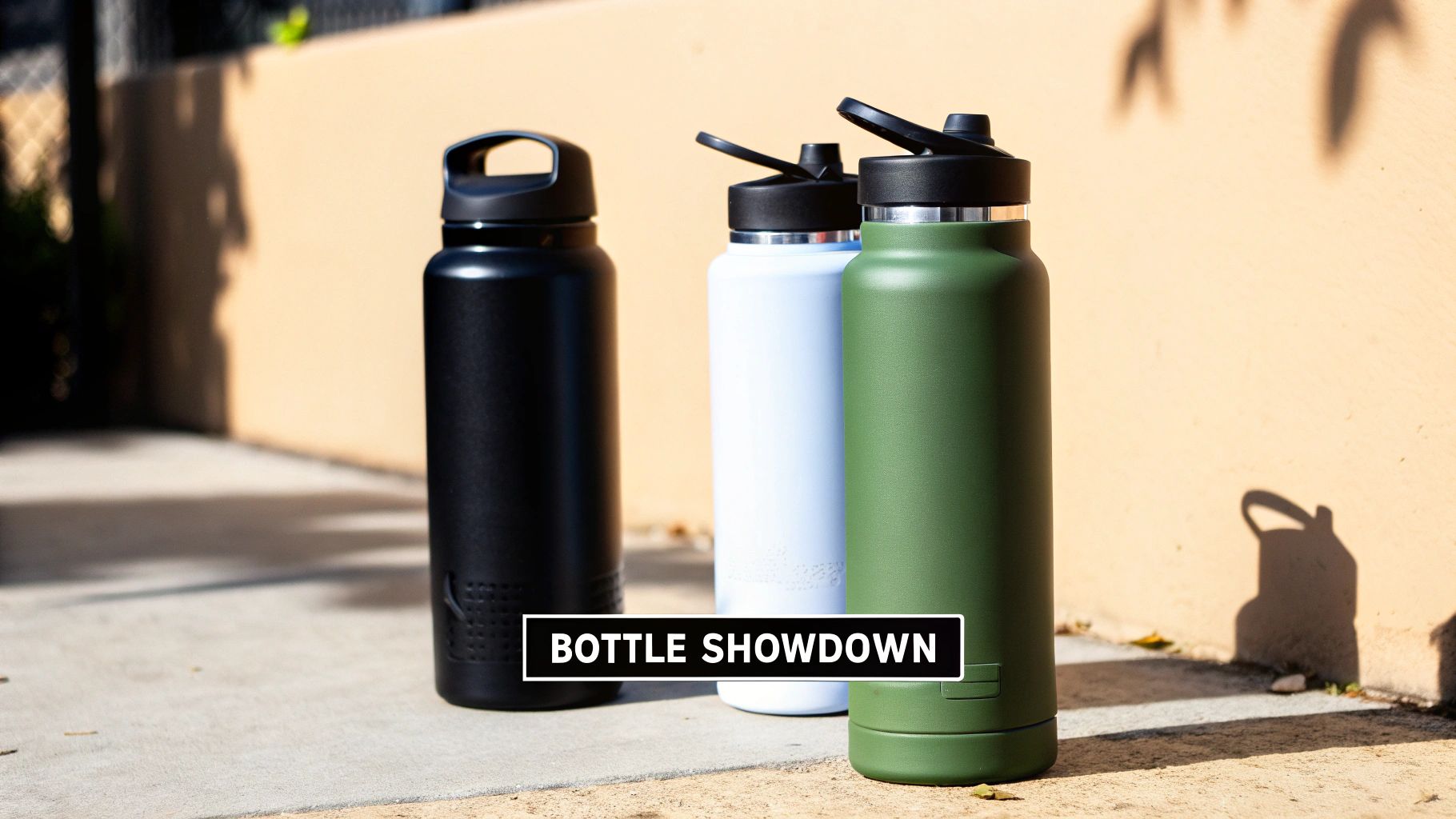
Picking the right insulated bottle isn’t about finding one "best" option for everyone. It's about figuring out which bottle’s strengths align with your daily grind. Instead of just rattling off a list of features, we’re pitting the top contenders against each other in real-world scenarios to see how they truly stack up.
This direct comparison will help you see past the brand hype and focus on what really matters. We'll look at how industry titans perform in different environments, from the rugged trail to the concrete jungle. Those subtle differences in design, materials, and lid systems can make or break your experience.
If you're navigating a daily commute, you need a bottle that’s sleek, totally reliable, and tough enough to get tossed in a bag with your laptop and keys. This is where the classic rivalry between Hydro Flask and YETI really shines, but with a focus on city life.
The Hydro Flask Wide Mouth has built its reputation on a clean, minimalist look and a vibrant powder-coat finish. It’s surprisingly lightweight for how well it insulates, making it an easy companion for long days out and about. Its slimmer profile also means it slides neatly into backpack pockets or a crowded tote.
On the flip side, the YETI Rambler is an absolute tank. It's built with thicker stainless steel walls that offer serious dent resistance—a huge plus if your bottle lives a rough-and-tumble life. It's a bit heavier, sure, but that over-engineered design gives you peace of mind that a simple drop won't wreck its vacuum seal.
Key Differentiator: The YETI Rambler is all about extreme durability, making it the go-to for anyone who’s hard on their gear. The Hydro Flask strikes a better balance, prioritizing a lighter weight and stylish design that’s perfect for those who value portability and aesthetics in an urban setting.
Let's be honest: the lid is the part you interact with most, and a bad one can ruin the whole experience. A leaky or awkward lid will send a bottle straight to the back of the cabinet. Here, we're comparing three completely different approaches to getting a drink.
The All-Rounder (Hydro Flask Flex Cap): This is your classic screw-on lid with a tough, flexible handle. It’s incredibly secure and 100% leak-proof, which is exactly what you want when it’s next to your laptop. The only downside is that it almost always requires two hands to open.
The One-Handed Wonder (Owala FreeSip): Owala’s patented lid is a game-changer for pure convenience. One push of a button flips open a protective cover, giving you the choice to sip through a built-in straw or swig from the larger opening. The fact that it locks shut makes it a fantastic choice for drivers or anyone juggling multiple tasks.
The Rugged Chugger (YETI Chug Cap): YETI's design is a smart two-part system. You get a wide-mouth opening for easy cleaning and adding ice, plus a smaller screw-off "Chug Cap" on top for a more controlled flow when you drink. It’s tough and secure, but like the Hydro Flask, you’ll need two hands to use it.
This focus on user-friendly design is driving huge market growth. For instance, the Asia-Pacific region is seeing explosive adoption, capturing 39% of worldwide sales in 2023. In China, urban sales alone jumped 15% year-over-year in 2024, fueled by a middle class of over 400 million people who are prioritizing health and wellness. You can dive deeper into the insulated water bottle market's regional growth for more data.
When you’re out hiking, camping, or spending a day at the beach, you need a bottle that keeps your water cold without weighing you down. This scenario calls for a specialized contender to go up against a mainstream favorite.
The Zojirushi Cool Bottle is an ultralight champion. Tipping the scales at just 9.3 ounces, it delivers fantastic insulation for its minimal weight, making it a backpacker’s dream come true. Its slim body and one-handed, spring-loaded lid are perfect for grabbing a quick drink on the trail. The only trade-offs are a smaller capacity and a more complex lid that takes longer to clean.
Then you have the Stanley Quencher H2.0, which has become a cultural icon for anyone needing massive capacity. Its 40-ounce size is way too heavy for a long hike, but it’s unbeatable for car camping, beach days, or all-day sporting events. Its ergonomic handle and a tapered base that actually fits in a cupholder make it the undisputed king of convenience when you're moving from your car to your destination.
The right choice here really depends on your style of adventure. If you're counting every ounce for a long trek, Zojirushi is the obvious winner. But if you just need to haul a ton of cold water for a group or a long day out, the Stanley is in a league of its own.
Let's simplify the decision by matching these bottles to common user profiles. Thinking about it this way helps translate specs and features into real-world benefits.
For the Style-Conscious Urbanite: The Hydro Flask is your pick. It wins on pure aesthetics and customization, with a huge range of colors and compatible lids. Its lighter build makes it the perfect accessory for the office, gym, or running errands around the city.
For the Hard-Wearing Professional: Go with the YETI Rambler. This bottle is for anyone whose gear is going to see some abuse. From construction sites to bumpy truck rides, its superior dent resistance means it’s built to last. Think of it as an investment in pure durability.
For the Master of Multitasking: The Owala FreeSip is a lifesaver. If you constantly need a free hand, this bottle is for you. Parents, commuters, and busy professionals will absolutely love the clever lid design that nails both convenience and security.
Let's be honest, the "best" insulated water bottle doesn't really exist. The perfect bottle for a hardcore hiker would be total overkill for someone working at a desk. The real secret is finding the bottle whose strengths perfectly match your daily routine.
We've put these bottles through the wringer, and now it's time to connect the dots. This is where we move past the raw temperature data and talk about what really matters: how a bottle performs in the real world. Whether you need something tough enough for the trail or sleek enough for your commute, we’ve got a recommendation that just plain works.
When you're miles from the nearest town, you need gear you can bet your life on. For hikers, campers, and anyone who gets their hands dirty outdoors, two things are non-negotiable: extreme durability and a 100% leak-proof lid. A dented bottle can lose its vacuum seal, and a leaky cap in a backpack is a day-ruining disaster.
This is where the YETI Rambler shines. Its construction is, frankly, over-engineered in the best way possible. The thick, 18/8 stainless steel walls shrugged off drops on rocky ground in our tests, showing far less damage than most competitors and, most importantly, protecting its insulation.
The Chug Cap is just as tough. It’s a brilliant two-part system that gives you a wide mouth for easily scooping ice from a cooler, but a smaller opening on top for drinking without splashing yourself on the move. Yes, it's a heavy bottle, but when reliability is paramount on a day hike or at a campsite, those extra few ounces are a trade-off worth making every time.
The daily grind has its own unique demands. You’re looking for a bottle that’s slim enough to slip into a crowded backpack, light enough to carry around all day, and easy to use one-handed while weaving through a busy station. Convenience and smart design are just as critical as keeping your drink cold.
For the commuter, our hands-down pick is the Owala FreeSip. The magic of this bottle is all in the lid. Its patented design lets you either sip upright through a built-in straw or tilt it back to swig from a wider opening—it's unbelievably practical. A simple push of a button flips the protective cover open, making one-handed use totally seamless.
The FreeSip also has a slick locking mechanism that doubles as a carry loop, giving you peace of mind that it won't pop open inside your laptop bag. While its insulation is top-notch, it’s these little user-friendly details that make it the clear winner for anyone navigating a hectic, on-the-go lifestyle.
A key takeaway from our testing is that lid design often dictates a bottle's ideal use case. A secure screw-top like YETI's is perfect for rugged transport, but the one-touch convenience of Owala's lid is unbeatable for quick, easy access during a hectic day.
Great performance shouldn’t have to cost a fortune. If you want fantastic insulation and a solid build without the sticker shock, the key is finding that sweet spot between price and features. Our testing proved that you don't always have to pay a premium for premium results.
The Takeya Actives bottle consistently delivers the best bang for your buck. In our tests, it kept water ice-cold for well over 24 hours, putting it right up there with the big-name brands. The powder-coat finish feels durable and grippy, and it even comes with a protective silicone bumper to ward off dings and silence that clanging sound when you set it down.
What really sets it apart at this price is the insulated spout lid. It offers a smooth, fast flow for quick hydration and, most impressively, it’s genuinely leak-proof—a common failure point on cheaper bottles. For a fraction of the cost of its rivals, you get the full package. It’s the smartest buy in the category.
Whether it’s a family road trip, a day at the soccer fields, or just trying to stay hydrated through a long workday, sometimes size is all that matters. But a great large-capacity bottle needs to be more than just big; it has to be easy to carry, pour, and clean.
The Stanley Quencher H2.0 became a viral hit for a reason: it nails these requirements perfectly. Available in massive 30 and 40-ounce sizes, its genius lies in the combination of a sturdy, ergonomic handle and a tapered base designed to fit in most car cupholders. This simple design choice makes lugging around a huge amount of water feel surprisingly manageable.
Its three-position lid adds another layer of versatility—you can use the included straw, drink directly from the opening, or close it to minimize splashes. While it isn't designed to be completely leak-proof if tipped over, its sheer practicality for car travel, picnics, and sideline hydration is unmatched. If you need to haul a ton of water without the hassle, the Quencher is in a league of its own.
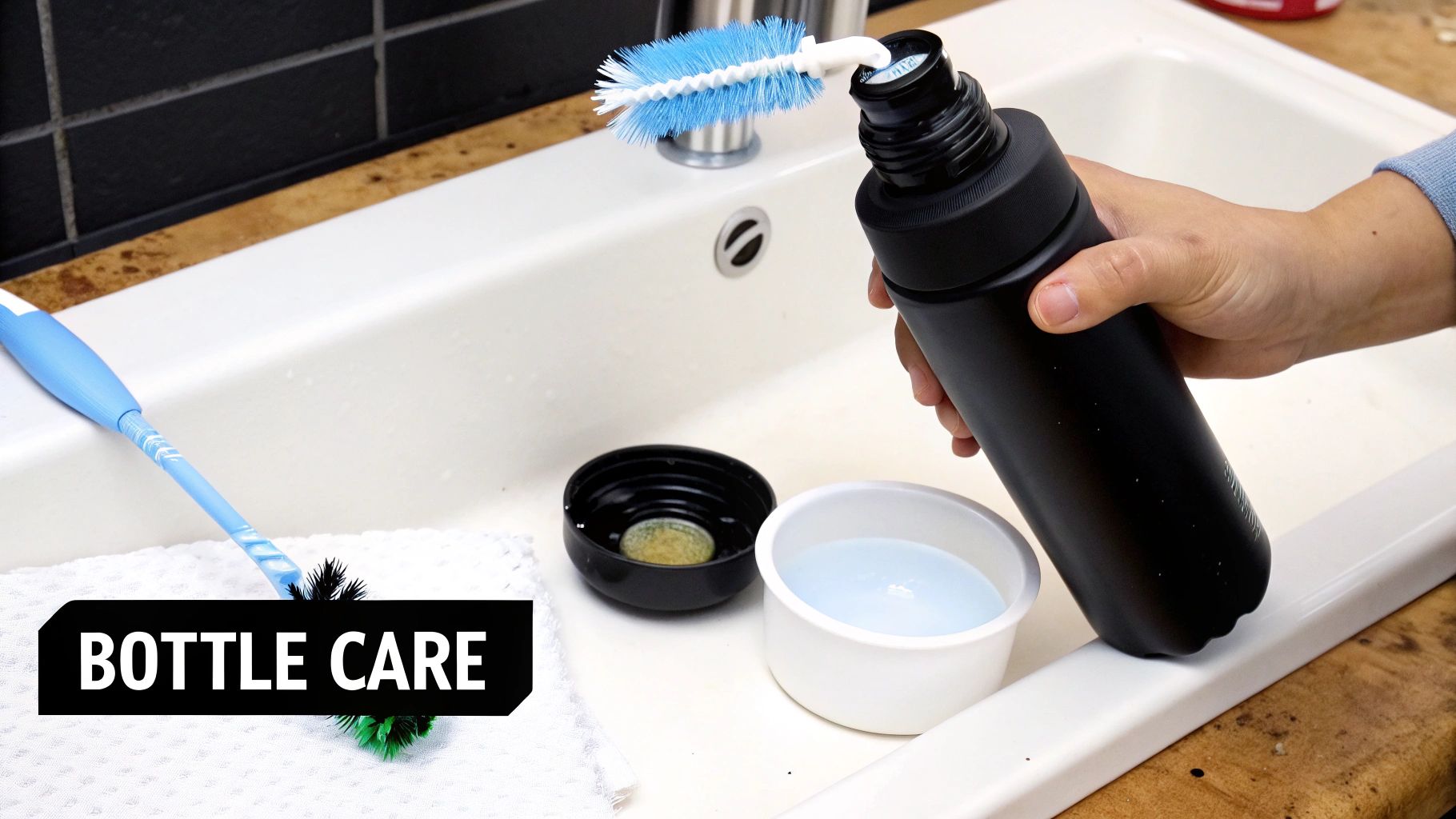
You've picked out a great insulated bottle, and with a little care, it can be your trusty sidekick for years. Just like any other quality gear, a bit of upkeep is the key to longevity. Proper cleaning doesn't just keep things fresh; it prevents nasty bacteria from building up and protects the vacuum seal that works so hard to keep your drinks hot or cold.
Thankfully, keeping your bottle in top shape is pretty straightforward.
The easiest way to stop grime and weird smells from ever starting is a quick daily rinse. This isn't a full-on deep clean, just a simple habit to prevent anything from sticking around.
At the end of the day, dump out whatever is left and give the bottle and lid a good rinse with warm, soapy water. Don't forget the lid and its little seals—that’s where gunk loves to hide. Let everything air dry completely overnight before putting it back together.
Pro Tip: Try not to let sugary drinks, milk, or coffee sit in your bottle for too long. The residue is a magnet for mold and bacteria, and the funky odors they create are a real pain to get rid of later.
Every few weeks, it's a good idea to give your bottle a more thorough cleaning. You'll also want to do this right away if you notice an odor that just won't quit. This deeper scrub gets rid of the buildup that a simple rinse can’t touch.
Your best friend for this job is a good bottle brush. It’s the only way to really scrub the inside walls and the very bottom. For the cleaning solution itself, you have a few great options that don't involve harsh chemicals:
No matter which method you use, be sure to rinse the bottle and all its parts thoroughly afterward to get rid of any lingering taste.
Even with the best care, you might run into a problem or two. Here's how to tackle them without wrecking your bottle.
Getting Rid of Stubborn Stains Coffee and tea have a knack for leaving behind brownish stains. To get them out, a long vinegar soak or an overnight session with a cleaning tablet usually does the trick. If you need it gone now, the baking soda paste is surprisingly effective.
Handling Minor Dents A small dent on the outside is usually just a battle scar. The important thing to check is that it hasn't punctured either the inner or outer wall. As long as it hasn't, the vacuum seal should be fine, and the bottle will keep insulating just as well as it did before.
What to Do If Your Bottle Loses Its Insulating Power If your hot drinks are suddenly lukewarm in an hour, it almost certainly means the vacuum seal is broken. This is usually caused by a major drop or a puncture. Unfortunately, a broken vacuum seal can’t be fixed. When that happens, it’s time to retire the bottle and look for a new one.
When you're shopping for an insulated bottle, a few questions always seem to pop up. How long will it really keep my water cold? Can I pour my morning coffee in it? What’s the best way to clean it? We get it.
Here are the straightforward answers to the most common questions we hear, based on our own experience and testing.
A good rule of thumb for a quality bottle with double-wall vacuum insulation is that it should keep your water cold for at least 24 hours. That’s the baseline.
Top-tier models can often double that, pushing cold retention out to 48 hours or even longer, especially if you give them a head start with some ice. Just remember that how you use it matters. Opening the lid constantly or leaving it in a hot car will naturally chip away at that time.
Yes, absolutely. Most of the best insulated bottles are built with 18/8 food-grade stainless steel for this very reason—it handles both hot and cold liquids safely and without leaching any flavors. Go ahead and fill it with coffee, tea, or hot chocolate.
On average, you can expect your bottle to keep drinks piping hot for about 6 to 12 hours.
It’s always a good idea to check the manufacturer's specific recommendations for your bottle. While the bottle itself is usually fine, some lids—especially complex straw or chug-style lids—might not be designed for steaming hot liquids.
Keeping your bottle fresh is crucial, and thankfully, it's pretty simple. A consistent cleaning routine prevents any weird smells or gunk from building up.
For a daily wash, all you need is warm water and a little dish soap. Give it a good rinse to make sure you get all the soap out.
For a deeper clean, especially if you’ve had coffee or a smoothie in there, you have a couple of great options:
Don't forget the lid! Gaskets and straw parts are prime spots for buildup. After washing, let every piece air dry completely before you put it all back together. This is the single best way to prevent that musty smell and keep your bottle ready for anything.
Discover the latest in hydration technology and more at FindTopTrends. Explore our curated selection of top-rated gear by visiting us at https://findtoptrends.com.




