


No products in the cart.


Free Shipping Australia-Wide

5 star customer service

Quality Tested Products

When you think of the best online shopping apps, big names like Amazon for its endless aisles, Etsy for handcrafted goods, and Newegg for tech gear probably come to mind. These platforms aren't just online stores; they've completely changed how we find and buy things, offering a blend of huge selections, smart recommendations, and app-only deals.
The way we shop has been turned on its head. It wasn’t that long ago that buying something online meant you were stuck at a desk, clicking through clunky websites with agonizingly slow checkout pages. Now, that whole process fits neatly into a slick, powerful app right in your pocket. This is more than just a simple upgrade—it's a total reinvention of our relationship with retail.
A great shopping app is like having a personal shopper who gets to know you. It learns your tastes, remembers your sizes, and even hunts down deals on the stuff you’re eyeing. This move to mobile isn't just a fleeting trend; it’s the main event in e-commerce today.
The stats don't lie. Mobile commerce is on track to make up 46% of all online sales in 2025, which translates to a mind-boggling $3.2 trillion worldwide. We're not talking about a small corner of the market—this is how most people now prefer to shop. In the U.S. alone, a whopping 70% of mobile shoppers would rather buy through an app than a mobile website. That tells you everything you need to know about where consumer loyalty lies.
This massive shift has set a new bar for what we expect in terms of convenience, forcing retailers to bring their A-game directly to our screens.
With a sea of apps to choose from, picking the right one is about more than just convenience. It’s about building a shopping environment that’s safer, smarter, and fits your life. The best online shopping apps deliver a few key things that websites just can't compete with:
This guide is your roadmap. We’ll walk through how to judge an app on these critical points, so you can find the perfect fit for the way you shop.
Ever wonder what makes you use one shopping app over and over again, while others get deleted after a single use? It’s not just about what they sell; it’s about the entire experience. Think of it this way: a basic car will get you from point A to point B, but a great one makes the journey comfortable, intuitive, and even fun with features like a great sound system or a responsive GPS. The best shopping apps do the same for your shopping.
To really pick an app that works for you, you need to know what to look for. It breaks down into two camps: the absolute must-haves that every solid app needs, and the next-level features that show an app is truly ahead of the curve.
These are the fundamentals. If an app fumbles on these, all the fancy bells and whistles in the world won't save it from being frustrating.
Think of these features as the engine of the app. Without a strong engine, you're not going anywhere.
The way we shop has changed dramatically, moving from brick-and-mortar stores to our desktops, and now, to the phones in our pockets. This evolution is all about making things more convenient and personal.
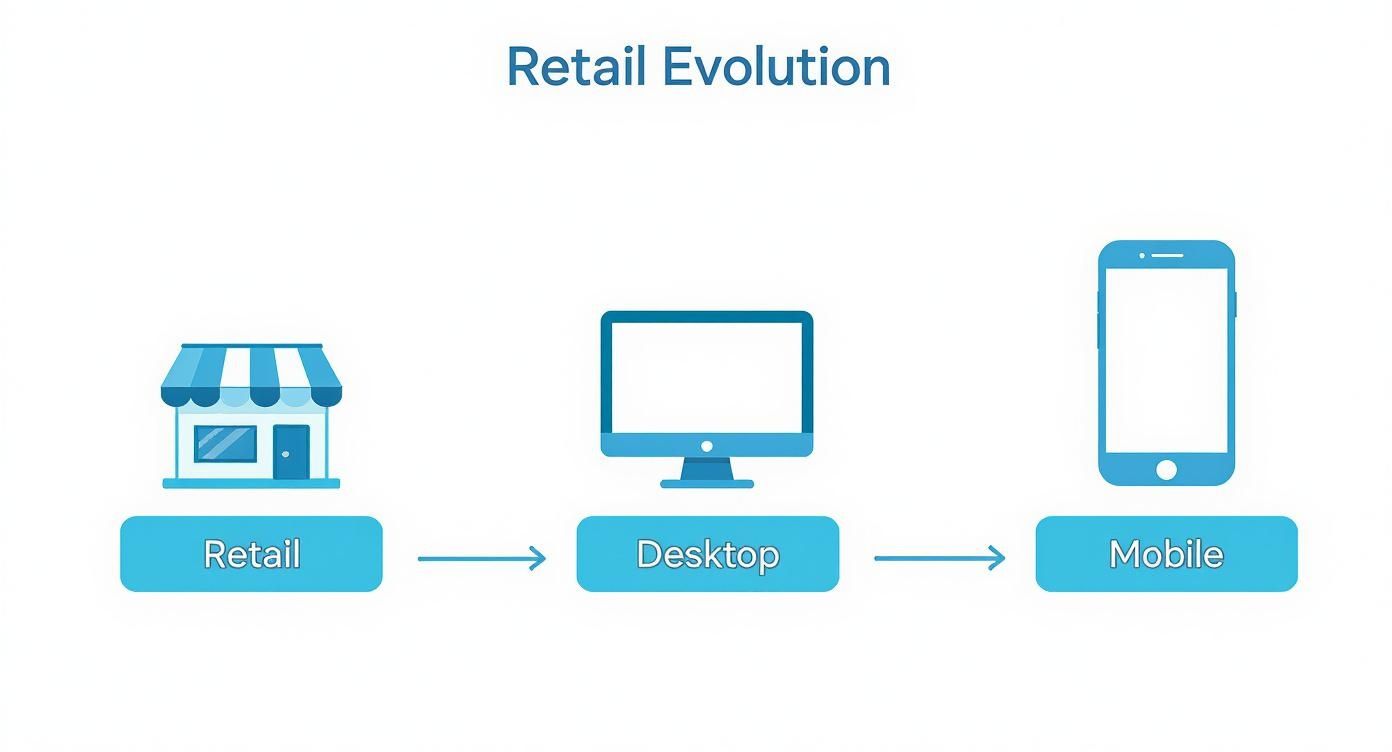
As this image shows, the mobile app is the final step in that journey, creating the most direct and powerful link between you and your favorite brands.
Once the basics are nailed down, this is where the truly great apps pull away from the pack. These aren’t just gimmicks; they’re smart tools that solve real-world shopping problems.
A perfect example is how apps use AI to personalize your feed. Instead of just showing you what's popular, the best apps look at what you’ve browsed, what you’ve bought, and what you’ve saved. They then create a "For You" section that feels like it was put together by a personal shopper who just gets you.
It's a powerful tool for retailers, too. One study found that 80% of shoppers are more likely to buy from brands that offer personalized experiences. This shows that smart recommendations are more than just a cool feature—they're central to how we shop now.
Augmented Reality (AR) is another huge leap. Ever been afraid to buy a couch online because you couldn't tell if it would fit in your living room? AR lets you use your phone's camera to "place" a true-to-scale 3D model of that couch right in your space. Suddenly, the biggest guesswork of online shopping is gone. Some fashion apps are even rolling out virtual dressing room technology to help you see how clothes might fit your body type.
To make it easier to see what's what, here’s a quick breakdown of the foundational features versus the more advanced ones that create a top-tier experience.
| Feature Category | Essential Feature | Advanced Feature Example | Why It Matters |
|---|---|---|---|
| Product Discovery | A good search bar with basic filters. | AI-powered "For You" recommendations. | Moves from you finding products to products finding you. |
| Product Visualization | High-resolution photos and videos. | AR "View in Your Room" or virtual try-on. | Bridges the gap between online and in-store confidence. |
| Checkout Process | Standard credit card/PayPal checkout. | One-click checkout with digital wallets. | Removes friction and saves precious time at checkout. |
| Customer Engagement | Simple email newsletters. | Push notifications for price drops and back-in-stock items. | Turns a passive wishlist into an active money-saving tool. |
This table helps illustrate how advanced features aren't just new toys; they are direct upgrades to the core shopping experience, making it faster, smarter, and more personal.
Finally, the best apps wrap everything up with features that make the entire process, from paying to waiting for your package, completely painless.
By understanding what to look for—from the must-have basics to the truly innovative extras—you can easily spot the apps that will make your shopping life better.
When you’re shopping online, trust is everything. The best apps offer incredible convenience, but they also handle your sensitive personal and financial details. That’s a huge responsibility, which makes security an absolute deal-breaker.
Think of an app's security like the lock on your front door. A cheap, flimsy lock might be easy to pop open, but it doesn't offer much peace of mind. A solid, modern deadbolt, on the other hand, protects what’s most important to you. The same logic applies to your digital wallet.
This guide will show you how to check that lock. We’ll skip the generic advice and give you actionable steps to make sure your data stays yours, so you can shop with confidence.
The first thing a new app does is ask for permissions. Have you ever stopped to wonder why a clothing retailer needs access to your microphone or contacts? It’s a great question to ask, and understanding these requests is your first line of defense.
Think of app permissions as keys to different rooms in your digital home. You wouldn’t hand a stranger the key to your bedroom, so why give an app access to data it has no business with?
Here’s a quick rundown of what common requests mean:
By simply paying attention to these requests, you stay in control of your personal information. If an app's demands seem way over the top for what it does, it’s probably a good idea to find a different one.
The checkout is where the magic—and the risk—happens. This is the most critical point of any transaction, and the best shopping apps protect it with rock-solid, secure payment gateways.
Typing your credit card details directly into every single app is like leaving a copy of your house key under every doormat on your block. It’s just not a great idea.
A far safer way to pay is by using a trusted, third-party payment system. These services act as a secure go-between, processing your payment without ever sharing your actual card details with the retailer. This massively cuts down the risk of your financial info being exposed if the retailer ever has a data breach.
By using a digital wallet or a trusted gateway, you’re essentially creating a firewall for your money. Instead of sharing your sensitive card number with dozens of different stores, you only entrust it to one highly secure service.
Keep an eye out for these options when you're ready to pay:
For a more detailed look at protecting yourself, check out this excellent guide on how to shop online safely. Sticking to apps that use these secure methods is a simple but powerful way to ensure worry-free shopping.
The best shopping apps are more than just digital catalogs; they’re packed with tools designed to help you save money. But just having an app on your phone won’t do the trick. To really see the benefits, you need to get strategic and make its features work for you.
It's all about flipping your mindset from a passive browser to a savvy shopper. With a few smart moves, you can turn every purchase into a win and make sure you’re never paying more than you have to.
Think of your wishlist as your savings command center. It’s not just a scrapbook of things you like; it’s a watchlist for items you want to snag at the right price. When you add something to your list, you're essentially telling the retailer, "I'm interested, but I'm waiting for a deal."
Retailers pay close attention to this. When it's time to clear out inventory or drum up sales, one of their first moves is to target users who have already shown interest. So, simply adding an item to your wishlist can be the trigger that gets a personalized discount sent straight to your inbox.
Beyond that, a well-managed wishlist helps curb impulse buying. It encourages patience and lets you wait for the perfect moment to make your move.
Patience is a virtue, but automating it is a superpower. The single most powerful tool for this is the price drop alert. This feature turns your app from a simple catalog into a 24/7 deal-hunting assistant.
Getting one set up is incredibly easy:
This simple tactic flips the script. Instead of you constantly checking for sales, the deals come to you. It's the ultimate low-effort, high-reward strategy for saving cash on the things you actually want.
If you want to become a pro at this, you can learn more about how to configure these notifications in our guide on price drop alerts. It’s a game-changer for anyone serious about saving money.
Getting an item on sale is good. But getting an item on sale, with a coupon, using your loyalty points? That’s where the real magic happens. This is called "deal stacking," and it’s what separates the casual shoppers from the pros. Think of it like building with LEGOs—each discount is a block, and stacking them creates something much bigger.
The best apps give you multiple ways to save, and your goal is to layer as many as you can onto a single purchase.
Here’s what a typical stacking workflow looks like:
Each layer you add shaves more off the final price. A 20% off sale item, plus a 10% off coupon, plus 2% cashback from your credit card adds up to a much bigger discount than any single one could offer. It takes a few extra seconds but can save you hundreds over the course of a year.
Let's get one thing straight: the idea of a single “best online shopping app” is a total myth. The right app for you is the one that just clicks with your personal habits, your budget, and what you’re trying to accomplish.
Think of it like picking a car. A two-seater sports car is a blast for a weekend getaway, but it’s completely useless for a family of five. That same family would love a minivan, but it’s overkill for a city commuter. Shopping apps are no different. The perfect app for a hardcore bargain hunter will feel like a cluttered mess to someone just looking for the latest fashion drops.
This personalized approach has never been more critical. The world of online retail is absolutely massive—global ecommerce sales are on track to hit somewhere between $6.42 to $7.4 trillion by 2025. Fashion ecommerce alone is ballooning into a $1.06 trillion industry. With that many options, you need the right tools to navigate the digital aisles effectively. You can find more fascinating numbers in this detailed report from Flowlu.
When you know your shopping style, you can cut through the noise and find the apps that feel like they were made just for you.
Do you get a genuine thrill from snagging the absolute lowest price? Is the idea of paying full retail almost offensive to you? If that’s you, then your phone should be loaded with an arsenal of discount-finding and price-slashing tools.
Your go-to weapon is an aggregator app. These platforms are brilliant—they pull product listings from thousands of retailers into one easy-to-use search. Instead of bouncing between a dozen different apps, you search once and see all your options laid out, usually sorted by price.
Secondhand marketplaces are also your playground. Apps focused on pre-owned goods are goldmines for finding designer clothes, electronics, and home goods at a massive discount.
If shopping for you is about discovery and expressing who you are, your apps should be a source of inspiration. You're not just buying a sweater; you're curating your personal brand. The best apps for you will be packed with editorial content, curated collections, and immersive visuals that spark new ideas.
Look for apps that feel more like a digital magazine than a simple store. Augmented reality (AR) features are huge here—the ability to "try on" a pair of sunglasses or see how a couch looks in your living room is a game-changer. It closes the gap between seeing something cool online and knowing it'll actually work for you.
Your shopping journey is about more than just transactions; it's about finding pieces that tell your story. The right app serves as your digital stylist, constantly introducing you to new possibilities that match your aesthetic.
For anyone still honing their personal look, it helps to start with the basics. Our guide on how to find your fashion style can help you build a solid foundation before you start chasing trends.
For you, time is money. The last thing you want is a clunky app that makes you jump through hoops. Your ideal shopping experience is fast, frictionless, and gets you from "I need this" to "order confirmed" in as few taps as possible.
The best apps for busy people have a super clean interface, a powerful search bar, and a checkout process that’s over in a flash. Features like one-click ordering, saved addresses, and integration with digital wallets like Apple Pay aren’t just nice to have—they’re essential.
You’ll probably gravitate toward the big, established retailers with rock-solid logistics. Apps that offer "buy online, pick up in-store" or give you predictable, fast shipping dates are your best friends. They take the guesswork out of the equation so you can get what you need and move on.
Your buying decisions are about more than price or style. They’re a statement about your commitment to sustainability and ethical practices. The best apps for you offer transparency and connect you with brands that align with your values.
Start by looking for apps that specialize in secondhand goods. Buying pre-owned is one of the most direct ways to shop more sustainably, and modern resale apps make the whole process incredibly easy and secure.
Beyond that, seek out platforms that specifically highlight brands committed to using sustainable materials, ethical sourcing, and fair labor. These apps do the research for you, giving you detailed info on a brand’s mission so you can make choices you feel truly good about.
Even with the best apps on your phone, you're bound to have a few questions. The world of online shopping is always changing, with new features, security worries, and money-saving tricks popping up all the time. It’s easy to feel a little overwhelmed.
Think of this section as your go-to guide for those nagging concerns. We’ll cut through the noise and give you clear, simple answers so you can shop with total confidence.
For anyone who shops more than once in a blue moon, the answer is a definite yes. A mobile website is fine for a quick, one-off purchase, but a dedicated app is built for a faster, smoother, and more personal experience that a browser just can't deliver.
Imagine a mobile website as a translated version of the desktop site—it gets the job done, but it’s not speaking its native language. An app, on the other hand, is designed from the ground up for your phone. That means faster loading, menus that make sense on a small screen, and way less frustrating pinching and zooming.
But the real magic is in the features you only get with an app:
Bottom line? For convenience, speed, and real savings, a good app wins every time.
Knowing how to protect yourself from shady apps is a must, and thankfully, a few quick checks can save you a lot of trouble. The single most important rule is to stick to official sources—the Apple App Store for iPhones and the Google Play Store for Android. These marketplaces do a pretty good job of filtering out the bad stuff before it ever gets to you.
Before you tap that download button, put on your detective hat for a minute. Look for these tell-tale signs of a legitimate app:
Trust your gut. If something about an app feels off—the logo looks weird, the description is full of typos—it probably is. Taking an extra 30 seconds to check these details can save you from a major headache down the road.
App notifications can be your best friend or your worst enemy. Used wisely, they're a fantastic tool for snagging deals. But if you're not careful, they'll just become a constant buzz of digital noise. The trick is to be the boss of your settings.
Never just accept the default notification permissions. Go into each app's settings menu and customize them to work for you. Your goal is to kill the marketing spam and only let the truly valuable alerts through.
Here’s a smart way to set it up:
This little bit of fine-tuning ensures your phone only buzzes with news you actually care about, keeping you in the loop without driving you crazy.
Without a doubt. In fact, it’s one of the biggest reasons to bother with an app in the first place. Brands see their app users as their most dedicated customers, and they go out of their way to keep you happy.
Think about it: they offer "app-only" deals and early access to big sales events as a core part of their strategy. It’s their way of giving you a compelling reason to download their app and keep it on your home screen. This means that by choosing to shop through the app, you’re often unlocking the absolute best prices and rewards that a company has to offer. For any serious bargain hunter, it's a no-brainer.
Ready to discover the latest must-have products without the hassle of endless searching? At FindTopTrends, we curate the best deals on everything from tech gadgets and home essentials to fashion and travel gear, all in one convenient place. Start exploring trending products on FindTopTrends and shop smarter today.




