


No products in the cart.


Free Shipping Australia-Wide

5 star customer service

Quality Tested Products

The "best" river kayak isn't a single boat—it's the one that feels right for you. It all comes down to your paddling style, where you plan to go, and how much experience you have under your belt.
For most people just getting started or those who want one boat for everything, a versatile River Runner is tough to beat. They strike a great balance between being stable enough to feel secure but nimble enough to have fun. If you’re a seasoned paddler, you might lean toward a nimble Playboat for surfing waves or a beefy Creek Boat for tackling steep, technical rapids.
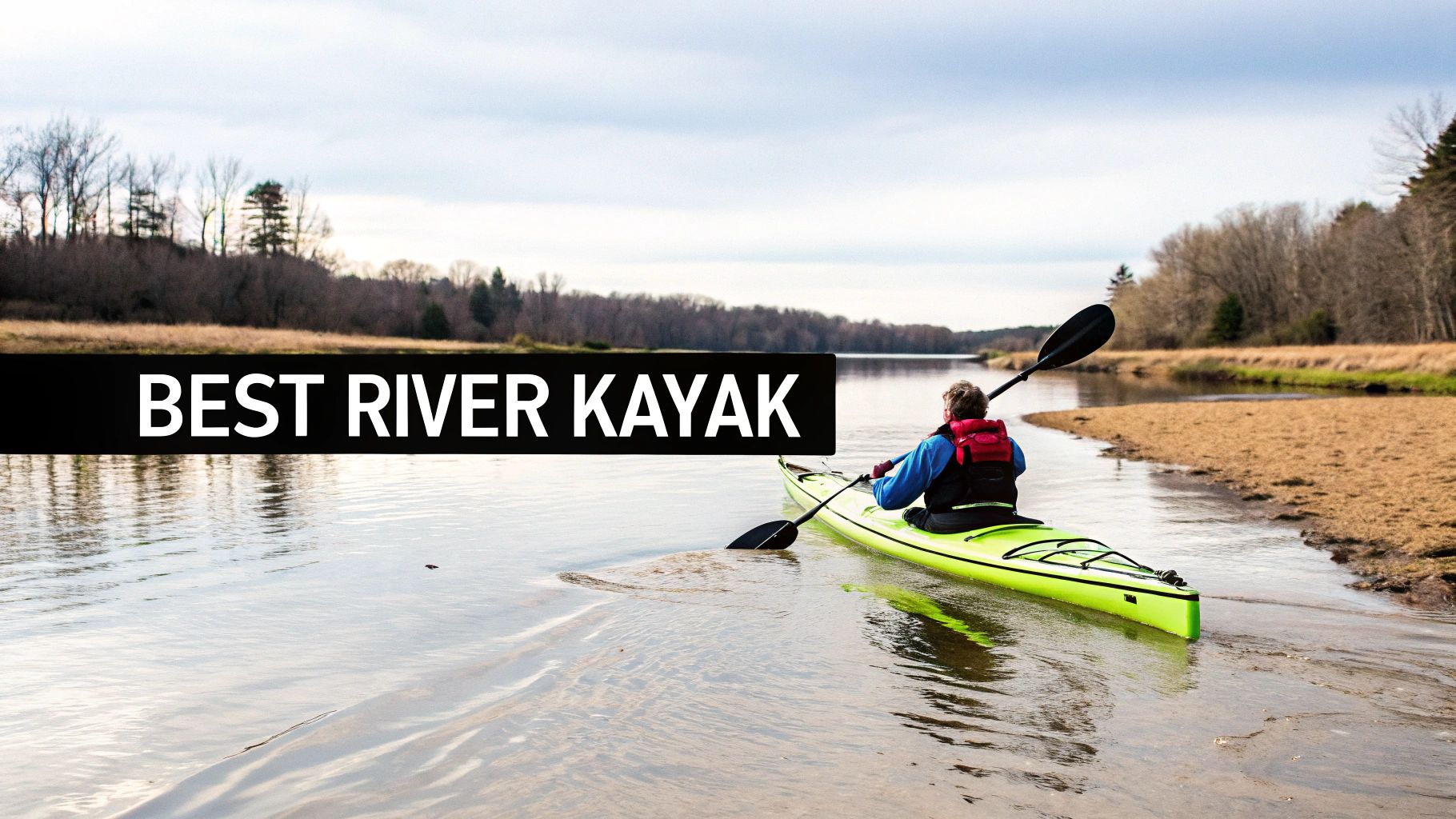
There’s nothing quite like the feeling of gliding down a river, reading the currents, and soaking in the scenery. It’s an incredible experience. But let’s be honest, walking into a gear shop or browsing online can feel as overwhelming as staring down your first Class IV rapid. This guide is here to clear the fog and help you choose a kayak with confidence. The goal is to find a boat that feels like it was made just for you.
And you're not alone in wanting to get out on the water. Kayaking is booming. The global market was valued at around USD 736.8 million in 2023 and is expected to sail past USD 1 billion by 2032, thanks to a huge spike in adventure tourism. For a deeper dive, you can explore the full kayak market growth projections on Dataintelo.com.
This guide is designed to give you the practical knowledge you need. We're not just going to throw a list of products at you. Instead, we'll equip you to make a smart decision that fits your adventure plans and your wallet.
Here’s what we’ll cover:
If you take one thing away, let it be this: The 'best' kayak is the one that gets you on the water safely and often. It should be a boat that helps you build confidence, not one that holds you back or pushes you into situations you aren't ready for. Our job is to help you find that perfect match.
Choosing a river kayak is a lot like picking the right tool for a job. You wouldn't use a sledgehammer for fine art, and you wouldn't bring a tiny paintbrush to a demolition site. River kayaks are specialized tools, and each one is engineered for a specific kind of water and paddling style. Getting a handle on the three main categories is the most important first step you can take.
Think of them as different kinds of off-road vehicles. Some are built for nimble, high-speed fun, others are like armored crawlers for the toughest terrain, and a third type is the dependable all-rounder. Let's break down which is which so you can find the perfect match for your river adventures.
Picture a nimble trick bike or a skateboard built for a half-pipe—that’s the soul of a playboat. These are the shortest and most squirrely kayaks out there, usually measuring just 5 to 7 feet long. Their purpose isn't about getting from point A to point B; it’s about having a blast on every wave and in every current feature along the way.
Playboats have a very distinct planing hull, which is flat on the bottom like a surfboard. This lets the boat skim and surf on top of the water, making it perfect for spinning, carving on waves, and pulling off aerial tricks. They also have low volume (the amount of space inside), which makes them easier to sink on purpose for freestyle moves like cartwheels.
If a playboat is a trick bike, the creek boat is the armored, rock-crawling Jeep of the kayaking world. These boats are built with one mission in mind: to get you down steep, technical, and dangerous whitewater safely. They're designed to keep you on top of the water and in control when things get serious.
Creek boats are defined by their high volume and lots of rocker (the upward curve from the front to the back). This distinct banana shape helps the boat pop up and over obstacles like rocks and huge waves instead of getting stuck. They have a rounded displacement hull that's more forgiving and less likely to get tripped up on rocks. They’re also built tougher, with thicker plastic and internal safety pillars to handle serious impacts.
Creek boats put safety and predictability first. Their entire design is about resurfacing quickly after a drop, turning when you need to in chaotic water, and protecting you from the harsh reality of difficult rapids.
These features make them the clear choice for tackling Class IV and V rivers, which are often full of waterfalls, tight slots, and unavoidable hazards. While they are incredibly stable and confidence-inspiring, they can feel a bit sluggish and unresponsive on easier water.
Meet the all-terrain SUV of river kayaks: the river runner. This boat hits the sweet spot right between the playful agility of a playboat and the bombproof stability of a creek boat. For most paddlers, this category offers the best of both worlds, making it an ideal first river kayak or a do-it-all boat for your collection.
River runners are longer than playboats but shorter than creek boats, typically falling in the 7 to 9-foot range. This middle-ground length helps them track straight on flat sections but keeps them nimble enough to dance through challenging rapids. They often blend features from the other two types, sporting a semi-planing hull and a moderate amount of rocker.
This jack-of-all-trades design makes them fantastic for a huge range of conditions, from scenic Class II floats to demanding Class III and even some Class IV rapids. You can still surf smaller waves and run tough lines, but you can also cover some distance without fighting the boat the whole time.
As technology improves, many new designs are blurring these lines even further. To see how modern materials are changing the game, it's worth exploring the differences in Aerowave kayaks versus traditional models, as these can offer major upgrades in performance and durability. Ultimately, a river runner is a fun, reliable, and predictable craft for almost any day-to-day river adventure.
Choosing the right river kayak is about so much more than picking a cool color. It’s about making a smart match between your boat, your current abilities, and the kind of water you actually plan to paddle.
Think of it like hiking. You wouldn't wear flip-flops to climb a mountain, right? And you wouldn’t lug heavy mountaineering boots on a casual park stroll. The exact same logic applies to kayaking on a river.
Putting the wrong boat on the wrong water can quickly turn a fun day into a frustrating—or even dangerous—one. A short, squirrely playboat will feel exhausting on a long, flat section because it just wants to spin. On the flip side, a big, stable creek boat won't have the agility for tight, technical rapids. You'll feel like you're trying to park a bus in a compact spot. The key is being honest about where you'll paddle most.
Paddlers have a universal language to describe a river's challenge and risk: the International Scale of River Difficulty. This system, which runs from Class I to Class VI, is the first thing you need to understand to pick the right kayak.
A crucial part of this journey is recognizing that your skill level and the river's difficulty are directly linked. The goal is to choose a boat that helps you progress safely and confidently, not one that pushes you into situations beyond your current capabilities.
Once you have a good handle on river classes and are realistic about your skill level, you can start mapping the different kayak types to the water.
This decision tree gives you a great visual for how to match a boat to your main paddling goal, whether that’s learning tricks, running rapids, or just enjoying the river.
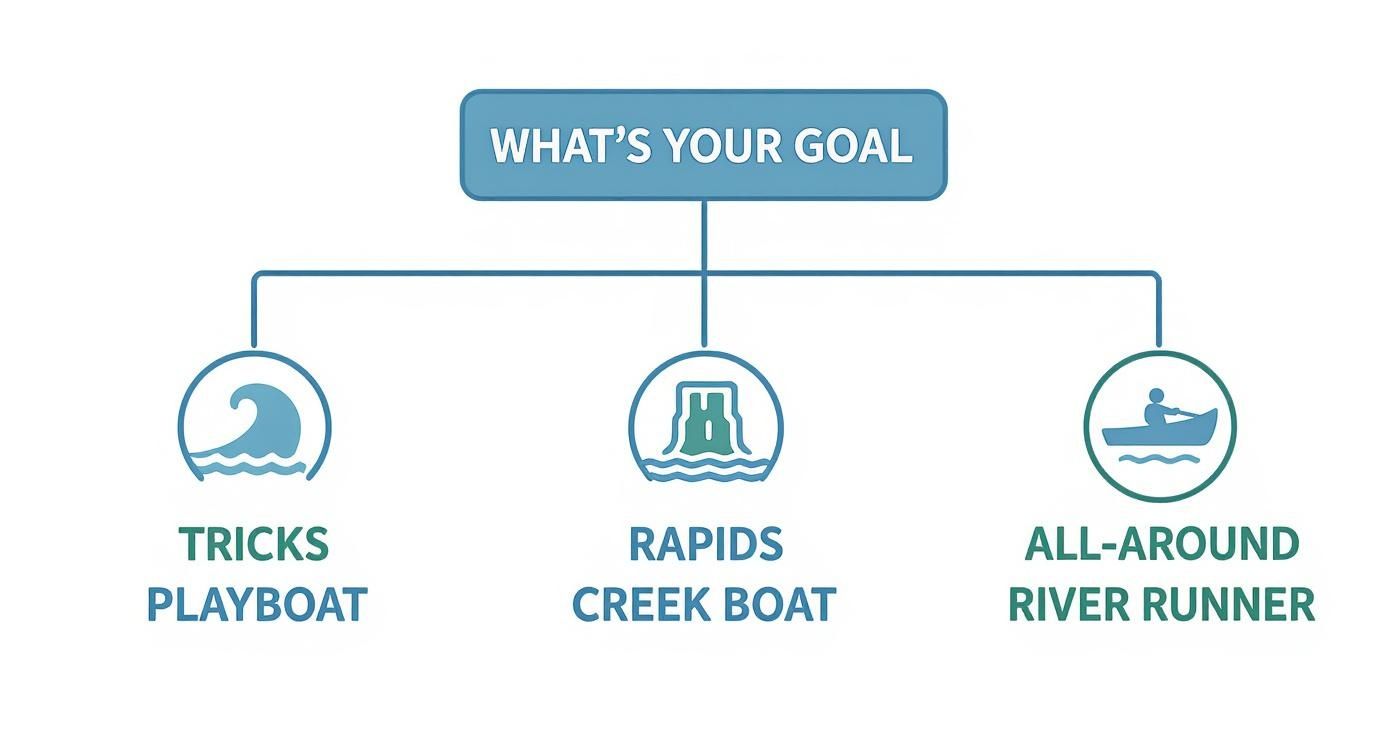
As you can see, what you want to do on the water—be it playful surfing or serious descents—should be the main driver in your decision.
A River Runner is your go-to for Class II-III and some of the easier Class IV water. Its versatile design is stable enough for a beginner to feel confident but has the performance an intermediate paddler needs for fun, splashy rapids.
A Playboat really shines on specific features within Class II-IV rivers. You wouldn’t paddle it for miles downriver, but you’d take it to a great surf wave or a "play park" to work on tricks.
A Creek Boat is the specialized tool for tough Class IV-V whitewater. Its high volume and extra safety features are built to handle steep, technical, and high-consequence rapids where you absolutely need a predictable ride.
As you plan your adventures, always remember that river conditions can change in a heartbeat. Knowing how to read the water is vital, but so is knowing how to read a map. For bigger trips, you might find our guide on how to use a map and compass useful. Getting out on the water is part of a huge trend—the water sports market was valued at over $58.5 billion in 2025, with massive growth in North America. Finding the best river kayak for you is all about creating a safe, fun, and lasting hobby.
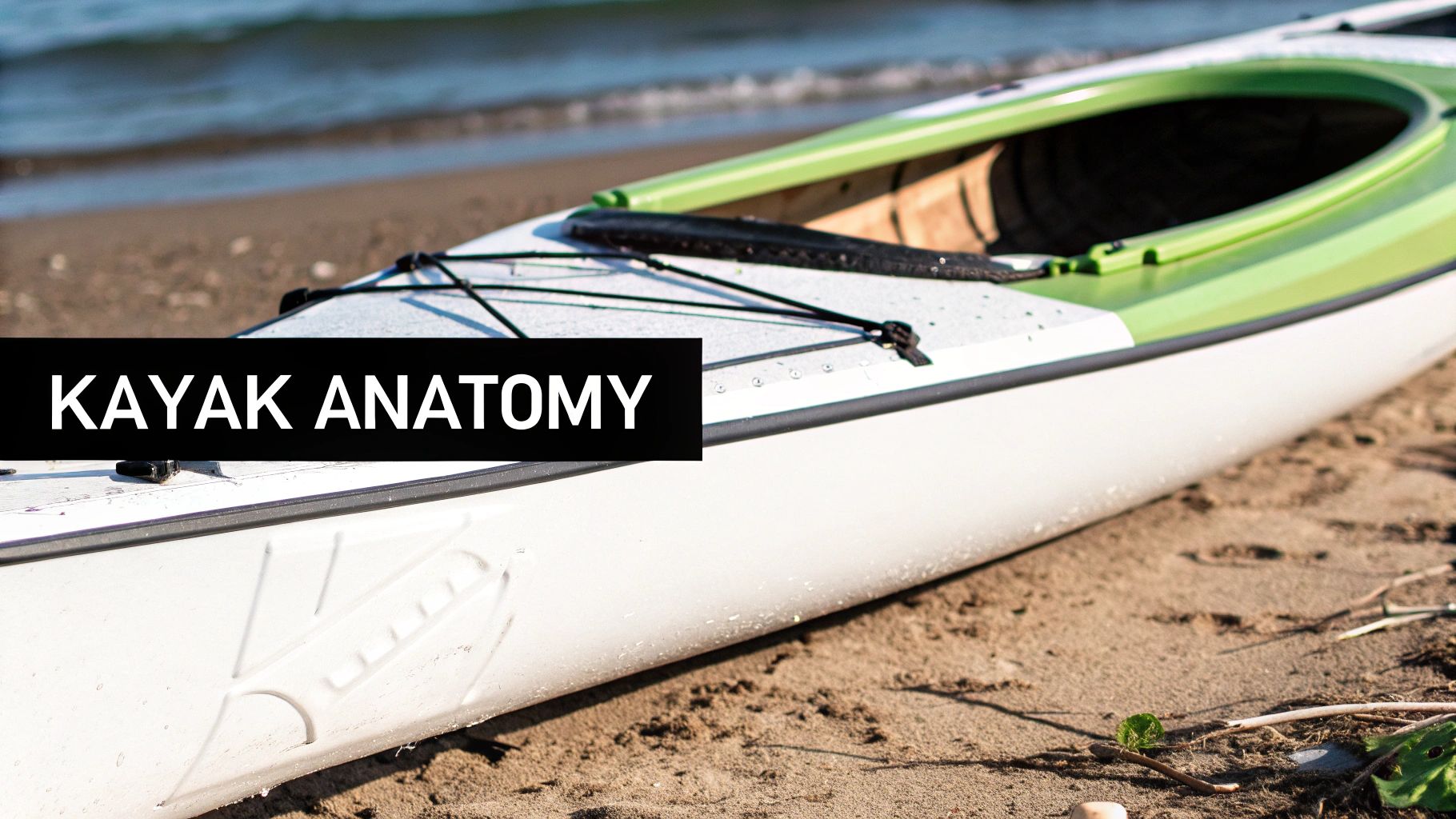
When you first start looking at river kayaks, the spec sheets can feel like they're written in a different language. Terms like "rocker," "chine," and "planing hull" get thrown around, and it's easy to feel a bit lost. But here's the secret: understanding these core design elements is how you learn to predict exactly how a boat will feel before you ever dip a paddle in the water.
This section is your translator. We're going to ditch the dry technical talk and use some simple analogies to explain what all those curves and edges really mean for your day on the river.
The hull is simply the bottom of the boat, but its shape is the single most important thing that defines how it performs. You'll mainly run into two types: displacement and planing hulls.
A displacement hull is rounded, kind of like the bottom of a canoe. It's designed to slice through the water smoothly and efficiently. This rounded shape makes the kayak very predictable and helps it deflect off rocks instead of getting pinned, which is why it's the go-to for forgiving creek boats.
On the flip side, a planing hull is flat, like a surfboard. This shape is all about skimming on top of the water when you get some speed up. This lets you surf waves and pull off slick spinning moves, making it the heart and soul of every playboat. Many all-around river runners use a hybrid design to get a bit of both worlds.
Think of the hull as the boat's personality. A rounded displacement hull is the steady, reliable friend, while a flat planing hull is the energetic, playful one. The right choice just depends on what kind of adventure you're after.
Look at a river kayak from the side. See how it isn't perfectly flat? That upward curve from the middle of the boat toward the front (bow) and back (stern) is called rocker. The easiest way to picture it is to think of a banana—some are nearly straight, while others have a serious curve.
A kayak with a lot of rocker (a big banana curve) is built to ride up and over waves. This makes it incredibly nimble and helps it pop back to the surface after plunging over a drop, a must-have feature for steep creeking.
In contrast, a kayak with less rocker has a flatter profile. This keeps more of the boat in the water, helping it track in a straight line and build speed. It's a great setup for paddling longer distances on gentler sections of water, which is why you see a more moderate rocker on river runners.
The line where the bottom of the hull meets the sides is called the chine. This edge has a huge impact on how the boat carves and turns.
Volume, measured in gallons or liters, is just the total amount of space inside the kayak. High-volume boats are more buoyant and ride higher in the water, which is crucial for staying on the surface in big rapids. Low-volume boats, on the other hand, are easier to get underwater for freestyle tricks. You’ll want to pick a volume that matches your body weight so the kayak performs as intended.
Finally, there’s outfitting. This is everything inside the boat that connects you to it: the seat, backband, hip pads, and foot braces. A good, snug fit isn't just about being comfortable—it's about control. When you're properly outfitted, your kayak becomes an extension of your body, responding instantly to every little shift of your hips.
All these specs can seem a bit abstract, so let's put them together. This table breaks down what each measurement means for you out on the water.
| Specification | What It Measures | How It Affects Performance |
|---|---|---|
| Length | Total length from bow to stern | Longer: Faster, tracks straighter. Shorter: More maneuverable, easier to turn. |
| Width | The widest point of the kayak | Wider: More stable initially. Narrower: Faster, easier to roll. |
| Volume | Total interior space (in gallons/liters) | High Volume: More buoyant, stays on the surface. Low Volume: Slices through water, easier for tricks. |
| Rocker | The "banana curve" of the hull | More Rocker: Excellent maneuverability, rides over waves. Less Rocker: Better tracking and speed. |
| Hull Shape | The profile of the bottom of the boat | Planing (Flat): Surfs well, agile. Displacement (Round): Stable, predictable, forgiving. |
| Chine | The shape of the edges | Hard (Sharp): Aggressive carving, precise turns. Soft (Round): Forgiving, smooth turns. |
Ultimately, a great boat with bad outfitting will always feel sloppy and unresponsive. Finding that perfect connection between you and your kayak is the final piece of the puzzle.
Let's talk money. Figuring out your budget is a huge step toward getting the right river kayak, and the great news is, you've got options. Getting into kayaking has never been more accessible, but the trick is knowing what your money gets you and planning for the total cost, not just the boat.
The world of canoeing and kayaking is massive—it’s a global market valued at around $755.9 million in 2025 and growing. With an estimated 10 million units sold each year, the variety is staggering. You can dig into more of these numbers with insights from Archive Market Research if you're curious. For us, that variety means there’s a perfect boat out there for your budget.
I find it easiest to think about kayak prices in three main buckets. As you move up, you're generally paying for better materials, smarter performance-focused designs, and more comfortable, adjustable outfitting.
Remember, the kayak is just the start. To be safe and have fun, you need a few other critical pieces of gear. Factoring these in from the beginning saves you from sticker shock later.
Your budget shouldn't just cover the boat; it must include the non-negotiable safety equipment. Think of it like buying a car—the price of admission includes insurance and fuel. For kayaking, your PFD and helmet are your insurance policy.
Here's the essential gear you absolutely need to add to your budget:
It's just like getting ready for a big hike—you wouldn't leave without the right gear. For more tips on trip prep, our backpacking essentials list has some great pointers that apply here, too. And don't forget the used market! It's an awesome way to find high-quality gear for a fraction of the retail price, especially when you're just getting started.
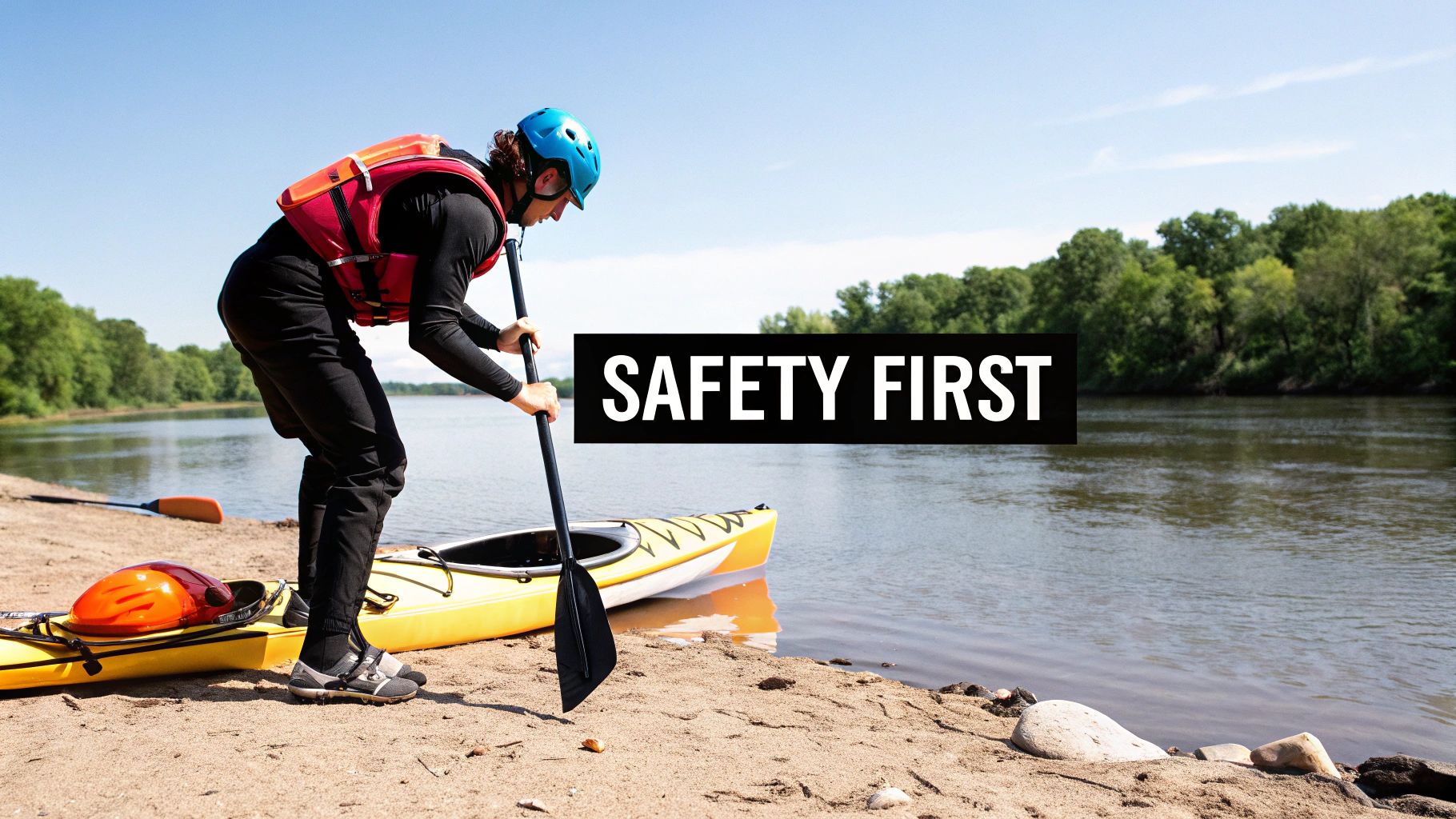
Finding the perfect river kayak is a great first step, but it’s really just the beginning of the adventure. To make sure you and your boat have a long, happy life together on the water, you need to think about smart habits both on and off the river.
It’s about more than just paddling—it's about taking care of your gear and, more importantly, yourself. A little upkeep goes a long way, ensuring your kayak is ready to go whenever you are.
You don't need a professional workshop to keep your kayak in top shape. A few simple habits will protect it from its two biggest enemies: damage from rocks on the river and damage from the sun and poor storage at home.
Here’s a quick checklist to keep your boat in prime condition:
A well-maintained boat is great, but the most important piece of safety gear is the person holding the paddle. The best river kayak in the world won't keep you safe if you don't respect the river and paddle within your limits.
One of the absolute golden rules of whitewater is to never paddle alone. Always go with at least one other person. Having a buddy on the water can turn a potentially dangerous situation into a simple, manageable inconvenience.
River safety isn't just about wearing a helmet. It's about knowing how to read the water, recognizing hazards before you're on top of them, and having a plan for when things go wrong.
Rivers are powerful, constantly changing environments. Knowing what to look for is the first step in staying out of trouble.
The single best way to prepare for these challenges is to take a swiftwater rescue course. Nothing beats hands-on training for real-world scenarios. For a deeper dive into essential gear, check out these resources on kayak safety equipment. Finally, always be ready for the small stuff by packing a solid first-aid kit; our guide to building a Wilderness First Aid Kit is a great place to start.
Jumping into the world of river kayaks can feel like navigating Class IV rapids for the first time—a little intimidating. It’s totally normal to have questions. Let's clear up a few of the most common ones we hear from paddlers so you can feel solid about your choice.
So, what's the real difference between a river kayak and a sea kayak? The easiest way to think about it is like a mountain bike versus a road bike.
A river kayak is your mountain bike: short, wide, and built to turn on a dime. It's designed to dodge rocks, play in currents, and handle the chaotic energy of a river.
A sea kayak, on the other hand, is the road bike of the paddling world. It's long, sleek, and made for tracking in a straight line across vast, open water. Taking a sea kayak down a twisty, technical river would be like trying to ride a skinny-tired racing bike down a rocky mountain trail—you're just using the wrong tool for the job.
When you're paddling on a river with any kind of current or rapids, a sit-inside kayak is almost always the way to go. The ability to add a spray skirt is huge. It locks you in and keeps water out when you punch through waves, which is critical for staying stable and dry.
A sit-inside design also connects you to the boat. You can use your knees and hips against the cockpit's interior to really drive the kayak, making it feel like an extension of your own body. It just responds better. Sit-on-tops are fine for a lazy float on a calm, warm day (think Class I water), but they don’t have the performance or safety you need for anything more demanding.
Your weight is a really big deal. Every single kayak has a manufacturer-recommended weight capacity, and you need to pay close attention to it for the boat to work properly. If you're too light, you won't sink the boat enough into the water to use its edges for carving and turning.
If you're too heavy for a kayak, it will ride too low, feel tippy as heck, and handle like a barge. It becomes sluggish, hard to maneuver, and much more likely to get swamped. The sweet spot is to be comfortably in the middle of the suggested weight range.
They definitely can be! Inflatable kayaks have improved massively over the years, but you have to get the right kind. The good ones, made from super-tough materials like drop-stitch PVC (the same tech used in high-end inflatable paddleboards), are incredibly rigid and can absolutely handle Class II and even some Class III whitewater.
Just be careful to avoid the cheap, pool-toy versions. They’re great for storage and transport, but they just won't hold up to rocks, sticks, and the general abuse of a real river. For someone tight on space who plans to stick to easier whitewater, a quality inflatable can be a perfect ticket to the sport.
At FindTopTrends, we hand-pick the best gear to get you out on your next adventure. Check out our collection of outdoor essentials and gear up for the river. Shop now at FindTopTrends.




