


No products in the cart.


Free Shipping Australia-Wide

5 star customer service

Quality Tested Products

A bike frame size chart is your secret weapon for matching your body—specifically your height and inseam—to the right bike. Getting this right is the single most important step you can take to guarantee a ride that’s comfortable, efficient, and, most importantly, safe. It's the foundation of every good cycling experience.
Think of it like buying a suit. You could grab one off the rack, or you could get one tailored to fit you perfectly. A bike frame is no different. The right one is built for your body, while the wrong one forces you into awkward, unnatural positions. An incorrect size is simply a recipe for a miserable ride.
It’s the source of those nagging aches and pains—that persistent neck ache, the numb hands from leaning too far forward, or the dull throb in your lower back. But it's not just about comfort. Your performance takes a direct hit. A frame that's too big will feel sluggish and hard to handle on corners, while one that's too small will feel twitchy and cramped, robbing you of power with every pedal stroke.
Ignoring a proper bike frame size chart can lead to more than just a few sore muscles. The numbers don't lie. Studies have shown that roughly 20-30% of cycling-related injuries can be traced back to an improper bike fit, which almost always starts with the wrong frame size.
It's no surprise, then, that up to 60% of cyclists now rely on a combination of frame size charts and professional fitting services to feel and perform their best. If you're looking to dive deeper, you can explore the data in this detailed report on bicycle frames.
This guide is here to cut through the noise with clear charts and straightforward measurement steps. While frame size is critical, it's also part of a bigger picture. For example, if you're shopping for an e-bike, you'll also want to understand things like motors and batteries, which you can learn about in this guide on how to choose an electric bike.
Getting the frame size right from the start saves you from discomfort, potential injury, and the costly mistake of buying the wrong bike. It’s the difference between a bike that gathers dust and one that becomes a trusted companion for adventure.
We're going to demystify the numbers and jargon, turning you from a hesitant buyer into a confident cyclist who knows exactly what they need.
Alright, this is where the rubber meets the road—the hard data you need to pick your next bike with confidence. I’ve broken it all down into three simple, easy-to-scan charts for the most common bike types: road, mountain, and hybrid.
Each chart lines up your height and inseam with the frame sizes you’ll see on manufacturer websites and in bike shops. You'll find both imperial (feet/inches) and metric (centimeters) measurements, plus the standard Small, Medium, and Large (S/M/L) labels.
It's important to understand why these charts are different. Road bike sizing is all about precision and aerodynamics, so sizes are almost always listed in centimeters. Mountain bikes, on the other hand, are built for maneuverability, so a simpler S/M/L system makes more sense.
Think of these charts as your reliable starting point. They give you a solid recommendation right away, which we'll fine-tune later when we get into taking your own measurements. Getting the right fit is crucial for any athletic gear. For example, runners also rely heavily on charts and precise measurements, as shown in this an ultimate sizing guide for finding your perfect fit.
With road bikes, sizing is a delicate balance between aerodynamic performance and long-ride comfort. The centimeter-based sizing isn't just for show; a tiny difference in frame size can dramatically change your posture and how efficiently you pedal.
If the frame is too big, you’ll feel stretched out, which often leads to back and neck pain. Go too small, and you’ll feel cramped, which kills your power output. This is why getting it right matters so much.
Common road bike sizes typically run from 48 cm to 62 cm. To put that in perspective, a rider with a 32-inch inseam would likely be pointed toward a 56 cm road frame. This standard of correlating height and inseam with a specific frame size is common across North America and Europe.
Use this chart to find where you land.
Road Bike Frame Size Chart
| Rider Height (ft/in & cm) | Inseam (in & cm) | Frame Size (cm) | Generic Size |
|---|---|---|---|
| 4'10" – 5'3" (148-160 cm) | 27"-29" (69-74 cm) | 47-50 cm | Extra Small (XS) |
| 5'3" – 5'6" (160-168 cm) | 29"-31" (74-79 cm) | 51-53 cm | Small (S) |
| 5'6" – 5'9" (168-175 cm) | 31"-32" (79-82 cm) | 54-55 cm | Medium (M) |
| 5'9" – 6'0" (175-183 cm) | 32"-34" (82-86 cm) | 56-58 cm | Large (L) |
| 6'0" – 6'3" (183-191 cm) | 34"-35" (86-90 cm) | 58-60 cm | Extra Large (XL) |
| 6'3" – 6'6" (191-198 cm) | 35"-37" (90-94 cm) | 61-63 cm | XX-Large (XXL) |
This table gives you an excellent baseline. Remember, it's a guide—your personal comfort is always the final deciding factor.
When it comes to mountain biking, the sizing philosophy shifts from aerodynamics to control and safety. The single most important factor is standover height—that’s the amount of space between you and the bike's top tube when you're standing with both feet flat on the ground.
You absolutely need enough clearance to hop off the bike quickly on tricky, unpredictable trails. This is why you’ll see mountain bike sizes measured in inches (e.g., 13 to 21 inches) or just simple S/M/L categories. A smaller frame will feel more nimble and easier to flick around tight corners, while a larger one can offer more stability on fast, bumpy descents.
Pro Tip: If you're stuck between two mountain bike sizes, it's usually smarter to go with the smaller one. You'll get more standover clearance and a bike that's easier to handle, which builds a lot of confidence on the trail.
| Rider Height | Inseam | Frame Size (in) | Generic Size |
|---|---|---|---|
| 4'10" – 5'2" (148-158 cm) | 27"-29" (69-74 cm) | 13"-14" | Extra Small (XS) |
| 5'2" – 5'6" (158-168 cm) | 29"-31" (74-79 cm) | 15"-16" | Small (S) |
| 5'6" – 5'10" (168-178 cm) | 31"-33" (79-84 cm) | 17"-18" | Medium (M) |
| 5'10" – 6'1" (178-185 cm) | 33"-35" (84-89 cm) | 19"-20" | Large (L) |
| 6'1" – 6'4" (185-193 cm) | 35"-36" (89-92 cm) | 21"-22" | Extra Large (XL) |
| 6'4" – 6'6" (193-198 cm) | 36"-38" (92-97 cm) | 23"+ | XX-Large (XXL) |
Hybrid bikes are the jack-of-all-trades in the cycling world, borrowing the best elements from road and mountain bikes. Naturally, their sizing reflects this do-it-all approach. The main goal is to put you in a comfortable, upright riding position that works just as well for your daily commute as it does for a weekend fitness ride.
The frame geometry is more relaxed than a road bike's but not quite as slack as a mountain bike's. This sweet spot makes them comfortable and easy to ride for almost anyone. Some brands will list sizes in inches, others in centimeters, but the core principle is the same: use your height and inseam to find a frame that won't put unnecessary strain on your back, shoulders, or wrists.
Use the hybrid bike frame size chart below to find your starting point.
| Rider Height | Inseam | Frame Size (in) | Frame Size (cm) | Generic Size |
|---|---|---|---|---|
| 4'10" – 5'2" (148-158 cm) | 27"-29" (69-74 cm) | 13"-14" | 33-37 cm | Extra Small (XS) |
| 5'2" – 5'6" (158-168 cm) | 29"-31" (74-79 cm) | 15"-16" | 38-42 cm | Small (S) |
| 5'6" – 5'10" (168-178 cm) | 31"-33" (79-84 cm) | 17"-18" | 43-47 cm | Medium (M) |
| 5'10" – 6'1" (178-185 cm) | 33"-35" (84-89 cm) | 19"-20" | 48-52 cm | Large (L) |
| 6'1" – 6'4" (185-193 cm) | 35"-36" (89-92 cm) | 21"-22" | 53-57 cm | Extra Large (XL) |
Think of a bike size chart as a map. It’s incredibly useful, but only if you know your starting point. For finding the right bike, that starting point is your own body measurements. Don't worry, this doesn't require any fancy equipment, and we'll walk through it step-by-step.
We're going to get two key numbers: your total height and your inseam. While height gives you a good ballpark estimate, your inseam is the single most important measurement for sizing a bike. Why? Because it directly relates to "standover height," which is just a term for making sure you can stand over your bike comfortably and safely without the frame getting in the way.
The path to the right bike always follows the same order: start with your measurements, decide on the type of bike you want, and then find the corresponding frame size.
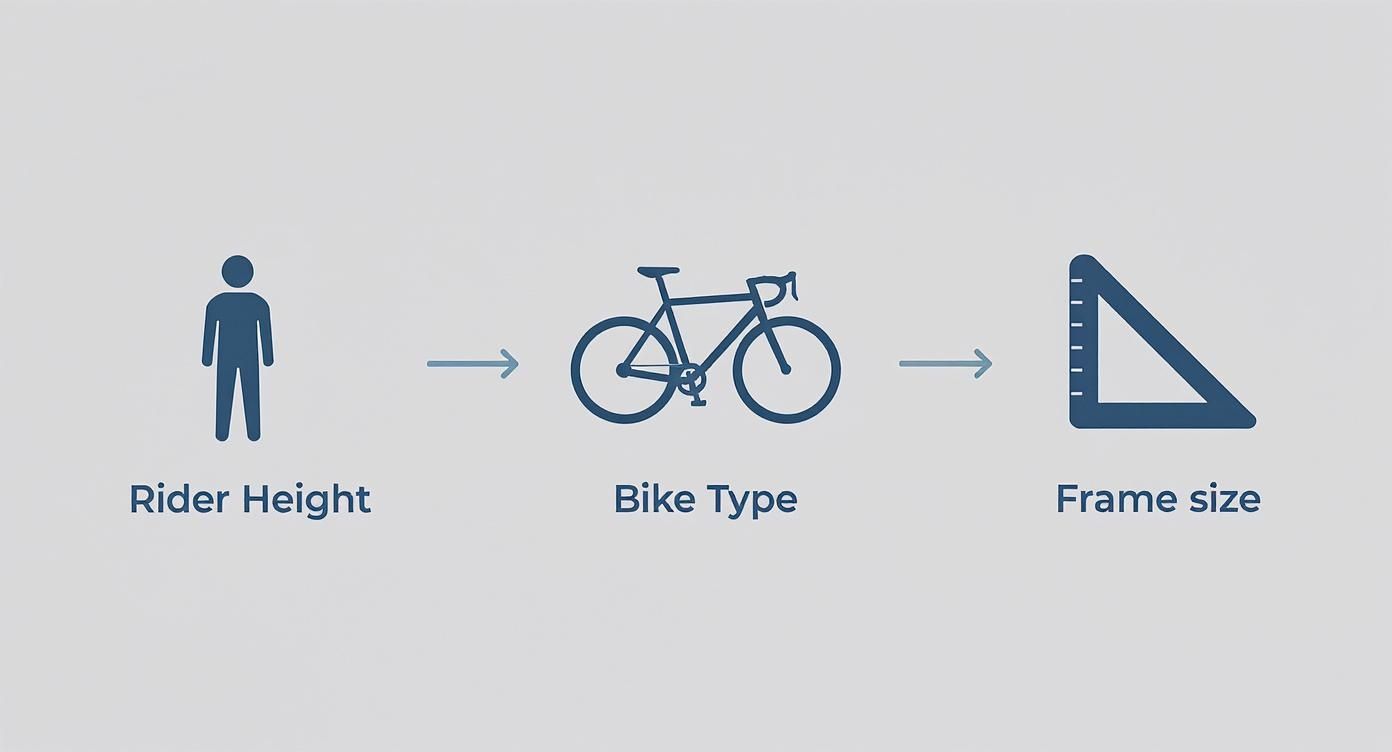
As you can see, it's a logical flow. You start with you, factor in the bike, and land on the perfect size.
First up, let’s get your total height. This is a simple measurement but provides a fantastic baseline for any size chart, especially when you have your inseam measurement to go with it.
That’s the first piece of the puzzle. Now, let’s move on to the most critical part.
Heads up: your cycling inseam is not the same as the inseam on your favorite pair of jeans. It's the measurement from your crotch all the way down to the floor, and getting it right is crucial for a comfortable and safe ride.
All you need is a hardcover book (about an inch thick) and a tape measure. For the most accurate number, do this while wearing thin athletic pants or the cycling shorts you'd normally ride in.
Why this matters: A correct inseam measurement is your best defense against buying a bike where the top tube is too high. It guarantees you'll have enough "standover clearance"—that's the space between you and the frame when you're standing flat-footed over the bike.
Here’s exactly how to do it:
With your accurate height and inseam in hand, you’re now ready to use any bike size chart with total confidence. You've officially taken the guesswork out of the equation.
https://www.youtube.com/embed/dxXi2PYKb54
Ever jumped on a friend’s bike and wondered why their medium mountain bike feels completely different from your 56cm road bike, even if you’re the same height? It’s not just about the numbers on a size chart. The real answer is baked into the frame’s geometry—think of it as the unique architectural blueprint for each type of ride.
A bike's purpose shapes its design from the ground up. A road bike is built to be fast and efficient on smooth pavement. A mountain bike, on the other hand, is engineered for control and stability on rough, unpredictable trails. These fundamental differences create a totally distinct feel, which is why a one-size-fits-all chart just doesn't work.
This need for specialized bikes isn't a niche concern, either. The global bicycle frame market was valued at around USD 22.6 billion in 2023 and is expected to grow to USD 38.3 billion by 2033. This boom is fueled by riders seeking the right tool for the job, whether it's for commuting, fitness, or sport. You can learn more about the bicycle frame market growth to see how this trend is shaping the industry.
Road bike geometry is all about putting you in an aggressive, forward-leaning posture to cheat the wind. This is achieved with two critical measurements that you won’t always find on a basic size chart: reach and stack.
This setup helps you slice through the air with incredible efficiency, but it demands a good deal of flexibility. It’s a design that unapologetically prioritizes speed, sometimes at the expense of pure comfort.
In contrast, a mountain bike is all about an upright, commanding riding position. Its geometry is built to keep your weight balanced and ready to react instantly to whatever the trail throws at you—rocks, roots, or sudden drops.
To get that feeling, designers use:
This geometry gives you the control and confidence you need on technical singletrack, where staying upright depends on quick, decisive movements. This focus on rider control is a key difference from other personal transport; for a fun comparison, check out our electric scooter buying guide and see how their design priorities differ.
The Takeaway: A road bike leans you forward for speed, while a mountain bike sits you up for control. These opposing design philosophies are why your road bike size will feel entirely different from your mountain bike size.
Understanding these nuances is the final piece of the puzzle. It helps you look beyond the raw numbers on a bike frame size chart and connect with the feeling a bike is designed to deliver, making sure you end up with a frame that truly matches how you want to ride.
So, you've got your measurements and you've spent some time with the size charts. You're almost there, but don't rush to the checkout just yet. Even with all the right data, a few common slip-ups can easily land you with a bike that just never feels quite right. Think of this section as your final check to make sure you're avoiding the pitfalls most riders fall into.
Getting this right is what separates a bike that becomes a trusted partner on the road or trail from one that just ends up collecting dust.
This is, without a doubt, the number one mistake people make. Your height is a decent starting point, sure, but it’s a tiny piece of the puzzle. People’s bodies are all built differently. You could have two people who are both 5’10”, but one might have a long torso and shorter legs, while the other has the opposite proportions.
Your inseam is the more critical measurement, period. It’s what determines your standover clearance—that all-important safety gap between you and the bike's top tube. A bike that technically "fits" your height but leaves no room for your inseam is not just uncomfortable, it can be downright dangerous if you have to hop off in a hurry.
Never, ever assume a "Medium" from Trek is the same as a "Medium" from Specialized. It’s not. Sizing isn't standardized across the industry, and it often varies between different models from the same exact brand. One company's 56 cm road bike might be an aggressive, race-ready machine, while another's is designed for comfortable, upright touring.
The Fix: You have to treat every bike as a totally new puzzle. Always hunt down the specific geometry chart for the exact model you're eyeing. Ignore the "M" or "L" sticker and look at the real numbers—reach, stack, and standover height will tell you the bike's true story.
This one is a deal-breaker. Standover clearance is the space between your crotch and the bike’s top tube when you’re standing with both feet flat on the ground. It’s not just about comfort; it's about safety. If you have to dismount quickly, you’ll be very glad you have that space.
As a rule of thumb, here’s what you should be looking for:
We've all been there. Your friend gets a new bike, they absolutely love it, and you're a similar height. It's so tempting to just buy the same one and call it a day. Don't do it. This is the same trap as just using your height—it completely ignores your personal body proportions.
Your buddy might have longer arms or a shorter torso, meaning their dream bike could be a nightmare for you. This same principle applies to all kinds of gear; our downhill ski length guide dives into how crucial these individual factors are, too.
Always, always trust your own measurements. A bike that’s truly fitted to your body will be more comfortable, perform better, and keep you safer than one you picked just because it worked for someone else.
Even after staring at charts and taking measurements, you might still have a few questions. That's totally normal. Choosing the right bike size can feel like a big decision, so let's walk through some of the most common "what if" scenarios that riders run into.
Ah, the classic sizing dilemma. It happens all the time. The right answer really boils down to your body shape and how you like to ride.
As a general rule of thumb, going with the smaller size usually gives you a more agile and lively bike. It’s a lot easier to make a slightly smaller frame fit bigger (think a longer seat post or stem) than it is to shrink a frame that’s too large.
On the other hand, the larger size often feels more stable, especially when you're cruising at speed. It creates a more stretched-out position, which can be great for comfort on long rides. If you have a long torso or prioritize stability over snappy handling, the bigger frame could be your ticket.
They can be, yes. Women-specific bikes are built with female anatomical averages in mind—often a slightly shorter torso and longer legs compared to a man of the same height. This translates to frames with shorter top tubes, which shortens the reach to the handlebars. They also frequently come with components like narrower handlebars and a women's-specific saddle right out of the box.
That said, plenty of women ride and love unisex frames. It all comes down to individual fit.
Key Takeaway: Don't get too hung up on the label. Always, always look at the geometry chart for any bike you're considering, whether it's marketed as unisex or women-specific. The numbers never lie.
This one is a big deal for safety. Standover height is the space between you and the bike's top tube when you're standing over it with your feet flat on the ground. It’s not just a guideline—it’s about avoiding injury.
Skimping on standover clearance is a recipe for a very painful accident during a sudden stop.
You can make small adjustments, but you can't fix a fundamental mismatch. Swapping out parts like a stem, handlebars, or a seat post is perfect for fine-tuning your position on a bike that is already the correct size.
Think of it as dialing in the details, not performing major surgery. If you try to compensate for a frame that’s way too big or small with extreme component changes, you’ll completely throw off the bike's handling, balance, and safety. Your number one goal should always be to get the frame size right from the very beginning. For a deeper dive into this, check out our complete guide on how to choose a bike.
At FindTopTrends, we're dedicated to helping you find high-quality products that fit your lifestyle perfectly. Explore our curated collections of outdoor gear, tech, and essentials to stay ahead of the curve. Discover your next favorite product today at FindTopTrends.




