


No products in the cart.


Free Shipping Australia-Wide

5 star customer service

Quality Tested Products

If you're looking for the short answer, here it is: the best binoculars for an Alaska cruise are almost always an 8x42 model. This specific configuration hits the sweet spot, giving you enough magnification to see distant wildlife, a wide view to easily find it, and fantastic light-gathering capabilities for those classic overcast Alaskan days. Most importantly, you get a stable, bright image from the deck of a moving ship, avoiding the frustrating shakiness that comes with more powerful binoculars.
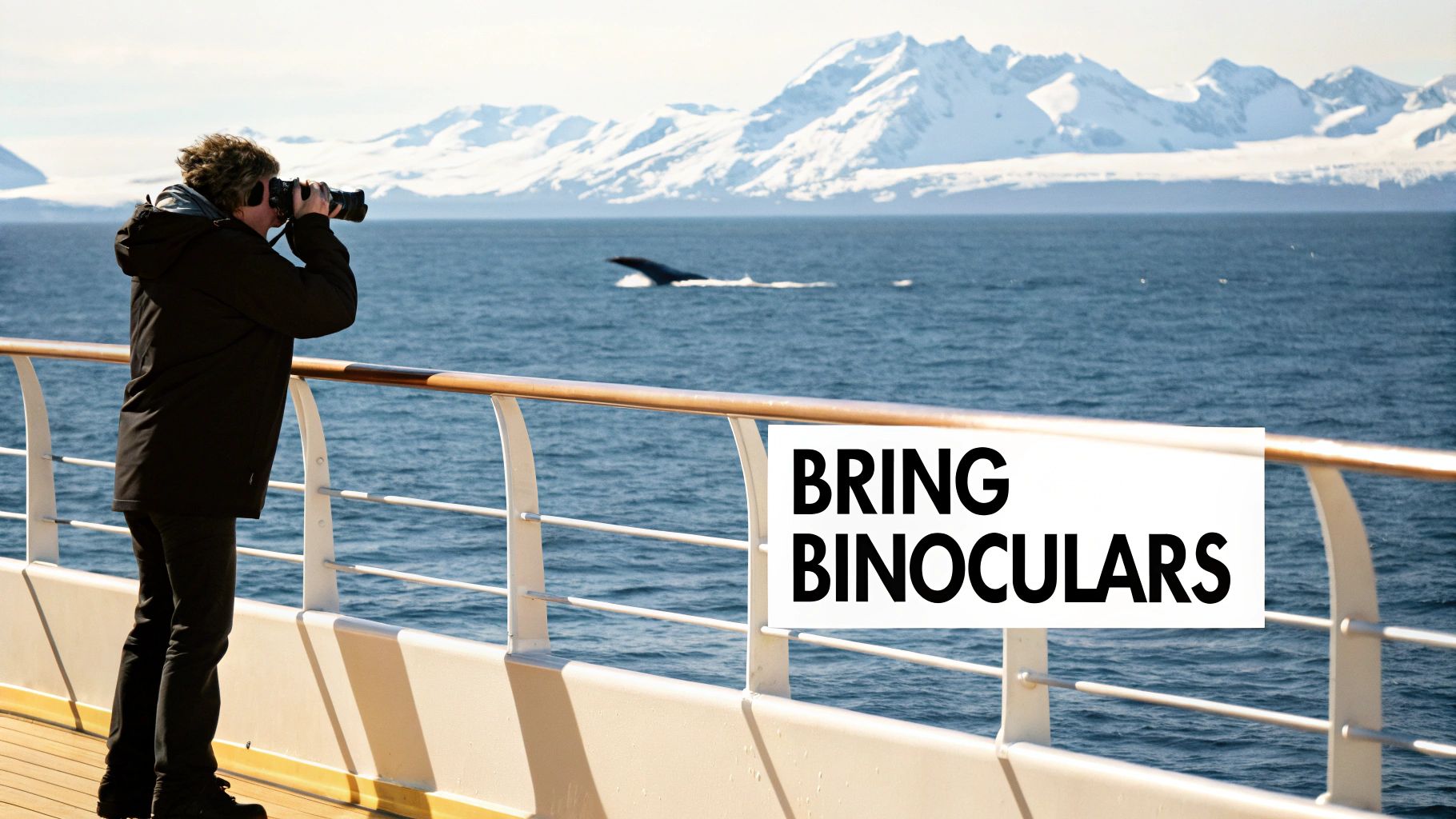
An Alaskan cruise isn't just a trip; it's an immersion into a world of epic scale and fleeting details. From the ship's rail, you’ll be surrounded by towering glaciers, ancient forests, and rugged coastlines that seem to stretch on forever. But the moments that truly take your breath away often happen far from the ship—a pod of orcas breaking the surface, a brown bear ambling along a distant shore, or a bald eagle perched silently in a faraway spruce.
Without the right gear, these incredible sights remain just blurry specks on the horizon, their magic lost in the distance. This is where a quality pair of binoculars becomes less of an accessory and more of an essential part of your adventure. Think of them as your personal zoom lens for the wild, turning you from a passive observer into an active explorer.
The most obvious job of binoculars is to bring the distant world into sharp, clear focus. A good pair lets you appreciate the fine details that make Alaska’s scenery and wildlife truly come alive. You won't just see a whale; you'll see the mist hanging in the air from its blowhole and the unique patterns on its fluke as it dives. You won't just spot a dark shape on the beach; you'll identify it as a black bear and watch it methodically flip over rocks, searching for a meal.
The impact is huge. Onboard passenger reports consistently show that using quality optics increases meaningful wildlife sightings by 30-75%. For animals on the shoreline, like bears and eagles, binoculars can improve positive species identification at several hundred meters by up to 60%, letting you witness behaviors you'd completely miss otherwise.
Binoculars do more than just help you spot wildlife; they enrich the entire journey. They let you:
Think of your binoculars as the bridge connecting you to the Alaskan wilderness. They collapse the distance, letting you form a much deeper, more personal connection with the environment. They turn good moments into truly unforgettable memories.
Maximizing your chances of seeing incredible creatures starts with the right equipment. Taking the time to understand your gear is the first step in preparing for the amazing nature and wildlife viewing experiences ahead. The right pair ensures you’re ready for every spontaneous, breathtaking moment Alaska has in store.
When you first start looking at binoculars, you’ll see a set of numbers like 8x42 or 10x50 printed on every single pair. This isn't some secret code for gearheads; it's the key to understanding exactly what those binoculars can do for you. Honestly, getting a handle on these two numbers is the most important first step you can take.
Think of them as the binocular's vital stats. The first number is all about power, and the second is about its ability to see in gloomy weather. Once you know what they mean, you can glance at any pair and instantly know if it's the right tool for spotting a whale at dusk or a bear on a foggy shoreline.
The number that comes before the "x" — the 8 in 8x42 — is its magnification power. It’s pretty simple: an 8x binocular makes whatever you're looking at appear eight times closer than it does with your naked eye. That bear 400 yards away? Through these, it’ll look like it’s only 50 yards away.
Now, your first instinct might be to go for the highest magnification you can find. For a cruise ship, that’s a classic rookie mistake. Think about zooming in all the way with your phone's camera; the slightest shake of your hand becomes a massive blur. That same effect is magnified a hundred times by the gentle, constant movement of a ship on the water.
High magnification amplifies every tiny tremor from your hands and the boat itself. The result is a shaky, jittery view that's not just hard to focus on, but can literally give you a headache. This is why 8x is the sweet spot for most people on the water—it's the perfect blend of power and stability.
With 8x magnification, you get a steady, comfortable image that lets you easily track a soaring eagle or a breaching whale. It’s simply a more practical and enjoyable choice for your adventure. For a more detailed breakdown of all the specs, you can check out our complete binoculars buying guide.
The second number, like the 42 in 8x42, tells you the diameter of the big lenses at the front, measured in millimeters. This number is all about light-gathering ability. Just think of the objective lenses as the binocular's windows.
This is a huge deal for an Alaska cruise. Alaska is famous for its dramatic, overcast skies, misty mornings, and long twilight hours. And guess when the wildlife is most active? Yep, right then. Binoculars with larger objective lenses are your best friend in these low-light situations.
A pair of 8x42 binoculars, with its 42mm lenses, is widely considered the gold standard for all-around wildlife viewing. They pull in plenty of light to give you a bright, crisp, and colorful image, even when the sun is hiding. Sure, a compact 8x25 pair is smaller and lighter, but its little 25mm lenses will produce a dim, murky image that makes spotting that eagle in a shadowy spruce tree nearly impossible.
By understanding just these two numbers, you've already figured out the most critical piece of the puzzle. You now know that a spec like 8x42 isn't just a model number—it’s a promise of a steady, bright view perfectly matched for the wild, beautiful coast of Alaska.
Alaska’s weather is a huge part of its wild charm, but it can be absolutely brutal on your gear. One minute you're soaking up the sun on deck, and the next, you're hit with a sudden drizzle or a thick blanket of fog. For your binoculars to work when that humpback whale suddenly breaches, they need to be built tough—ready for anything the Last Frontier throws at them.
Think of these features less as options and more as survival gear for your optics. Without them, even a pricey pair of binoculars can turn into a useless, fogged-up paperweight at the exact moment you need them most.
Let's be clear: this is the single most important feature your binoculars for an Alaska cruise must have. It’s not just about surviving a rainstorm. It's about dealing with the constant humidity, the salt spray from the ocean, and the dramatic temperature swings you'll experience every single day.
Waterproofing: This comes from O-ring seals that completely block moisture, dust, and grime from getting inside the binocular barrels. It means your optics can handle rain, mist, and even an accidental drop into a puddle without getting wrecked internally.
Fog Proofing: This is just as crucial. When you walk from your warm cabin out onto the chilly deck, the abrupt temperature change can make ordinary lenses fog up on the inside, blurring your view completely. To stop this, manufacturers purge the air out of the barrels and fill them with a dry, inert gas—usually nitrogen or argon—before sealing them tight.
Because this gas has zero moisture, there’s nothing inside to condense and cause fog. This guarantees you get a crystal-clear view the second you bring the binoculars to your eyes, which is absolutely vital for catching those fleeting wildlife sightings.
Think of it like this: your binoculars need their own high-performance Gore-Tex jacket. The waterproofing keeps the rain out, while the fog-proofing (the nitrogen or argon gas) acts like the breathable membrane, preventing them from steaming up from within. This one-two punch is essential for reliable performance in Alaska.
This diagram helps visualize the key specs we've been talking about, highlighting why a certain combination is so highly recommended by experts for Alaska.
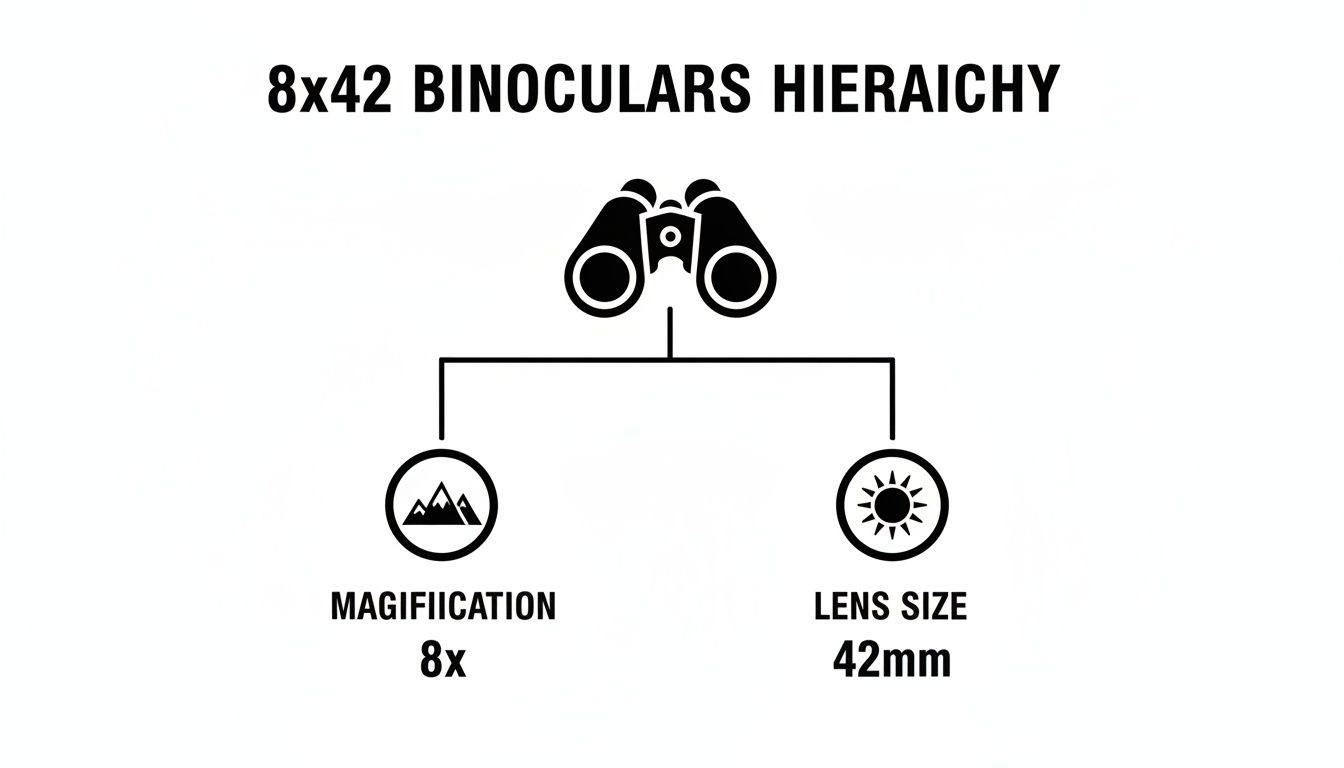
As you can see, the 8x magnification and 42mm lens size pairing really is the sweet spot for the kind of viewing you'll be doing on a cruise.
Beyond the rugged build, the quality of your view comes down to the microscopic coatings applied to the lenses and prisms. These coatings are the unsung heroes of optics, managing light to give you a brighter, sharper, and more colorful image. They're essentially like putting a high-end pair of polarized sunglasses on your binoculars.
Without good coatings, up to 5% of the light that hits a lens can reflect away and be lost. When you consider all the internal glass surfaces inside a pair of binoculars, that lost light adds up fast, resulting in a dim and disappointing view.
Here’s a quick rundown of the terminology:
Fully multi-coated lenses make a world of difference. They slash the harsh glare coming off the water and snow, boost the contrast so details pop, and deliver true-to-life colors. This makes it far easier to spot a dark-furred bear against a shadowed treeline or pick out the subtle patterns on a bird's feathers.
For a quick reference, this table breaks down how these key features stack up across different budget levels.
This table compares essential binocular features and their practical impact on an Alaska cruise, helping you prioritize what matters most.
| Feature | Why It Matters in Alaska | Good (Budget) | Better (Mid-Range) | Best (Premium) |
|---|---|---|---|---|
| Weatherproofing | Essential for rain, fog, and sea spray. | Waterproof, Nitrogen-Purged | Waterproof, Argon-Purged | Waterproof, Argon-Purged, Hydrophobic lens coatings |
| Lens Coatings | Cuts glare off water/ice, boosts brightness. | Fully Coated (FC) | Fully Multi-Coated (FMC) | FMC with Dielectric and Phase-Corrected Prism Coatings |
| Build/Armor | Grip and durability in cold, wet conditions. | Rubber Armor | Magnesium or Polycarbonate Chassis, Rubber Armor | Magnesium Alloy Chassis, Rugged Rubber Armor, Ergonomic Design |
| Glass Quality | Determines image sharpness and color accuracy. | Standard BK-7 Prism Glass | BAK-4 Prism Glass | ED (Extra-Low Dispersion) or HD Glass |
As you can see, you don't need to spend a fortune to get the essentials like waterproofing and decent coatings, but investing a bit more in things like Fully Multi-Coated (FMC) lenses and BAK-4 prisms delivers a noticeably better viewing experience.
The final piece of the puzzle is how the binoculars are actually built and, just as importantly, how they feel in your hands. You'll be on a moving ship, often in chilly weather where you might be wearing gloves. Comfort and grip matter.
Always look for a pair with a rubber-armored exterior. This armor does two things: it provides a secure, non-slip grip (even when wet) and adds a layer of shock absorption to protect the delicate optics from minor bumps and drops. It also makes the binoculars much more comfortable to hold in cold weather than a bare metal body.
Speaking of which, dressing right is key to enjoying your time on deck. For more advice, check out our guide on how to dress for cold weather to stay warm while you scan the horizon for wildlife.
By making sure your binoculars have these core "survival" features—great weatherproofing, quality lens coatings, and a durable, ergonomic build—you're ensuring they'll be a reliable companion, always ready to bring you that breathtaking view, no matter what the Alaskan weather has in store.
When you're picking out the best binoculars for an Alaska cruise, the first big decision you'll face is magnification. It almost always boils down to two options: 8x or 10x. It’s easy to assume that more power is always better, but on a constantly moving cruise ship, the answer isn't so simple.
Think of it this way: you wouldn't use a massive telephoto lens to take a group photo. The right tool depends on the job. The gentle, ever-present motion of a ship completely changes the game, making stability just as important as power.
For almost everyone heading to Alaska on a cruise, an 8x magnification is the undisputed champion. It hits the sweet spot, balancing useful power with a wide, stable view that’s incredibly forgiving out on the water.
Imagine a pod of orcas suddenly surfaces off the side of the ship. With 8x binoculars, you get a much broader field of view—the total amount of scenery you can see from left to right. This wide window makes it far easier to scan the vast coastline, find the whales, and keep them in frame as they move.
The biggest win for 8x, though, is stability. Every tiny tremor from your hands and every gentle sway of the ship gets amplified by the lenses. At 8x power, this effect is minimal and easy to manage, giving you a calm, steady image. This means less eye strain, fewer headaches, and a much more enjoyable experience when you're glassing for hours.
On a moving platform like a cruise ship, 8x magnification provides a clear, stable, and wide view that is simply easier to use. It lets you find wildlife faster and track it more effectively, making it the most practical choice for most travelers.
In short, 8x binoculars are your go-to workhorse. They’re forgiving, easy to handle, and perfectly suited for the dynamic environment of a cruise, ensuring you spend less time fighting a shaky image and more time soaking in the sights.
While 8x is the best all-arounder, there’s still a strong case for 10x magnification. These are the specialist's tool, built for moments when you need to zoom in on a specific, distant, and relatively still target.
Picture a mountain goat clinging to a faraway cliff or a bald eagle perched atop a towering Sitka spruce. This is where 10x really shines. That extra power brings your subject 25% closer than an 8x pair, revealing fine details like the texture of a bear’s fur or the distinct white head of an eagle.
But this power comes with real trade-offs on a ship. The field of view is noticeably narrower, almost like looking through a tube. This makes it much harder to find what you're looking for in the first place.
More importantly, that extra magnification amplifies every little shake. It takes a much steadier hand to get a stable image, which is a tall order on a moving deck. Experienced users might manage it, but for many, 10x binoculars at sea are just plain frustrating.
So, how do you choose? It really comes down to your personal style and what you prioritize seeing. This head-to-head comparison should make the decision for your binoculars for an Alaska cruise a little clearer.
| Aspect | 8x Magnification (The All-Rounder) | 10x Magnification (The Specialist) |
|---|---|---|
| Best For | Quickly finding and tracking moving wildlife like whales, dolphins, and seabirds from a moving ship. | Zeroing in on stationary subjects like perched eagles, bears on the shore, or distant glaciers. |
| Stability | Much more stable and easier to hold steady on a moving deck, reducing hand shake and eye strain. | Significantly more sensitive to shake, requiring a very steady hand or some form of bracing. |
| Field of View | Wider view, making it easier to scan large areas and locate animals quickly. | Narrower view, which can make it more difficult to initially find your target. |
| User Friendliness | Very forgiving and easy for beginners to use effectively, providing a comfortable viewing experience. | Can be challenging for novices to use on a boat; better suited for experienced users. |
Ultimately, for a stress-free and rewarding viewing experience on an Alaska cruise, 8x magnification is the safest and most recommended choice. It delivers all the power you truly need with the stability and wide view that are critical for success on the water.
Figuring out how much to spend on binoculars for your Alaska cruise can be a bit of a head-scratcher. The great news? You don't have to break the bank to get a stunning view of a calving glacier or a distant whale. But it’s really important to know what you get for your money at different price points so you end up with a pair you're happy with.
Think of it this way: a cheap plastic poncho will keep you from getting soaked in a sudden downpour, but a proper Gore-Tex jacket offers serious protection, comfort, and will last for years. Binoculars are much the same—investing just a bit more can give you a dramatically better experience out on the water.
This is the starting point for most travelers, and honestly, you can find some fantastic, capable binoculars in this price range. If you want a major upgrade from using your naked eye but aren't ready to make a huge investment, this is your sweet spot.
Here’s what you can expect:
This price tier delivers incredible value, especially as competition has heated up. We're seeing more and more of the best-selling 8x42 travel binoculars fall squarely in the $80–$250 range, thanks to some excellent value-focused brands. You can dig deeper into these market trends and find some great recommendations in this guide to binocular pricing for travelers on TheTourExpress.com.
For a lot of people, this is the perfect middle ground. Spending a bit more here gets you a huge, noticeable leap in performance that really pays off in the tricky, often overcast light of an Alaskan morning.
What are you paying for? It all comes down to better glass and more advanced lens coatings. Binoculars in this tier almost always feature Fully Multi-Coated (FMC) lenses and often add sophisticated phase-corrected and dielectric coatings to the prisms.
Think of these advanced coatings as upgrading your view from standard to high-definition. They let way more light through, making the image brighter, sharper, and packed with color—especially at dawn and dusk when wildlife is most active.
You’ll also find more rugged construction, often with lightweight magnesium bodies instead of plastic. This means they can handle the inevitable bumps of travel and are still light enough to hold for long stretches on deck without your arms getting tired.
Now we're in top-tier territory. Here, you get absolutely exceptional optical quality and, for a cruise, a true game-changer: image stabilization (IS).
Image-stabilized binoculars use tiny internal sensors and motors that instantly counteract the shake from your hands and the gentle roll of the ship. The result is a rock-steady, razor-sharp image that feels like you’re looking through a pair mounted on a heavy tripod. This technology makes powerful 10x or even 12x magnification completely usable from a moving deck, letting you see incredible detail without any of that frustrating jitter.
They're definitely a splurge, but if the budget allows, IS binoculars will completely transform your viewing experience. They are, without a doubt, the ultimate tool for making every wildlife sighting on your Alaskan adventure unforgettable.
Owning the perfect pair of binoculars for an Alaska cruise is a fantastic start, but knowing how to handle them on a moving ship is what truly brings those distant eagles and breaching whales into focus. These are the practical, on-the-ground tips I’ve learned that make the difference between a fleeting glimpse and a memory that lasts a lifetime.
First things first: you have to tune your binoculars to your eyes. This is done with the diopter adjustment, a little ring on one of the eyepieces (usually the right one). It's there to correct for the small vision differences between your two eyes, and getting it right is the secret to avoiding headaches and seeing a single, crisp image.
Think of this as a one-time setup. Once you do it, you won't have to mess with it again.
That’s it. From now on, the main focus wheel will adjust both eyes in perfect sync.
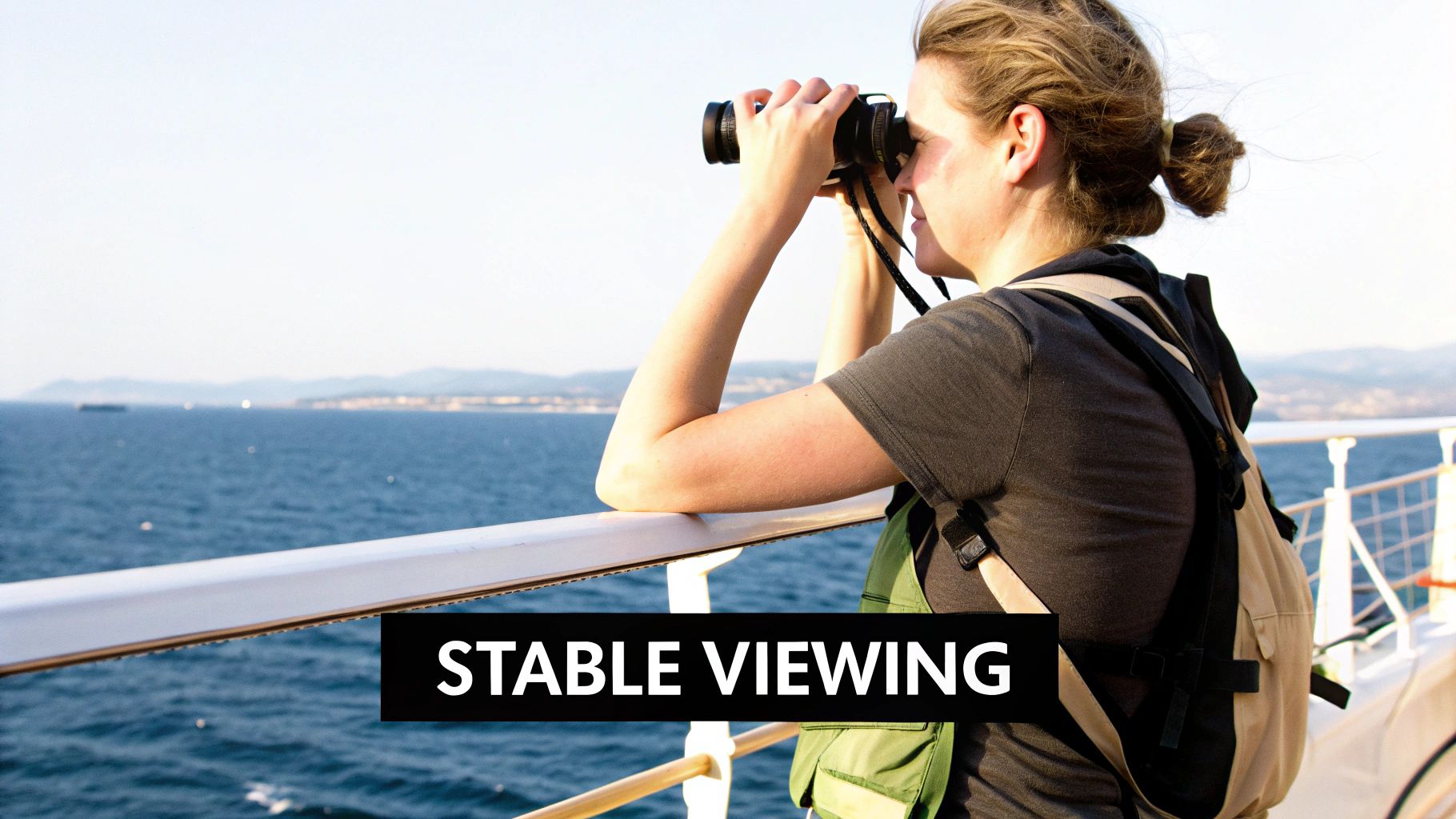
A cruise ship, no matter how large, is always moving. That gentle rock and roll is the number one enemy of a steady view. The trick is to make yourself part of the ship. Find a solid railing, a bulkhead, or even a sturdy deck chair to lean against. This will absorb a surprising amount of the motion.
Stand with your feet about shoulder-width apart for a solid base, and tuck your elbows in tight against your ribs. This creates a stable "tripod" with your body, minimizing the natural shake from your hands.
When looking for wildlife, resist the urge to just pan the horizon with your binoculars glued to your face. It's disorienting. Instead, scan a wide area with your naked eye first. When you spot a puff of spray or a dark shape on an iceberg, then bring the binoculars up to your eyes to zero in on it.
Your best viewing spots are often at the bow or stern of the ship, away from the central crowds. These areas typically offer wider, less obstructed views and plenty of solid structures to brace against for maximum stability.
A few small extras can make a huge difference in comfort and convenience, letting you spend more time looking for wildlife.
These simple habits and accessories will completely change your viewing game. If you're especially keen on spotting marine life, our guide to the best binoculars for whale watching offers even more specialized tips that work just as well in Alaska's icy waters.
You've waded through the specs and features, and now you're close to picking the perfect binoculars for your Alaska cruise. But a few questions might still be lingering. Let's clear up those final details so you can pack your bags with total confidence.
Think of this as a quick chat with an expert to make sure you're ready for every whale breach and soaring eagle.
For a moving cruise ship? Almost always, yes. The appeal of getting "closer" with 12x power is strong, but the reality is a shaky, frustrating image. Higher magnification acts like a magnifying glass for your own hand tremors and the gentle sway of the ship, making it nearly impossible to lock onto a subject.
Stick with 8x or 10x magnification. From years of experience, I can tell you this is the sweet spot. You'll get plenty of power to see a Dall's sheep on a distant cliffside without the distracting jitters that come with anything stronger.
Technically, yes. Realistically, you'll regret it. Alaskan wildlife doesn't wait for you to take turns. A pod of orcas might surface for just a minute, or a grizzly bear could wander into view on a shoreline and disappear just as quickly.
By the time you spot something amazing, grab the binoculars, pass them to your partner, and they readjust the focus and eyecups... the moment's gone.
Having your own pair means you're both ready, instantly. You get to share the awe of the moment together, looking at the same thing at the same time, instead of one person describing what the other just missed.
While their small size and light weight are tempting for travel, compact binoculars are a poor fit for Alaska's unique environment. Their small objective lenses (usually 25mm or so) just can't pull in enough light.
Alaska is often overcast, and the best wildlife activity happens at dawn and dusk. In these low-light conditions, a compact pair will give you a dim, murky view. For a bright, crisp image that truly captures the scenery, a full-size 8x42 pair is absolutely worth the small amount of extra space in your luggage.
Beyond your optics, protecting your entire trip is just as important. For peace of mind on other travel essentials, you can find great information on travel insurance for a cruise vacation.
Need them? No. But are they an incredible game-changer? Absolutely. If they fit within your budget, image-stabilized (IS) binoculars are a fantastic luxury. They use internal gyroscopes and sensors to electronically cancel out vibrations, giving you a rock-steady view that feels almost magical.
They make a huge difference, especially if you opt for 10x power on a moving deck. While not a necessity, they elevate the experience from great to truly unforgettable.
At FindTopTrends, we're passionate about helping you find the right gear for your adventures. We’ve done the research so you can focus on the experience. Browse our handpicked selection of top-rated binoculars and get ready to see Alaska in breathtaking detail. Start exploring at https://findtoptrends.com.




