


No products in the cart.


Free Shipping Australia-Wide

5 star customer service

Quality Tested Products

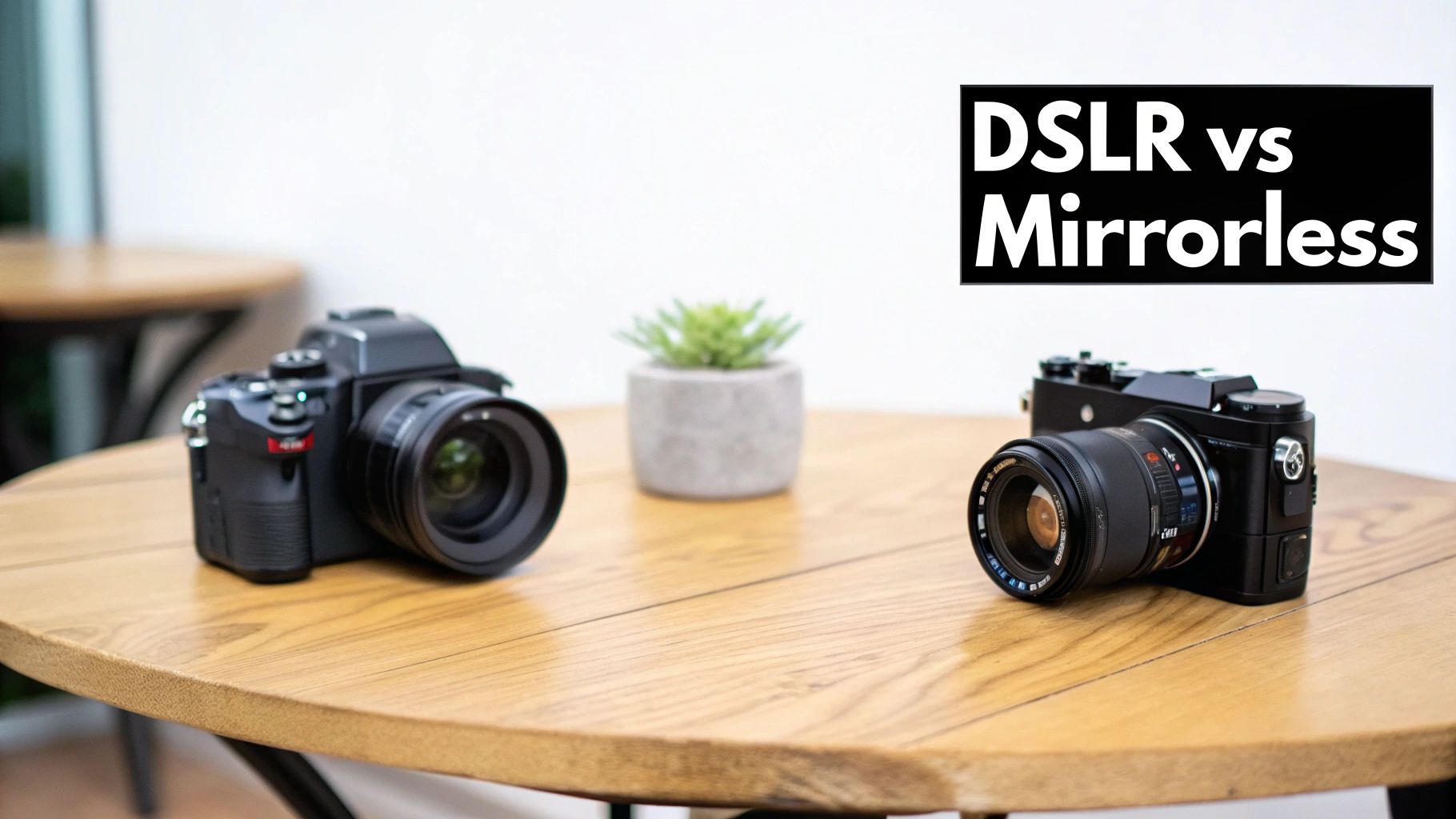
The biggest question in photography today often boils down to DSLR vs mirrorless camera. The core difference is actually pretty simple. A DSLR has a mirror inside that bounces light up into an optical viewfinder, letting you see straight through the lens. A mirrorless camera, as the name suggests, ditches the mirror entirely. Instead, light hits the sensor directly, and you see a digital preview of your shot on the screen or in an electronic viewfinder.
This single mechanical difference creates a domino effect, influencing everything from the camera's size and weight to its autofocus performance and video chops.
Choosing between these two isn't just about specs; it’s about how you want to shoot. A DSLR gives you that classic, unfiltered view of the world and a battery that can go all day, making it a reliable workhorse for many photographers. A mirrorless camera, on the other hand, offers a powerful "what you see is what you get" experience, with cutting-edge autofocus that can track a subject's eye across the frame, all in a much smaller package.
To get a clearer picture right away, let's break down the essential distinctions. Think of this as the cheat sheet for understanding what truly sets these two camera systems apart.
| Feature | DSLR (Digital Single-Lens Reflex) | Mirrorless |
|---|---|---|
| Viewfinder | Optical (OVF) shows a direct, real-time view through the lens. | Electronic (EVF) displays a digital preview of the final image. |
| Size & Weight | Generally larger and heavier due to the mirror box and prism. | Typically smaller, lighter, and more compact. |
| Autofocus | Uses a dedicated phase-detection sensor; fast but limited coverage. | On-sensor hybrid systems offer superior coverage and tracking. |
| Video | Capable, but often with less advanced video autofocus and features. | Generally superior video capabilities, focus, and resolutions. |
| Battery Life | Excellent; the OVF consumes no power, lasting for 800-1,200+ shots. | Weaker; the EVF and LCD are power-intensive, lasting for 300-500 shots. |
| Silent Shooting | Limited to "quiet modes" or live view; mechanical shutter is loud. | True electronic silent shooting is a common feature. |
| Lens Selection | Massive ecosystem of mature, affordable new and used lenses. | Newer, high-performance native lenses; adapters allow DSLR lens use. |
While this table gives you the high-level technical breakdown, remember that the "best" camera is entirely personal. Your shooting style, what you photograph, and your budget will ultimately steer you in the right direction. Each system has its own personality and excels in different situations.
The core decision comes down to this: A DSLR provides a raw, unfiltered connection to your subject through its optical viewfinder, while a mirrorless camera offers a highly accurate digital preview of your final shot before you even press the shutter.
As you weigh the pros and cons, it's also interesting to see how these traditional photography approaches are evolving in a world of new visual media. Understanding the foundational tech helps you pick the right tool for the job. In the sections that follow, we'll dig much deeper into each of these differences.
The whole DSLR vs. mirrorless debate really comes down to a single, critical component: the mirror. This one piece of machinery dictates everything from how you see your subject to the overall size and feel of the camera. It’s the fork in the road that creates two completely different ways of taking a picture.
A DSLR (Digital Single-Lens Reflex) camera is built around a system that photographers have trusted for decades. When you look through the viewfinder, you’re seeing the world through a clever series of reflections. Light comes through the lens, hits a mirror angled at 45 degrees, bounces up into a prism, and then gets directed straight to your eye.
What you see is a pure, analog view of your scene. There's no screen, no digital processing, and zero lag. It's a direct, unfiltered connection between you and whatever you're shooting.
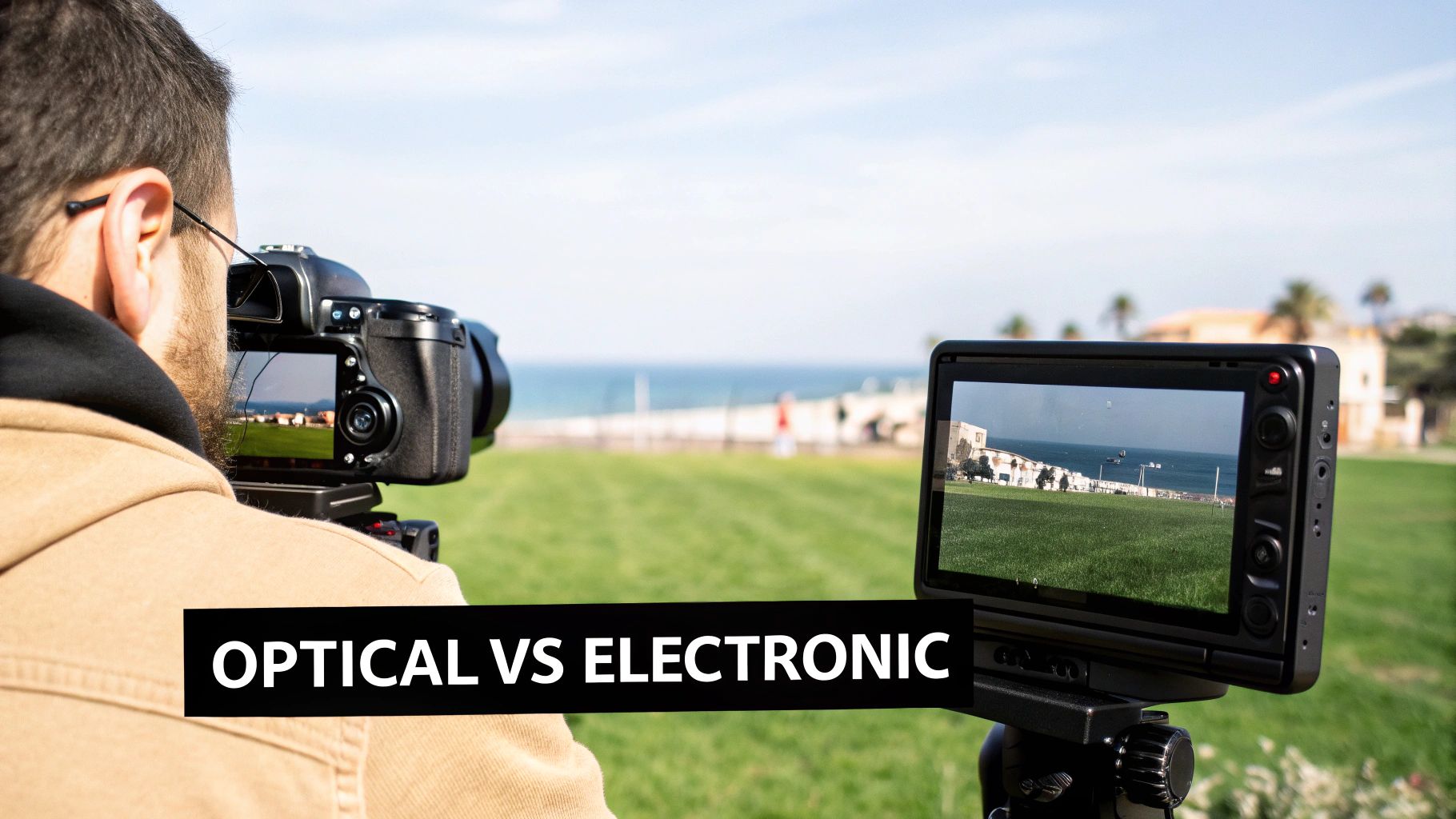
The magic of a DSLR is its Optical Viewfinder (OVF). Because you’re looking through glass and not at a screen, you get a crystal-clear, vibrant view that many photographers, especially traditionalists, absolutely love.
When you finally press the shutter button, the mirror physically flips up, allowing light to pass through and hit the image sensor. That mechanical movement is what creates the classic, satisfying clack sound that's so characteristic of DSLRs.
A mirrorless camera, just as the name suggests, gets rid of the mirror and prism entirely. This changes everything. Light passes through the lens and goes straight onto the image sensor, all the time. This simple but profound design shift allows for smaller, lighter, and mechanically simpler cameras.
Instead of an OVF, mirrorless cameras rely on an Electronic Viewfinder (EVF). The EVF is essentially a tiny, high-resolution screen inside the viewfinder that shows you a live feed from the sensor. And this is where the mirrorless advantage really kicks in.
The real power of a mirrorless system is its 'what you see is what you get' (WYSIWYG) approach. The EVF shows you a live preview of exactly how your photo will look with all your settings applied.
This means you can see if your shot is overexposed or underexposed before you even take it. You can also overlay helpful tools like a live histogram or focus peaking (which highlights sharp areas in the frame) right in the viewfinder, giving you an incredible amount of control. For newcomers, our guide on essential photography equipment for beginners can help you understand how this modern workflow makes learning easier.
This technological shift isn't just about personal preference; it's steering the entire camera industry. The market has decisively pivoted toward mirrorless technology. In fact, DSLR sales have plummeted by around 60% over the past eight years as mirrorless systems have taken over.
Even the old guards of the DSLR world, like Canon, have announced they're no longer developing new flagship DSLR cameras. Their focus is now squarely on their mirrorless lines, which tells you everything you need to know about where the future is headed.
Once you get past the internal mechanics, the real story in the DSLR vs. mirrorless debate is how they actually perform on a shoot. These core design differences lead to very different experiences and results, creating specific strengths and weaknesses that directly impact your workflow. Let's dig into what that means for you in the real world.
This isn’t about declaring one technology "better" than the other. It’s about which one performs better for a specific job. A wedding photographer has a completely different set of needs than a landscape artist, so the performance specs that truly matter will change.
The viewfinder experience is probably the first thing you'll notice and the most personal difference between the two. A DSLR’s Optical Viewfinder (OVF) gives you a pure, unfiltered view straight through the lens. There’s zero lag. For sports or wildlife photographers trying to track an unpredictable, fast-moving subject, this is a massive advantage.
The downside? The OVF can’t show you what your settings are doing to the final image. You see reality, not the photo you're about to take. To check your exposure or white balance, you have to take the shot and then look at the back screen—a process we old-timers call "chimping." This two-step dance can really slow you down when moments are fleeting.
On the other hand, a mirrorless camera's Electronic Viewfinder (EVF) is a total game-changer for many photographers. It’s a tiny screen that shows you a live digital preview of your shot, with all your settings applied.
The trade-off for all this information is potential—though often tiny—lag, especially on older or entry-level models. It also uses more battery. For those shooting in the dark, an EVF can electronically brighten the scene to help you compose, a huge benefit for anyone looking into the best camera for night photography.
Autofocus is where modern mirrorless cameras have sprinted ahead. DSLRs rely on a separate phase-detection AF sensor, which is fast and effective, but its focus points are usually bunched up in the center of the frame. This forces you into the "focus-and-recompose" technique, which can throw your focus off if you're shooting with a super-shallow depth of field.
Mirrorless cameras, however, handle autofocus directly on the image sensor. This is huge. It allows focus points to cover nearly 100% of the frame. More importantly, it powers incredibly smart subject-tracking algorithms.
The latest mirrorless systems can find and lock onto human eyes, animal eyes, faces, and even specific objects like cars or birds. The camera just sticks to your subject as it moves across the frame. For portrait, wedding, and wildlife photographers, this is nothing short of revolutionary. High-end DSLRs have good tracking, but they just can't match the frame coverage and sheer "stickiness" of the best mirrorless AF.
Getting rid of the mirror box means mirrorless cameras can be significantly smaller and lighter than their DSLR cousins. This is a godsend for travel, street, and landscape photographers who have to carry their kit all day. A smaller camera is also less intimidating and easier to pack.
But size isn't the whole story. Many pros, myself included, sometimes prefer the chunky, substantial grip of a pro-level DSLR, especially with a big telephoto lens attached. The balance just feels right. Bigger bodies also have more room for dedicated buttons and dials, meaning you can change settings by feel instead of digging through menus. Ergonomics are personal, so I always recommend getting your hands on both types of cameras before you buy.
While top-tier DSLRs can shoot beautiful video, this is one area where mirrorless has a clear, undeniable lead. Because they use on-sensor autofocus, mirrorless cameras deliver smooth and reliable continuous AF while recording video. DSLRs have always struggled with this, often forcing filmmakers to rely on manual focus.
Mirrorless cameras just come better equipped for video across the board:
Whether you're shooting stills or video, knowing the different types of cinematic shots can help you unlock your camera's full potential. But for serious videographers or anyone who does both, the choice almost always leans toward a mirrorless system today.
Finally, an area where old-school tech wins. Because a DSLR isn't powering a screen when you use the optical viewfinder, its battery life is fantastic. It's not uncommon to get 1,000 shots or more from a single charge. For event photographers shooting all day, this is a major advantage.
Mirrorless cameras are constantly powering either the EVF or the rear LCD, so they burn through batteries much faster. You're typically looking at 300-500 shots per charge. Most pros just carry a pocketful of spares, but it’s a key difference to be aware of. In terms of toughness, pro-grade DSLRs are famous for being built like tanks, though high-end mirrorless bodies have become just as rugged and weather-sealed in recent years.
To make things clearer, here’s a look at how these differences play out in common shooting situations.
The best camera often depends entirely on what you're shooting. This table breaks down which system tends to have the upper hand in different scenarios.
| Scenario | DSLR Advantage/Consideration | Mirrorless Advantage/Consideration |
|---|---|---|
| Fast-Action Sports | Zero-lag OVF is perfect for tracking erratic subjects. Superior battery life for all-day events. | Advanced AF tracking covers the entire frame, locking onto subjects with incredible accuracy. Faster burst shooting rates. |
| Portrait Photography | Often more comfortable with large lenses. The massive lens selection offers many classic portrait primes. | Eye-AF is a complete game-changer, ensuring tack-sharp focus on the subject's eyes, even with wide-open apertures. |
| Travel & Street | Can be found for much cheaper, leaving more budget for lenses or travel itself. | Smaller, lighter, and more discreet. The silent electronic shutter is perfect for candid shots without drawing attention. |
| Videography | Can produce excellent video, but often requires more manual work (like pulling focus). | Superior autofocus, higher resolutions (4K/8K), faster frame rates, and more video-centric features like Log profiles. |
| Landscape Photography | Excellent battery life is a plus for long hikes. The optical viewfinder consumes no power. | The EVF allows you to preview exposure and use focus peaking for perfect sharpness from front to back. Lighter to carry. |
| Low-Light / Astro | The optical viewfinder doesn't create digital noise or lag in dark conditions. | The EVF can brighten the scene, making it far easier to compose your shot in near-total darkness. |
This comparison shows there's no single "winner." A sports photographer might stick with a DSLR for its lag-free view, while a portrait shooter will find mirrorless Eye-AF indispensable. Your personal priorities should guide your decision.
When you pick a camera, you're doing more than just buying a body. You’re buying into a whole system—lenses, flashes, batteries, and all the accessories that go with it. In the great DSLR vs. mirrorless debate, the lens ecosystem is often the real decider, influencing your creative freedom and how much you'll spend down the road. It’s a classic battle: the established, affordable past versus the innovative, fast-moving future.
DSLR systems, especially Canon's EF and Nikon's F mounts, have been the industry standard for decades. That long history is their biggest plus. The market is absolutely swimming in lenses from camera makers and third-party brands like Sigma and Tamron, covering every possible focal length and budget you can imagine.
For anyone trying to build a solid kit without spending a fortune, this is a massive win. You can snag professional-grade DSLR lenses on the used market for a fraction of what they originally cost, making it so much easier to get started with quality glass.
On the other side of the fence, you have the newer mirrorless lens mounts—think Canon RF, Nikon Z, and Sony E-mount. Since these were designed from the ground up without a bulky mirror box in the way, engineers have been able to cook up some truly incredible optical designs. These native mirrorless lenses often deliver next-level sharpness, more advanced coatings, and features that are perfectly matched to the modern cameras they’re built for.
Of course, all that innovation doesn't come cheap. Native mirrorless lenses tend to be more expensive, and the used market just isn't as deep or affordable as it is for DSLRs. The selection is growing at an incredible pace, but it's still playing catch-up to the sheer volume of DSLR glass out there.
The trade-off is pretty straightforward. DSLRs give you access to a gigantic, time-tested collection of affordable lenses. Mirrorless systems offer the absolute peak of modern optical tech and performance, but you’ll pay a premium for it and have a smaller (though growing) selection to choose from.
So, what if you want the new mirrorless body but already have a bag full of DSLR lenses? That’s where adapters come in. These handy devices let you mount older DSLR lenses onto a new mirrorless camera, which is a lifesaver for anyone making the switch. You can upgrade your camera body for awesome features like an EVF and Eye-AF while keeping your favorite EF or F-mount glass in rotation.
Canon and Nikon make their own adapters that work incredibly well, usually with no real drop in autofocus speed or image quality. In fact, some photographers swear their old DSLR lenses perform even better on a mirrorless body, thanks to the more advanced on-sensor autofocus systems.
While adapters are a brilliant solution, they do add a little extra bulk and create one more connection point that could potentially fail. For the most compact and streamlined setup, you just can't beat a native mirrorless lens.
Let's be clear: the future of camera development is mirrorless. Every major manufacturer has shifted its research and development budget away from DSLRs. That doesn't mean your DSLR will suddenly stop working, but it’s a strong signal about where the industry is going. New lenses, firmware updates, and the next big features will almost all be for mirrorless systems.
Even with that trend, DSLRs aren't going away anytime soon. As of 2024, Canon is still the king of the DSLR market, selling around 2.84 million units a year and holding about 46.6% of the market share. Their entry-level DSLRs still outsell many popular mirrorless cameras, which proves people still want these reliable, budget-friendly workhorses. You can read more about these camera market trends and sales figures to see the full picture.
Ultimately, choosing mirrorless is an investment in where photography is headed. Choosing a DSLR is tapping into a rich, affordable legacy that can still produce absolutely beautiful, professional-quality images for many years to come.
All the technical talk is great, but the real question is simple: what do you actually shoot? Forget generic pro/con lists. The best camera for you comes down to your personal style, your subjects, and your budget.
Let's get practical and look at who you are as a photographer. Your needs will point you directly to the right camera system.
Getting started is all about learning the ropes of exposure and composition without getting bogged down by gear. The classic debate here pits the sheer value of an old-school DSLR kit against the intuitive feedback of a modern mirrorless camera.
You can find incredible deals on entry-level DSLRs like a Canon Rebel or Nikon D3500. They're built like tanks, they're affordable, and the universe of cheap used lenses is massive. The optical viewfinder gives you a pure, unfiltered view of the world, which is a fantastic, distraction-free way to learn how to frame a shot.
On the other hand, a mirrorless camera can make the learning process feel almost like a cheat code. Its electronic viewfinder is a game-changer; it shows you in real-time exactly how your final photo will look as you adjust settings. This "what you see is what you get" approach provides instant feedback, helping you connect the dots between aperture, shutter speed, and ISO much faster. If you're leaning this way, check out our guide on the best mirrorless cameras for beginners.
Recommendation: For most people starting out today, I'd point them toward a mirrorless camera. The live preview in the viewfinder shortens the learning curve dramatically and builds confidence from day one.
When you're living out of a suitcase, every ounce counts. For anyone shooting on the road—whether it's landscapes or street photography—size, weight, and subtlety are everything.
This is where mirrorless cameras win, hands down. By ditching the heavy mirror box, they are naturally smaller and lighter than their DSLR cousins. A compact mirrorless body paired with a small prime lens fits easily into any bag, is comfortable to carry all day, and doesn't scream "tourist" when you're trying to capture candid moments.
While some smaller DSLRs exist, they simply can't compete with the portability of a comparable mirrorless setup. Plus, the silent electronic shutter on most mirrorless cameras is a massive advantage for shooting quietly in museums, churches, or any intimate setting where a loud shutter clack would ruin the moment.
A wedding photographer’s camera isn't just a tool; it's a workhorse. It needs to be utterly reliable, perform brilliantly in any light, and have autofocus that never quits.
For years, high-end DSLRs like the Canon 5D or Nikon D850 series were the undisputed kings here. They built their reputation on bulletproof reliability and phenomenal battery life that could easily survive a 12-hour wedding day on a single charge. Their lag-free optical viewfinders were perfect for nailing fast-moving, unrepeatable moments like the first kiss.
But the game has changed. Modern professional mirrorless cameras now offer some killer advantages. The biggest one is Eye AF, which locks onto a subject's eye with terrifying accuracy, guaranteeing critically sharp portraits even when shooting wide open. Silent shooting is another massive perk, letting you capture intimate ceremony moments without the disruptive clack-clack of a mirror. Sure, battery life is weaker, but pros just carry a few spares.
Recommendation: The tide has officially turned. For working pros, the superior autofocus tracking and silent shooting make a high-end mirrorless system the smarter long-term investment for wedding photography.
This infographic helps visualize some of the key differences you’ll be weighing.
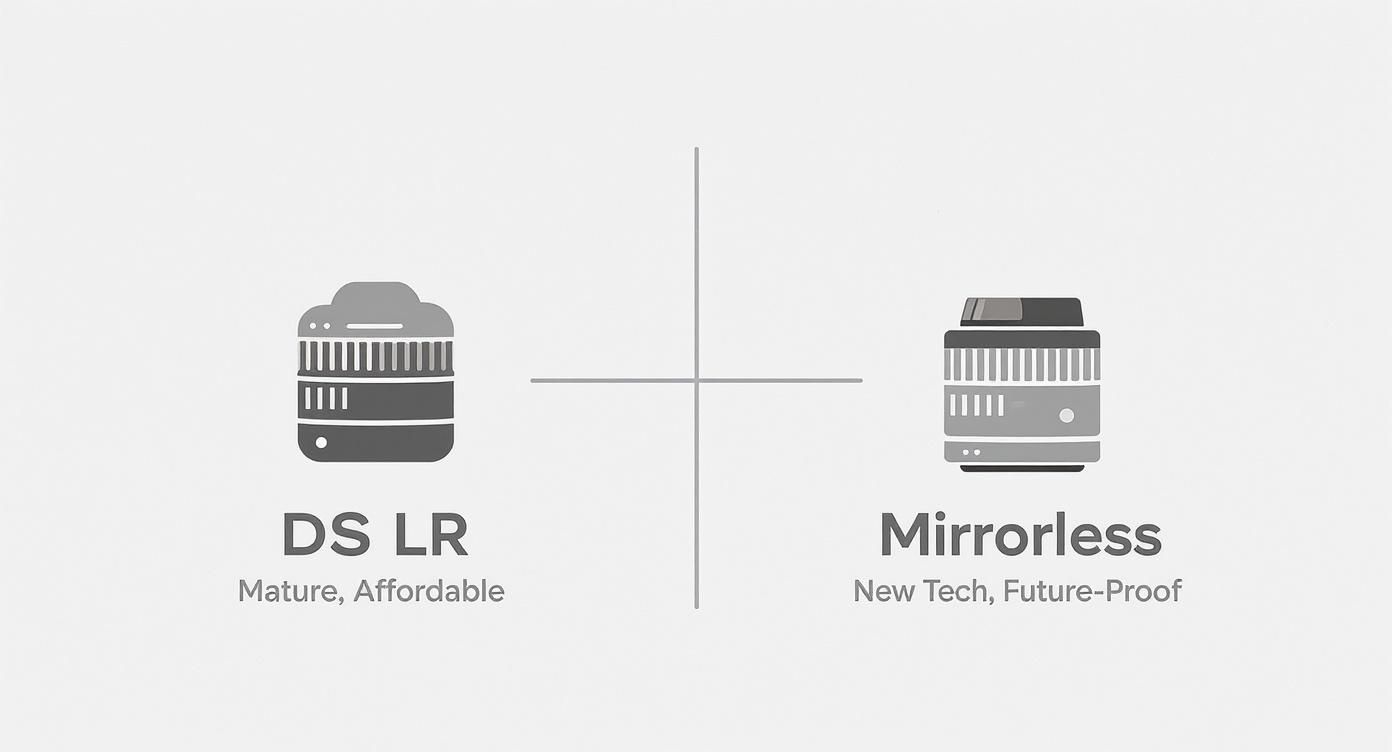
It really boils down to this: DSLRs offer a mature, affordable ecosystem, while mirrorless represents the future of camera technology.
If you're serious about shooting video, this isn't even a debate. The choice is clear. While DSLRs can produce gorgeous footage, they were always designed as stills cameras first, with video added as an afterthought.
Mirrorless cameras, however, were born for a hybrid world of photos and video. Their on-sensor phase-detection autofocus delivers the smooth, confident focus tracking that DSLRs just can't touch when filming. They also pack in features that videographers depend on:
The market has already voted with its wallet. In 2024, mirrorless camera sales officially overtook DSLRs, with roughly 2.9 million units sold compared to 2.4 million for DSLRs. This isn't just a trend; it's a fundamental shift, driven largely by the superior video capabilities of mirrorless systems.
Recommendation: If video is a primary—or even a significant—part of what you do, get a mirrorless camera. The technical advantages for video are just too massive to ignore.
After digging through all the tech specs and real-world differences, a few key questions usually bubble up. Let's tackle those head-on so you can feel completely confident in your final decision.
This is the big one, and the answer might surprise you: neither is inherently better. When you compare cameras at similar price points, you’ll find that both DSLRs and mirrorless systems deliver practically identical image quality.
What really drives the quality of your photos are the sensor size (like full-frame vs. APS-C) and the camera's image processor. The mirror mechanism, or lack thereof, doesn't actually impact the pixels. A $2,000 full-frame DSLR and a $2,000 full-frame mirrorless camera will give you images with the same detail, dynamic range, and low-light capability. The choice really comes down to the experience of shooting, not the final result.
Here's the bottom line: Don't get hung up on image quality when choosing between DSLR and mirrorless. Focus on the features that matter to you—the viewfinder, the autofocus system, the size—and how they fit your personal style.
"Obsolete" is a strong word, but there's no denying the industry has made its choice. All the major players—Canon, Nikon, Sony—are pouring their research and development money into mirrorless. All the exciting new lenses, firmware updates, and groundbreaking features are happening on the mirrorless side.
That said, DSLRs are far from useless. They are still incredibly powerful cameras that professionals rely on every day to create stunning images. If you're on a budget or already have a bag full of great DSLR glass, they offer tremendous value. It’s better to think of them as a mature, proven technology rather than an expired one.
Yes, you absolutely can! This is a huge relief for anyone with a collection of lenses who's considering the switch. Both Canon and Nikon make fantastic, first-party adapters that let you mount your old lenses onto their new mirrorless bodies.
These official adapters are designed to work flawlessly, preserving—and sometimes even improving—the autofocus performance of your glass. It’s like giving your favorite EF or F-mount lens a new life, letting it take advantage of the sophisticated on-sensor autofocus systems in modern mirrorless cameras. While cheaper third-party adapters exist, they can be hit-or-miss, so sticking with the manufacturer's own is the safest bet for reliable performance.
This all comes down to how each camera uses power. A DSLR’s optical viewfinder is just a clever series of mirrors and prisms. Looking through it uses zero battery. The camera only really sips power when you press the shutter or use the live view on the back screen.
A mirrorless camera, on the other hand, has to power a high-resolution screen constantly—either the electronic viewfinder (EVF) or the rear LCD. That continuous drain is what chews through the battery so much faster.
This gap is definitely narrowing as mirrorless cameras get more efficient, but if you’re shooting a long event and don't want to swap batteries, the DSLR still has a clear advantage.
Ready to explore the latest in camera technology and accessories? At FindTopTrends, we curate a wide selection of photography gear to help you capture your vision. Discover trending cameras, lenses, and more by visiting us at https://findtoptrends.com.




