


No products in the cart.

Free Shipping Australia-Wide

5 star customer service

Quality Tested Products

If you want to learn how to organize kids' toys, the very first thing to do—before you even think about buying cute new bins—is to declutter. This is the foundation. It's all about sorting through every last toy and deciding what's staying and what's going.
Getting this part right clears out the clutter and gives you a realistic idea of what you actually need to store, making it so much easier to create a system that your family can stick with.
Before you can organize, you have to know what you’re working with. I’ve seen it happen a thousand times: parents rush out to buy storage solutions, only to find they have the wrong sizes, the wrong types, or just not enough. Decluttering first avoids all that. Think of it as creating a clean slate for a peaceful, organized play space.
The sheer volume of toys coming into our homes is no joke. The global toy market hit an estimated $155.7 billion in 2021, and North America was responsible for nearly a quarter of that. So if you feel like you're drowning in toys, you're definitely not alone.
One of the most effective and straightforward ways to tackle the toy mountain is the four-box method. It’s simple. Just grab four boxes or bins and label them:
Try to get your kids involved in this process. Instead of framing it as "getting rid of stuff," you can ask which toys they think another child would be excited to have. It’s a great opportunity to teach them about generosity. And be sure to respect their attachment to certain items; forcing them to give up a special toy can backfire. This isn't just about cleaning up—it's about teaching them to be mindful of what they own.
The goal isn't just to get rid of things, but to mindfully curate a collection of toys that truly spark joy and creativity for your child. A smaller, well-loved collection is always better than a mountain of forgotten plastic.
This initial purge is like hitting a reset button for your playroom. For a deeper dive, this a comprehensive guide to organizing kids' toys offers fantastic insights. Once you have a handle on what you're keeping, you’ll be in the perfect position to build a smart storage system that lasts. Our guide on how to declutter your home has even more tips to help you get started.
Now that you’ve sorted through the mountain of toys, it’s time for the fun part: creating a storage system that actually works for your family. A great system isn't just about hiding the mess. It's about building an environment where your kids can easily find what they want to play with and—this is the magic part—put it away themselves. The secret is to think in zones.
Instead of one giant, chaotic toy box, try creating specific areas for different types of play. You could set up a cozy reading nook with forward-facing bookshelves, a creative corner with art supplies within reach, or a building zone with dedicated bins for LEGOs and blocks. This simple strategy stops the "everything bin" from becoming a black hole where good toys go to be forgotten.
This decision tree can help you visualize the sorting process you've just completed.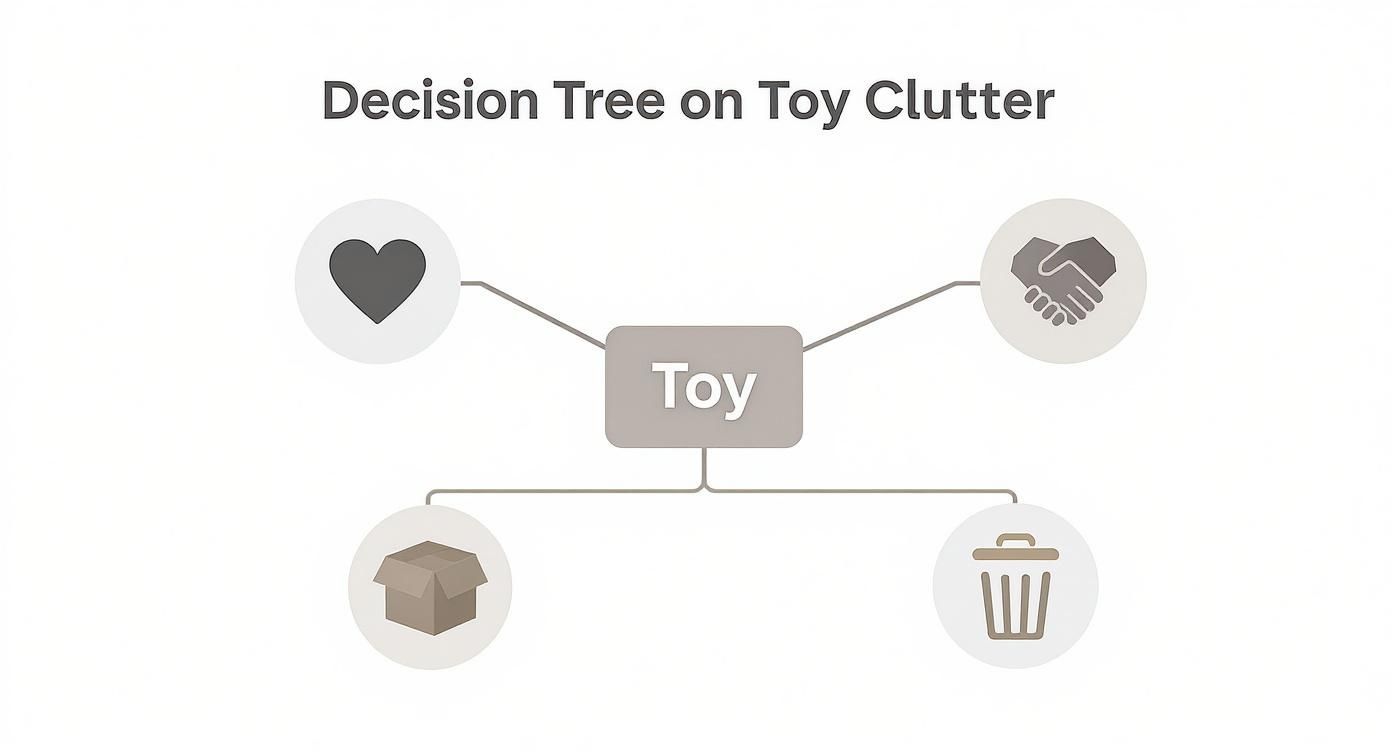
Having clear categories like "Keep," "Donate," and "Store" is the essential first step before you can build an effective storage system.
The containers you pick can make or break your whole system. I know those wicker baskets look gorgeous on Pinterest, but from experience, clear bins are often more practical. Kids can see exactly what's inside without having to dump the entire contents onto the floor.
If you're working with a smaller living area, think vertically! Going up is a game-changer for maximizing your floor space. Our guide on how to organize small spaces has some great ideas you can borrow.
Here are a few storage workhorses that I've found to be incredibly effective:
Choosing the right container for the right toy is key. This quick comparison table can help you match the best storage solution to your needs.
| Storage Type | Best For | Pros | Cons |
|---|---|---|---|
| Cube Shelving | Bulkier toys, books, fabric bins, display items | Versatile, stylish, keeps items off the floor | Can be bulky, open shelves can look messy |
| Clear Plastic Bins | Small-to-medium toys (LEGOs, dolls, cars) | Easy to see contents, stackable, durable | Can look cluttered if not uniform |
| Rolling Carts | Art supplies, craft kits, homework stations | Mobile, keeps projects contained, easy access | Limited capacity, can be a tipping hazard |
| Fabric Bins | Soft toys, dress-up clothes, blankets | Lightweight, kid-friendly, comes in many colors | Can lose shape, contents are hidden |
| Over-the-Door Hangers | Barbies, action figures, small craft supplies | Utilizes vertical space, great for small rooms | Limited weight capacity, can damage doors |
Ultimately, the best choice depends on what you're storing and how your kids play. A mix-and-match approach often works best!
The best toy storage systems are designed from a child's perspective. Keep frequently used toys on lower shelves at their eye level. This empowers them to make their own play choices and manage their own cleanup.
This is especially critical when you think about the holidays and birthdays. Globally, toy sales have risen by 7%, with a staggering 60% of annual sales happening during the holiday season alone. A flexible system is the only way to handle that influx without descending into total chaos. If you're looking to dive deeper, exploring guides on effective toys organizer storage solutions can give you even more ideas to implement in your home.
Let's be honest: the "everything" toy box is a recipe for disaster. It seems like the easiest solution, but it quickly turns into a bottomless pit where toys go to be forgotten. The secret to effective toy organization is creating categories that actually make sense to your kid. When a system is intuitive for them, they're more likely to play independently and clean up afterward.
So, how do you do it? Watch how your child plays. That's your biggest clue. You can group toys into logical sets that mirror their play patterns.
The right system is the one that clicks for your family.
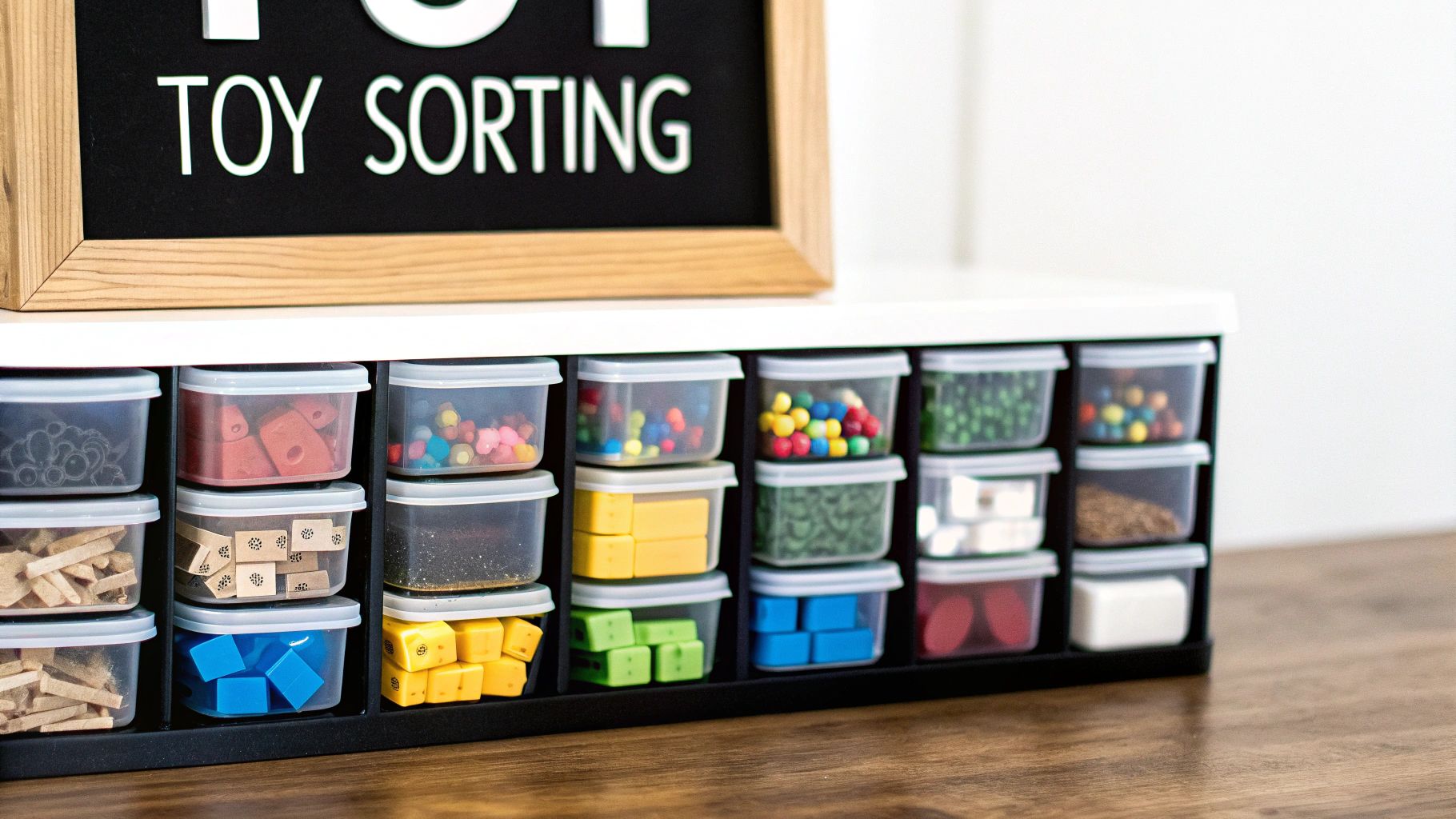
Okay, let's talk about the tiny-piece problem. Those intricate STEM kits, craft supplies, and board game pieces are a special kind of challenge. One lost component can render an entire toy useless. For these, your mantra should be containment and compartmentalization.
I've found that small, targeted solutions work best here. Simple zippered pouches are fantastic for keeping all the pieces of a single puzzle together. For craft supplies, those clear, compartmentalized containers you see for beads or fishing tackle are an absolute lifesaver. They keep googly eyes separate from pom-poms, which cuts way down on frustration when your little one is in the middle of a masterpiece.
With the educational toys market projected to hit an incredible $108.5 billion by 2030, we're seeing more and more of these amazing (but piece-heavy) STEM and coding toys. Keeping these valuable learning tools organized is non-negotiable. You can see more about these toy market trends on mordorintelligence.com. Dedicated, labeled containers are your best friend.
The real goal here is to give every tiny piece a home. When a child knows exactly where to find that one specific wheel for their robot, they can spend more time creating and less time rummaging through a giant bin.
It’s all about creating these little "micro-systems" that make a huge difference in the grand scheme of things. By the way, if you're looking for ideas that are a bit simpler to organize, you might want to check out our guide on https://letsparty-au.myshopify.com/blogs/news/toys-for-a-one-year-old. Sorting everything into clear, manageable groups is the first real step toward a playroom that's both fun and functional.
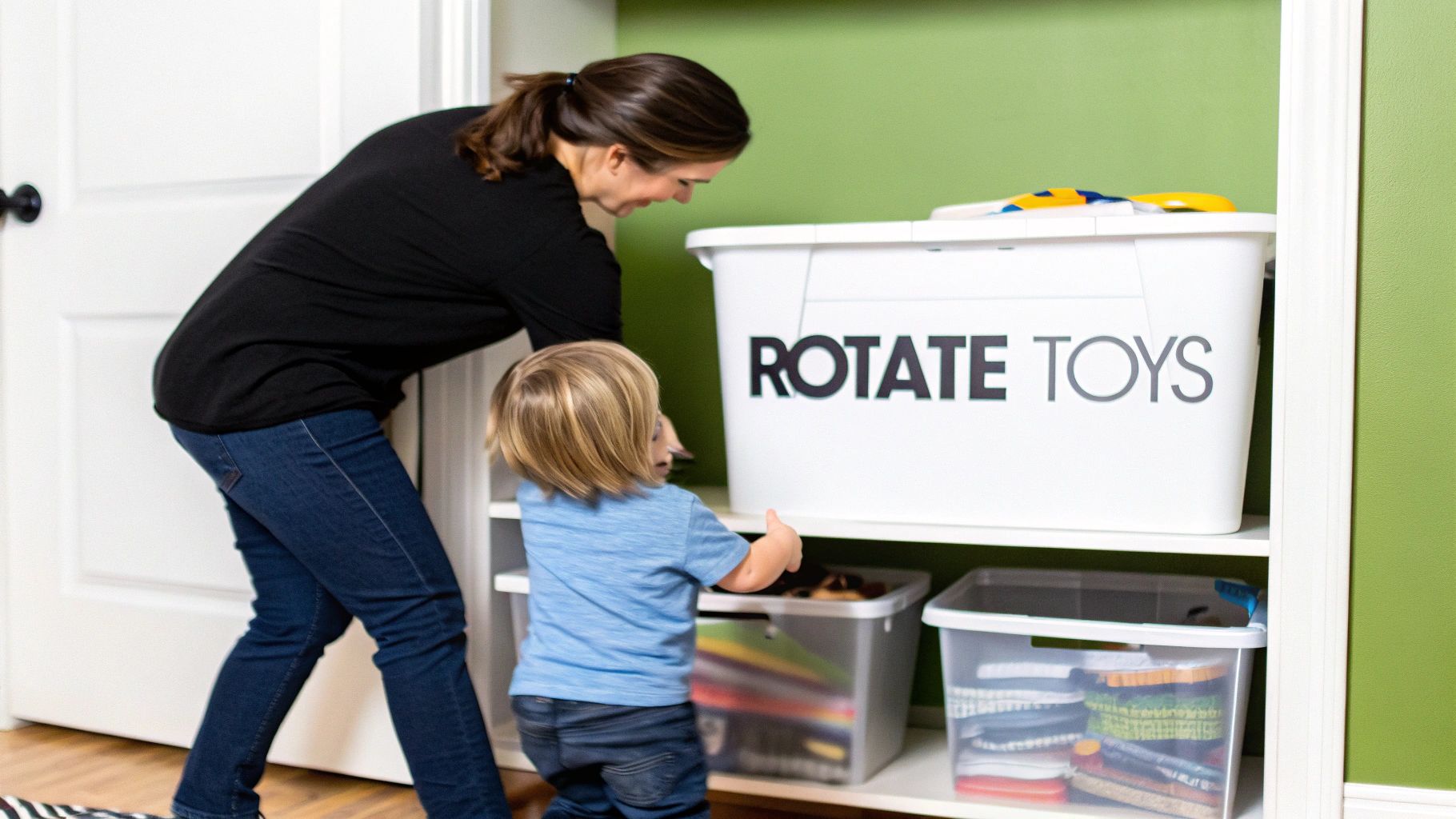
So, you’ve decluttered. Great job! But even with a smaller collection, the sheer number of toys can still feel like a lot. This is where a toy rotation system becomes an absolute game-changer.
The concept is brilliantly simple: you only keep a small, curated selection of toys out for your kids to play with. The rest? They go into storage, completely out of sight. This immediately cuts down on the daily mess and, just as importantly, helps prevent kids from getting overwhelmed by having too many options.
The real magic, though, is what happens when you swap the toys out. Those stored-away toys suddenly feel brand new again, sparking a wave of fresh excitement. I've seen it time and time again—it encourages deeper, more creative play without you having to buy a single new thing.
First things first, gather up all the toys that made the cut from your big sort-out. Now, split them into three or four separate groups.
Think about creating a balanced "play diet" in each box. You'll want a little bit of everything:
Once you have your groups, pick just one to stay out in the playroom. The others go into hiding. Opaque bins are your best friend here because "out of sight, out of mind" is the goal. Tuck them away in a closet, the garage, or under a bed—anywhere they won't be a constant temptation.
A toy rotation isn't about taking things away. It's about helping kids appreciate what they have. By limiting the choices, we encourage them to dive deeper into the toys that are available, which is incredible for their focus and creativity.
How often should you swap the toys? Honestly, there’s no magic number. Some parents I know do it every two weeks, while others find that a monthly or even seasonal rotation works better for their family.
Pay attention to your kids. A good signal to switch things up is when you notice they're getting bored or not really engaging with the current selection anymore. That's your cue.
When rotation day comes, make it a fun event. Get the kids involved in packing up the "resting" toys and picking out the next bin. This turns cleanup into an exciting activity and helps make toy organization a sustainable habit, not just a one-off project.
Getting the playroom organized is a huge win, but let’s be honest—the real victory is keeping it that way. The secret isn't a single, massive clean-up effort. It's about weaving small, consistent habits into your family's daily life. This approach not only stops the toy chaos from creeping back in but also teaches kids some incredibly valuable lessons about responsibility.
One of the best tricks I've learned is the "10-minute tidy-up" before bed. We set a timer, crank up a fun playlist, and make it a game. The goal isn't perfection; it's simply resetting the room for the next day. Everyone pitches in to put things back where they belong, and before you know it, the job is done without feeling like a chore.
To prevent the sheer volume of toys from becoming overwhelming, I always schedule a quick decluttering session before birthdays and holidays. It’s the perfect time. With the excitement of new gifts on the horizon, it’s much easier to convince kids to let go of things they’ve outgrown.
A truly organized space isn't a one-and-done project; it’s a living system. What works for a three-year-old who loves blocks won't work for an eight-year-old obsessed with LEGOs. You have to be ready to change things up.
As your kids' interests evolve, so should your storage. That might mean swapping out big, open bins for containers with dividers for all those tiny pieces, or maybe adding a rolling cart for art supplies.
It’s a good idea to periodically ask yourself a few questions about how the system is holding up:
By making these little tweaks and building a quick clean-up into your daily rhythm, you can actually maintain a functional, peaceful playroom that works for your family, not against it.
Even the most perfect system will have you scratching your head now and then. When it comes to corralling kids' toys, every family faces similar hurdles. Don't worry, you're not alone! Here’s my take on some of the questions I get asked all the time.
This is the million-dollar question, isn't it? The secret is to weave cleanup into your daily rhythm, making it as normal as brushing teeth. It's not a negotiation; it's just what we do after we play.
Turn it into a beat-the-clock game or a fun challenge like, "who can find five red toys first?" Most importantly, set them up for success. Your system needs to be simple enough for a toddler to manage. Use picture labels for little ones who can't read yet and make sure bins and shelves are at their level. If they can’t reach where a toy goes, they can’t put it away. And remember to praise the effort—that positive reinforcement goes a long way.
For things like LEGOs, beads, or puzzle pieces, containment is the name of the game. Small, dedicated containers are your best friend here.
I also recommend keeping these special containers on a slightly higher shelf. This way, you control when the tiny-piece-palooza happens.
It's always easier to prevent a spill than to clean one up. A little controlled access for those itty-bitty toys will save your sanity (and your vacuum cleaner).
When you're short on space, you have to think vertically. Get that clutter off the floor! Wall-mounted shelves, hanging mesh hammocks for the stuffed animal army, and over-the-door organizers are all fantastic options. Don't forget the goldmine of space under the bed—it's perfect for stashing away toys that aren't in the current rotation.
Also, look for furniture that can pull double duty. Think storage ottomans or a toy chest that also works as a bench. A toy rotation system is especially powerful in tight quarters because it automatically limits how much stuff is actually out at any given time.
Ready to find more smart solutions for your home? At FindTopTrends, we track down the best products to make your life easier and more organized. Find your next great purchase at https://findtoptrends.com.




