


No products in the cart.


Free Shipping Australia-Wide

5 star customer service

Quality Tested Products

Simple toys for a newborn aren't just for keeping them busy; they're the very tools that build your baby's brain, one connection at a time. Things like high-contrast cards, a soft rattle, or a textured ball are the fundamental building blocks for your little one's mind, turning simple playtime into a powerful learning experience.
Think of your newborn's brain as a brand-new city. At birth, it has all the buildings it needs (the neurons), but there are very few roads connecting them. Every single time your baby sees a new shape, hears a gentle sound, or feels a soft fabric, a new road—a neural pathway—gets paved between those buildings.
The more often that road is used, the stronger it gets. It’s like turning a little dirt path into a multi-lane superhighway. This is why simple, everyday play is so incredibly important. When you dangle a black-and-white toy in front of your baby, you’re not just catching their attention; you're giving their brain a workout, strengthening the pathways for vision and focus. A newborn's eyesight is still blurry, so they see those bold, contrasting patterns most clearly. Following that toy with their eyes is like reps at the gym for their visual tracking skills.
In the beginning, play is all about sensory exploration. Your newborn is a tiny scientist, learning about the world entirely through their senses—touch, sight, sound, and even movement. Every new sensory experience floods their brain with information, helping it piece together an understanding of this big, new world.
This process is so vital that a baby's brain actually overproduces connections. Later on, a natural cleanup process called synaptic pruning gets rid of the weak or unused pathways. This makes the active, well-traveled connections even stronger and more efficient. It’s the brain’s way of tidying up to focus on what’s most important, which is why those repeated play experiences matter so much.
The first three months are a period of astonishing brain growth. In fact, the brain doubles in size during the first year alone. Play-based sensory stimulation is the main engine driving this rapid expansion, laying the foundation for all future learning.
You don't need fancy, high-tech gadgets to fuel this incredible development. Often, the most effective toys are the simplest ones. An unbreakable mirror for tummy time encourages your baby to lift their head, strengthening neck muscles while sparking the first hints of self-awareness. An activity gym with a few dangling toys motivates them to reach and grasp, building the foundation for fine motor skills.
This growing understanding of developmental play is reflected worldwide. The market for these kinds of toys is projected to hit around $15 billion in 2025, showing just how much parents are recognizing the importance of early cognitive and sensory stimulation.
As you start looking for toys, remember that you are the secret ingredient that brings them to life. You can learn more about how to choose the top educational toys for infants to boost learning in our detailed guide. Every coo, every rattle, every moment of play is an opportunity to help build a brilliant mind.
It’s easy to feel a little lost when you see how fast your baby is growing. But the right toys can turn that feeling into a shared journey of discovery and joy. A newborn’s development isn’t a mystery—it follows a pretty predictable path of milestones. When you choose newborn brain development toys that line up with their current stage, you’re giving them the perfect little challenge to help them learn without getting frustrated.
Think of it like buying shoes for a growing child. You wouldn't hand a toddler a pair of sneakers three sizes too big. In the same way, a toy that's too advanced won't capture a newborn's interest. But one that's a perfect match for their abilities? That’s what will fascinate them and fuel their amazing progress. This simple, chronological approach helps you stay one step ahead, ready with the perfect toy at just the right time.
This visual timeline gives you a snapshot of just how incredible that brain growth is in the first few months.
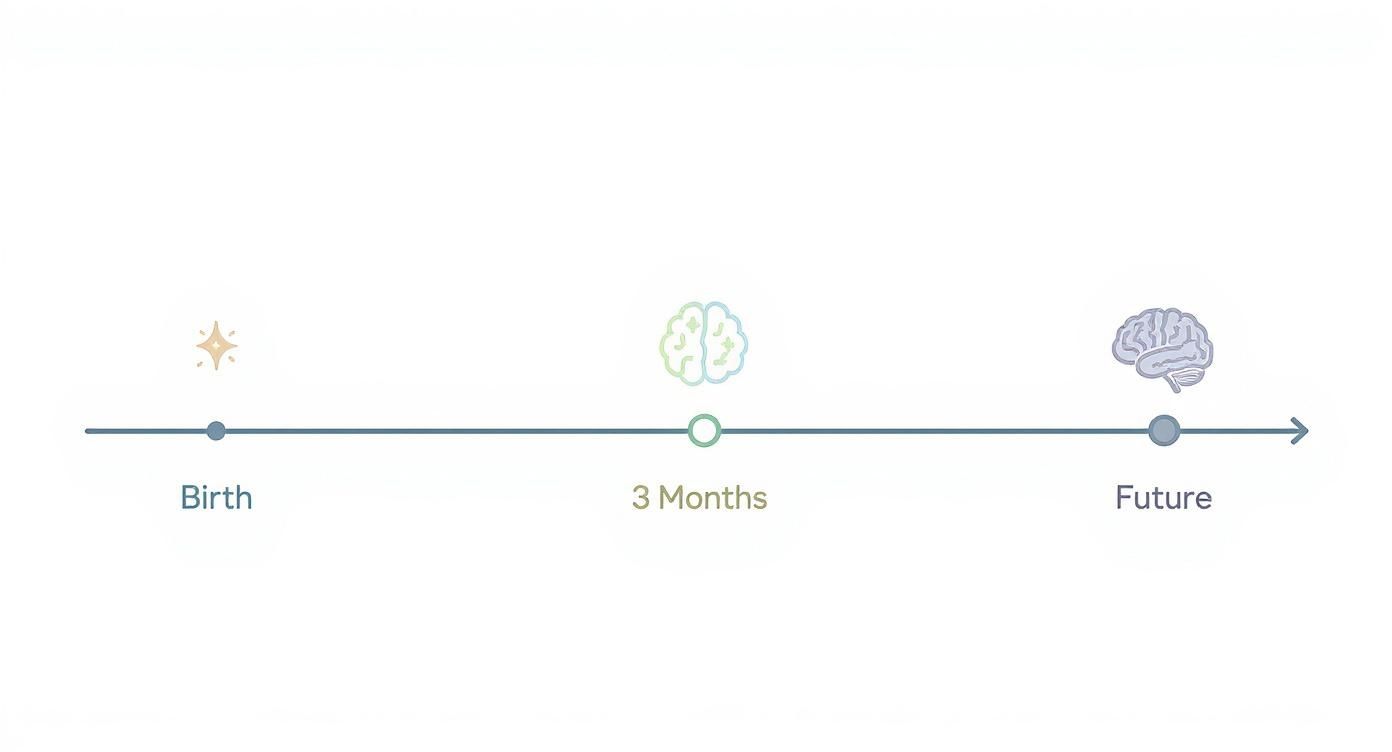
As you can see, the brain’s foundational wiring, which is already in place at birth, absolutely explodes by three months. This sets the stage for every single skill they'll learn down the road.
To help you connect the dots between milestones and toys, here's a quick guide that breaks down the first six months.
This table maps key developmental milestones in a newborn's first six months to the ideal types of brain-stimulating toys.
| Age Range | Key Brain Development Milestone | Recommended Toy Type | How It Helps |
|---|---|---|---|
| 0-3 Months | Developing vision and focus | High-contrast mobiles, black & white flashcards | Newborns see bold, contrasting patterns best. These toys encourage visual tracking and strengthen eye muscles. |
| 0-3 Months | Reflexive grasping | Lightweight rattles, wrist shakers | A baby’s initial grasp is an instinct. A light toy allows them to connect their movement with sound, an early lesson in cause and effect. |
| 4-6 Months | Purposeful reaching and grasping | Activity gyms, play mats with hanging toys | Encourages batting, reaching, and developing hand-eye coordination. Tummy time on the mat builds crucial neck and back strength. |
| 4-6 Months | Oral and sensory exploration | Textured teething toys, soft crinkly books | As babies start exploring with their mouths, these toys provide safe tactile and auditory feedback, soothing gums and building sensory awareness. |
| 4-6 Months | Developing fine motor skills | Soft, textured sensory balls | Passing a ball between hands builds bilateral coordination, while varied textures provide rich tactile input for a developing brain. |
By pairing the right toy with the right milestone, you're not just providing entertainment; you're actively supporting their cognitive journey from the very beginning.
In those first few weeks, your baby’s world is a soft, beautiful blur. Their vision is just coming online, which is why they’re so drawn to bold, high-contrast patterns. Their movements are mostly reflexive, driven by pure instinct. The big developmental "job" right now is all about strengthening their neck, learning to focus their eyes, and discovering those fascinating things at the end of their arms—their hands!
The best toys for this stage are wonderfully simple. They don't need fancy buttons or lights. Their only job is to meet your baby's senses right where they are.
Remember, the goal isn't to entertain but to engage. Short, focused periods of play, just a few minutes at a time, are far more effective than trying to create constant stimulation. A calm, attentive environment is where the best learning happens.
Once your baby hits the four-to-six-month mark, their world opens up in a huge way. Their vision gets sharper, they gain much more control over their head and neck, and their movements suddenly have purpose. This is when they start reaching, grasping, and putting absolutely everything in their mouth to explore.
This newfound coordination is a sign of a major leap in brain development. The neural pathways connecting what they see with what they can do are becoming superhighways. Toys at this stage should feed that exciting new ability to interact with the world.
Here are some of the best toys to support this phase:
By carefully choosing toys that match these milestones, you’re giving your baby the right tools at the right time. This thoughtful approach turns simple playtime into a powerful engine for building a strong, healthy brain.
Walking down the toy aisle can feel overwhelming. With so many colors, sounds, and textures vying for your attention, how do you choose the right newborn brain development toys? The secret is to shift your mindset. Instead of asking what a toy does, ask what it helps your baby learn to do.
Forget the complex gadgets for a moment. The most powerful tools are often the simplest ones, designed to target specific areas of growth. Think of it as turning playtime into a gentle, purposeful brain-building session.
This guide will walk you through the best toys for nurturing each of your newborn's developing senses and skills. We'll move beyond the marketing hype to show you how certain toys directly support visual tracking, auditory processing, tactile discovery, and motor control. It’s about turning a guessing game into a confident choice.
A newborn’s vision is a work in progress. Their world is a little fuzzy, which is why high-contrast patterns and gentle, slow movements are so captivating. Toys that cater to this developing eyesight are critical for helping them learn to focus, track objects, and recognize patterns—the very first steps in making sense of the world.
Here are a couple of fantastic options:
From day one, your baby is an expert listener, tuning into the symphony of sounds around them. The right auditory toys do more than just make noise; they teach profound lessons, like cause and effect. When an infant shakes a rattle and hears it jingle, they've just conducted their first science experiment: "When I do this, that happens!"
Look for these gentle sound-makers:
Key Insight: The goal here is stimulation, not overstimulation. A single, clear sound is far more beneficial for a newborn's brain than a chaotic mix of noises from too many electronic toys at once.
For a newborn, touch is a primary language. Their skin is incredibly receptive, and every new texture they feel—soft, bumpy, crinkly, smooth—sends a wealth of information to their brain. This is how they build their sensory library and begin to understand the physical properties of their world.
To engage their sense of touch, try these:
It’s no surprise that the market for toys that support these milestones is booming. Valued at $831 million in 2024, the infants and toddlers toy market is projected to hit $1.81 billion by 2032. This isn’t just a trend; it’s a reflection of parents actively seeking out toys that foster cognitive and motor skills.
Gross motor skills are all about the big muscles—the ones in the arms, legs, and torso that power major milestones like rolling over, sitting up, and crawling. The right toys can make the "work" of building this foundational strength feel like pure fun.
These toys are essentials for motor development:
As your baby grows, their play will naturally change. To get a peek at what's next, check out our guide on the best learning toys for 6-month-olds. And for more creative ways to engage all five senses, you can explore these fantastic sensory play ideas that support everyday development. By choosing toys that meet your baby where they are, you give them the perfect tools for their amazing journey of growth.
When you’re choosing toys to help your newborn’s brain develop, safety isn’t just a feature—it’s everything. The goal is to spark curiosity and wonder, but that can only happen in a completely secure play environment. A safe toy lets your baby explore without limits, giving you the peace of mind to soak in those incredible moments of discovery.
Think of it like building a house. You wouldn't hang beautiful pictures on a crumbling wall. In the same way, even the most engaging toy is useless if it isn't fundamentally safe for your baby to grab, hold, and inevitably, stick in their mouth. This guide will walk you through a simple checklist to make sure every toy is ready for playtime.
Navigating the labels on baby products can feel like trying to read a foreign language. You'll see phrases like "BPA-free" and "non-toxic" everywhere, but what do they actually mean?
Beyond the materials, a toy's physical construction is just as important. A newborn's movements are still clumsy and instinctual, so their toys have to be tough enough to handle being grabbed, dropped, and chewed on without falling apart. A quick once-over before playtime can make all the difference.
Your own hands are your best safety inspection tool. Before you give a toy to your baby, run your fingers over every inch of it. Feel for sharp points, rough patches, or anything that feels like it could come loose. It's a simple habit that takes seconds but provides invaluable protection.
Here are the red flags to always watch for:
The educational toy market is massive and growing fast—it's expected to jump from $66.22 billion in 2024 to $126 billion by 2032. But with that growth comes a flood of unbranded or knock-off products that might not meet safety standards.
By sticking to well-known brands that follow strict safety regulations (like ASTM F963 in the U.S.), you're buying an extra layer of confidence. You can learn more about the educational toy market and its safety challenges to understand why this matters.
Finally, keeping toys clean is a crucial part of safety. A baby’s immune system is still developing, so a simple cleaning routine helps keep germs at bay. Just get into the habit of wiping down plastic toys and tossing fabric ones in the wash as needed. When you make safety second nature, you create the perfect, nurturing space for your baby's amazing brain to grow.
While the right toys are fantastic tools, let’s be clear about a powerful secret: you are, and always will be, your baby’s most important “toy.” Even the most sophisticated newborn brain development toys can't compete with the simple, profound impact of your direct interaction. Your face, your voice, and your touch are the ultimate fuel for their developing mind.
Think of it this way—a toy is just an object until you bring it to life. A rattle is a piece of plastic until you shake it, smile, and show your baby what it can do. Your engagement and responsive care are what transform simple play into a rich, brain-building experience.
From the moment they’re born, babies are hardwired to connect with you. The most crucial learning doesn't happen during structured "learning time"; it happens in the simple, everyday moments you already share. These interactions lay the foundation for everything from language to emotional intelligence.
Best of all? Meaningful connection doesn't require special equipment. It's free, powerful, and available to you at any moment.
You know that high-pitched, sing-song voice that parents instinctively use when talking to a baby? It actually has a scientific name: parentese. And research has shown it’s a neurological superfood. The exaggerated vowels and melodic tones of parentese make it far easier for a baby’s brain to distinguish the sounds and syllables of speech, which can accelerate language development.
Your responsive interactions are the real engine of development. When you respond to your baby’s coo with a smile or a word, you're teaching them the fundamental rhythm of conversation. This back-and-forth exchange, known as “serve and return,” builds sturdy neural pathways for social and emotional learning.
Even simple games are profound learning tools. The classic game of peek-a-boo, for instance, is a fun way to teach object permanence—the idea that something still exists even when it's out of sight. For a young infant, grasping this concept is a massive cognitive leap.
Ultimately, the best toys are just props in the beautiful, unfolding play between you and your child. Your love, attention, and responsiveness are the true keys to nurturing a brilliant, thriving mind.
Ready to start playing? This is where the fun begins. Putting together your baby's first toy box isn't about buying everything you see. It’s about thoughtfully choosing a small, purposeful collection that supports all the incredible developmental leaps happening between 0-6 months.
The real magic is in finding versatile newborn brain development toys that grow with your baby. Think quality over quantity, always. A few well-selected items can open up a world of sensory learning and cognitive growth.
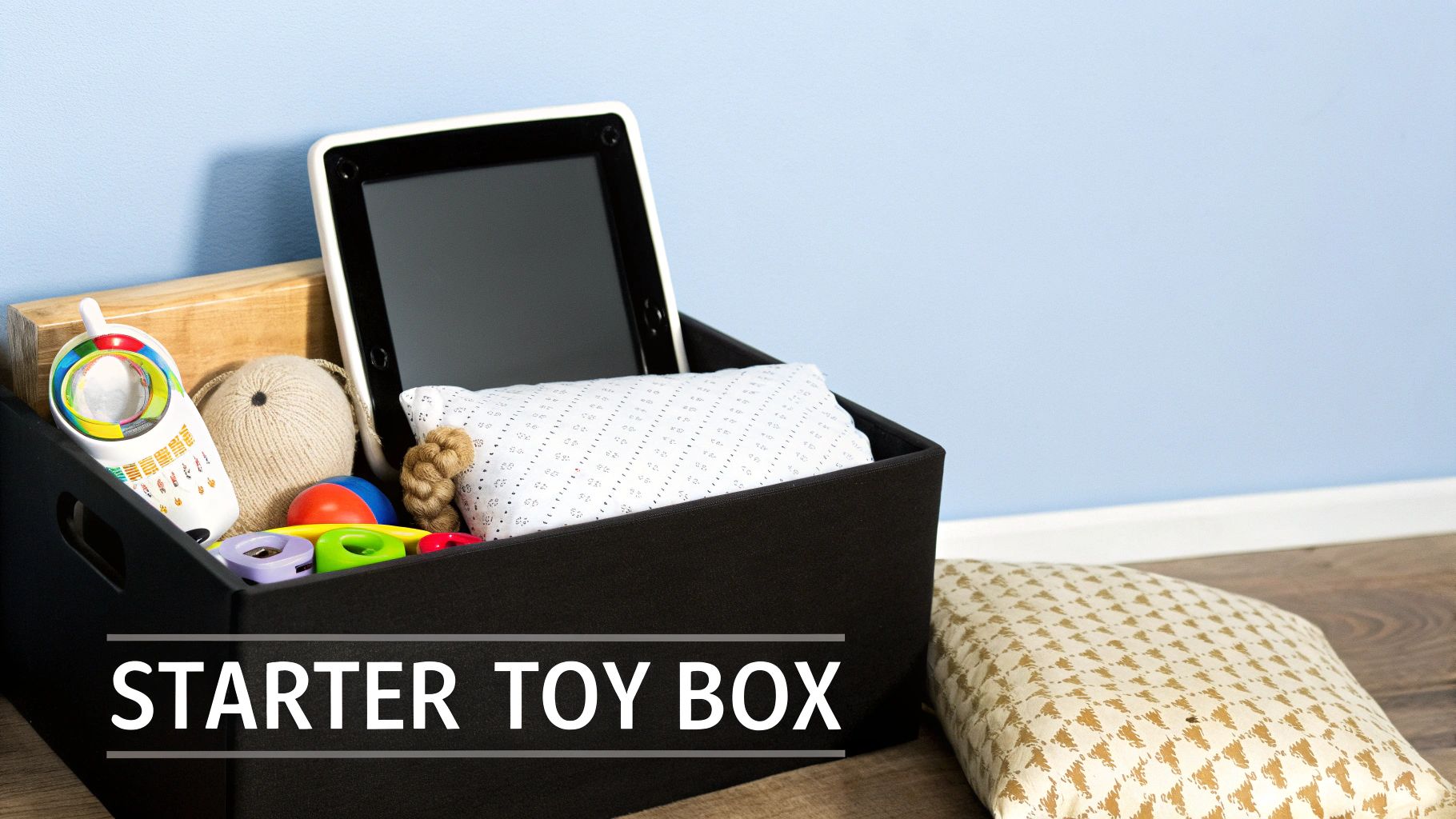
So, where do you start? I've put together a must-have list to get you going. Each item here is chosen because it targets a different, crucial area of early development, creating a fantastic foundation for learning through play. If you're looking for even more ideas, a guide on the best toys for newborn development can help you curate the perfect collection.
As your baby gets a little older, you can explore more specific options. We have a great list of recommended toys for a 2-month-old to guide you.
While you're building this little collection, it helps to keep a couple of core ideas in mind. These are the things that really make playtime meaningful.
The single most important principle is that your engagement brings any toy to life. A toy is just an object until you add your voice, your smile, and your interaction. You are the magic ingredient that transforms simple play into powerful brain-building.
Always look for toys that offer multi-sensory experiences—things that engage touch, sight, and sound. And of course, make safety your top priority. Always check for small parts and confirm that toys are made from non-toxic materials.
With this simple checklist and these guiding principles, you're all set to confidently support your newborn’s incredible journey through the profound power of play.
As a new parent, you're bound to have questions about what your baby really needs to thrive. Let's clear up some of the common ones so you can feel confident you're giving your little one the best start.
It's easy to get carried away and buy every cute toy you see, but honestly, less is more. For the first six months, a small, thoughtfully chosen collection of 5-7 key toys is plenty.
Think about it this way: you want to offer different sensory experiences, not create a mountain of plastic that overwhelms them. A few high-quality, versatile items will be far more engaging than a room full of clutter. Quality truly trumps quantity here.
The trick is to rotate them. Instead of piling everything in the playpen at once, switch out a few toys every week. This keeps things interesting and prevents your baby from getting bored.
A great way to approach this is by watching for new skills. For instance, once you see your baby starting to reach and bat at things (usually around four months), that's the perfect moment to bring out the activity gym. Your baby will give you cues—they'll let you know when they're up for something new.
A Quick Tip: Don't be surprised if a toy that was completely ignored last month suddenly becomes a favorite. A baby's brain is developing so fast that their interests change constantly. Rotation ensures there's always a just-right challenge waiting for them.
In a world full of screens, this is a big question. The expert consensus is clear: for babies under 18 months, nothing beats hands-on, real-world play. Their brains are wired to learn by touching, tasting, shaking, and dropping things.
A screen offers a passive experience that simply can't compare to the rich, multi-sensory feedback from a textured rattle or a crinkly fabric book. The most powerful "learning tool" your baby has is you and the world around them.
Ready to put together the perfect first toy box? At FindTopTrends, we've selected high-quality essentials designed to support every stage of your baby's early development. Explore our collection of baby care products today!




