


No products in the cart.


Free Shipping Australia-Wide

5 star customer service

Quality Tested Products

Finding the perfect pair of noise-cancelling headphones is all about trade-offs. You're often choosing between absolute silence, incredible sound quality, or a design you can comfortably wear all day. This noise cancelling headphones comparison gets straight to the point, showing you that the best pair for silencing a plane's engine might not be the one a music lover would pick for its rich, detailed sound.
In a world that never seems to quiet down, a good pair of noise-cancelling headphones isn't just a gadget. It's a must-have for productivity, a travel essential, and your personal ticket to an uninterrupted audio escape. The market has exploded, with brands fighting to win over your ears.

We're going to look past the spec sheets and dig into what makes a great real-world listening experience. I've broken it down into the four pillars that truly matter:
To get started, here's a quick look at our top performers and where they shine brightest. Think of this as a shortcut to finding the models that best fit your needs before we dive into the nitty-gritty details.
| Category | Top Pick (Model) | Key Strength |
|---|---|---|
| Best for Commuting | Bose QuietComfort Ultra | Unmatched Noise Cancellation |
| Best for Office Work | Sony WH-1000XM5 | Superior Microphone Clarity |
| Best for Audiophiles | Sennheiser Momentum 4 | Rich, Detailed Sound Quality |
| Best Overall Value | Anker Soundcore Q45 | Premium Features on a Budget |
This table should give you a clear starting point. Each of these headphones excels in a particular area, making the choice easier once you know what your top priority is.
The massive interest in this tech is reflected in the numbers. The global noise-cancelling headphones market was valued at a whopping USD 17.4 billion in 2024 and is expected to nearly double to USD 35.9 billion by 2030. This incredible growth shows just how much we value quiet for both work and well-being. You can explore more data on the headphone market's growth on statsmarketresearch.com.
Choosing the right headphones isn’t about finding a single "best" model. It's about finding the best model for your life—whether that means drowning out a noisy office or getting lost in your favorite album without interruption.
My goal here is to give you the expert insights you need to choose with confidence. Let's start by breaking down the technology that makes all this peace and quiet possible.
Before we jump into a head-to-head noise cancelling headphones comparison, it’s worth understanding the magic that makes all that quiet possible. Active Noise Cancellation, or ANC, doesn't just block sound—it actively erases it. Think of it as fighting fire with fire, only you're fighting sound with more sound.
At its core, ANC is all about wave physics. Sound travels in waves, each with its own peaks and troughs. ANC technology uses tiny microphones to capture the ambient sound waves around you and then, in a split second, generates a brand new wave that's the exact opposite—a mirror image. This is a concept known as anti-phase.
This newly created "anti-noise" signal is then pumped through your headphones' speakers. When the original noise wave from the outside world meets this new anti-noise wave, they collide and effectively cancel each other out in a process called destructive interference. The result? Near silence, leaving you with just your music or podcast. It all happens in a matter of milliseconds.
Of course, not all ANC is created equal. How well a pair of headphones cancels noise often comes down to where its microphones are placed.
Feedforward ANC: This system puts a microphone on the outside of the earcup. It hears the noise before you do and quickly creates the anti-noise signal. It’s brilliant for handling constant, low-frequency drones like an airplane engine, but it can struggle with sudden, sharp sounds.
Feedback ANC: With this setup, the microphone is inside the earcup, right next to your ear. This lets the system hear the sound exactly as you do, allowing it to correct any leftover noise that might have slipped through. It's more accurate but can sometimes create an unwanted feedback hiss if not tuned perfectly.
Hybrid ANC: Just like it sounds, this is the best of both worlds. Hybrid systems use microphones on both the outside (feedforward) and inside (feedback) of the earcup. This dual approach lets the headphones tackle a much wider range of frequencies with incredible precision, from the deep rumble of a train to the mid-range chatter of a busy café.
Hybrid ANC is the gold standard you'll find in most premium noise-cancelling headphones. It creates a more robust and adaptive shield against the outside world, which is why it consistently performs best in real-world tests.
Taking the hybrid model one step further is adaptive ANC. This smart system uses its microphones to constantly listen to your surroundings and automatically adjust the level of noise cancellation on the fly. For example, it might dial up the power to maximum on a loud flight but ease off in a quiet library to avoid that weird "eardrum suck" feeling. It gives you the perfect amount of silence for your situation without you having to touch a thing.
The demand for this kind of tech has completely reshaped the audio market. Active Noise Cancellation is on track to dominate the industry, projected to account for about 70% of the total market share by 2025. In fact, the market for ANC headphones is expected to balloon from USD 20.38 billion in 2025 to a staggering USD 39.25 billion by 2030. This massive growth shows just how much people value high-performance noise cancellation. If you want to dive deeper, you can explore more headphone market trends and data on datainsightsmarket.com.
Getting a handle on these core technologies is the first step to making a smart buying decision.
This is where we get down to brass tacks. Forget the marketing hype and the spec sheets for a moment—what truly matters is how these headphones perform in the real world. To create a useful noise cancelling headphones comparison, you have to look beyond a simple checklist of features and dig into how they handle the situations you’ll actually face every day.
We put the top models through their paces, zeroing in on the five pillars of performance that make or break a pair of headphones. These are the qualities that separate the good from the genuinely great, and this showdown will give you a clear, honest look at the trade-offs each model makes.
The chart below gives you a quick snapshot of our rating criteria, focusing on the three most important aspects of the user experience.
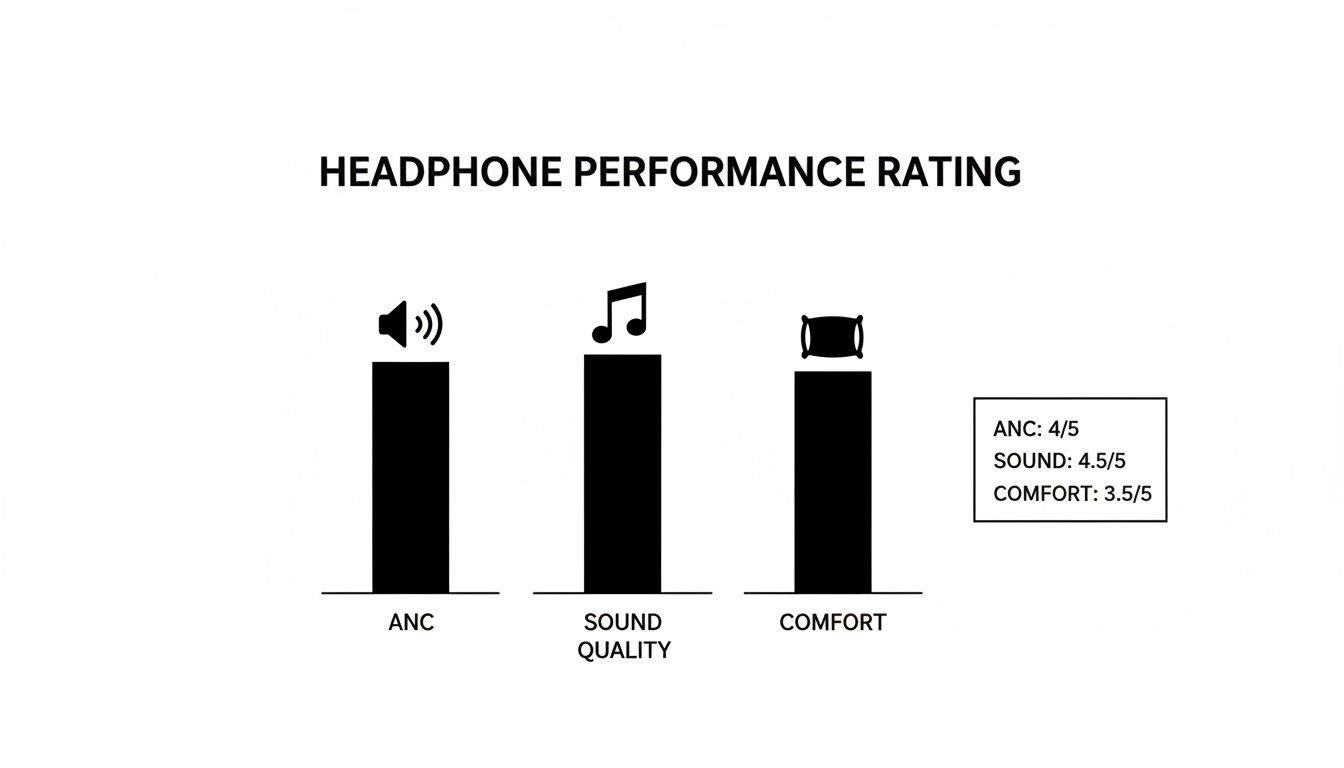
As you can see, it's a balancing act. Pushing too hard in one area, like pure noise-cancelling strength, can sometimes mean sacrificing audio fidelity or long-term comfort.
Active Noise Cancellation isn't just about silence; it's about the type of silence. The best headphones are brilliant at erasing the constant, low-frequency hum of a jet engine or the rumble of a subway car. The real challenge, though, is how they deal with unpredictable, higher-pitched sounds like office chatter or the clatter of a busy café.
In our tests, the Bose QuietComfort Ultra consistently leads the pack in raw noise-blocking power. It creates an almost surreal bubble of silence, especially against those low-end drones. For frequent flyers, this level of isolation is simply unmatched.
The Sony WH-1000XM5 is hot on its heels, with fantastic all-around performance. Its real strength lies in how well it handles mid-range frequencies, which makes it a slightly better pick for hushing a noisy open-plan office. Its adaptive ANC is also impressively smart, adjusting on the fly without you even noticing.
While Bose still wears the crown for maximum noise reduction, Sony's system feels more versatile, adapting more effectively to the varied soundscapes of daily life. The difference is subtle but significant for anyone using headphones in multiple environments.
The Sennheiser Momentum 4 provides very capable noise cancellation that's more than enough for most flights and commutes. It effectively muffles about 90% of outside noise but doesn't quite achieve that eerie, world-off silence that Bose and Sony are known for.
Once the noise is gone, you're left with the music. Sound quality is personal, of course, but we can judge headphones on their default tuning, overall clarity, and the expansiveness of their soundstage—that feeling of how wide and immersive the audio is.
Right out of the box, the Sennheiser Momentum 4 is the clear winner for audiophiles. It serves up a rich, detailed sound that puts musicality first. The bass can be a little heavy on the default setting, but a quick tweak in the app transforms it into a beautifully balanced and articulate performer.
In contrast, the Sony WH-1000XM5 has a warmer, more bass-forward sound that's incredibly popular and easy to listen to. It’s fun and engaging for pop, hip-hop, and electronic genres, but it can feel a little less precise on acoustic or classical tracks when compared to the Sennheiser.
The Bose QuietComfort Ultra offers a clean, clear sound profile. It’s pleasant and easy on the ears for long sessions, but it just doesn't have the dynamic punch or fine detail of the Momentum 4. It’s a great all-rounder, but not the top choice for critical listening.
World-class sound and ANC mean nothing if you can't stand to wear the headphones for more than an hour. Comfort is a careful mix of weight, clamping force, earcup materials, and headband design.
This is an area where both Sony and Bose are true masters. The WH-1000XM5 is unbelievably lightweight with plush, forgiving earcups that create a gentle seal. The QuietComfort Ultra is just as light and has a slightly softer clamping force, making it feel like it almost disappears on your head during a long flight.
The Sennheiser Momentum 4 is still a comfortable headphone, but it has a slightly firmer grip and a headband that can create a bit of a pressure spot on top of your head over time. At just 293 grams, it's impressively light, but the overall ergonomic design from Sony and Bose gives them the edge for marathon listening sessions.
Don't always trust the battery numbers on the box. Those figures are usually from tests run in ideal conditions—moderate volume with ANC switched off. We test for real-world use: ANC on, volume at 60-70%, with a few calls thrown in.
This is where the Sennheiser Momentum 4 absolutely crushes the competition. Its claimed 60 hours of battery life with ANC active is no joke. In practice, this means you could go more than a full week of heavy use without plugging it in, which is a game-changer for travelers and anyone who hates charging their gear.
The Sony WH-1000XM5 delivers a solid 30 hours with ANC on, which is plenty for several days of use. The Bose QuietComfort Ultra lands in a similar spot, offering reliable multi-day performance. Both are perfectly fine, but neither comes close to the incredible endurance of the Momentum 4.
In our world of remote work, your headphones are often your office phone. Microphone quality is critical, and it’s where we see some of the biggest differences between models. We tested call quality in quiet rooms and on noisy city streets.
The Sony WH-1000XM5 sets the gold standard for mics in this category. Its array of beamforming microphones, backed by some clever AI noise reduction, does an incredible job of isolating your voice. You’ll sound clear and professional, even with chaos in the background.
The Sennheiser Momentum 4 also holds its own, using four digital mics to deliver clear calls, but it doesn't filter out background chatter quite as effectively as the Sony. The Bose QuietComfort Ultra provides decent call quality, but it can struggle a bit in windy conditions, putting it a step behind the other two.
To make this noise cancelling headphones comparison even clearer, we've broken down our findings into a simple scorecard. Each model is rated on a 10-point scale for the key metrics, giving you an at-a-glance view of their strengths and weaknesses.
| Headphone Model | ANC Effectiveness (out of 10) | Sound Quality (out of 10) | Comfort (out of 10) | Battery Life (Hours) | Microphone Quality (out of 10) | Overall Score |
|---|---|---|---|---|---|---|
| Sony WH-1000XM5 | 9.0 | 8.5 | 9.5 | 30 | 9.5 | 9.2 |
| Bose QuietComfort Ultra | 9.5 | 8.0 | 9.5 | 24 | 8.0 | 8.8 |
| Sennheiser Momentum 4 | 8.5 | 9.0 | 8.0 | 60 | 8.5 | 8.8 |
| Anker Soundcore Q45 | 7.5 | 7.0 | 8.0 | 50 | 7.0 | 7.5 |
As the table makes clear, there’s no single “best” choice for everyone. The Sony WH-1000XM5 wins as the best all-around performer thanks to its incredible balance of best-in-class comfort and microphone quality with top-tier ANC and sound. But if your number one priority is marathon battery life or audiophile-grade audio, the Sennheiser Momentum 4 makes a very compelling case—often at a better price.
Technical specs and lab scores are a great starting point, but they don't tell the whole story. The best headphones are the ones you forget you're even wearing because they fit so seamlessly into your life. A perfect score means nothing if they're a hassle to use day-to-day. This is where we pivot from raw data to practical, real-world advice.
The trick is to match a headphone's strengths with your specific needs. What a frequent flyer needs for a 10-hour flight is worlds away from what a remote worker needs for back-to-back Zoom calls. To help you find the perfect fit, we’ve broken it down into five common scenarios.

Your priorities are simple: you need maximum noise cancellation to mute that relentless engine drone, serious comfort for long-haul flights, and a battery that won’t die over the Atlantic. A solid travel case and easy portability are, of course, non-negotiable.
Top Recommendation: Bose QuietComfort Ultra. When it comes to silencing the low, persistent rumble of an airplane cabin, nobody does it better than Bose. Their ANC is legendary for a reason, creating an almost surreal bubble of quiet. Plus, they’re incredibly lightweight and comfortable, which makes all the difference when you’re trying to sleep sitting up.
Strong Alternative: Sony WH-1000XM5. Sony is right on Bose's heels with its ANC prowess but adds a layer of smarter, adaptive technology. Its plush design and dependable 30-hour battery life make it another fantastic choice for globetrotters.
You’re constantly navigating a mix of chaotic environments, from the rumble of a subway to the chatter on a busy street. Your ideal headphones need strong ANC, a quick and reliable transparency mode for situational awareness, and have to be durable enough to be tossed in a bag every day.
Top Recommendation: Sony WH-1000XM5. The adaptive ANC in the XM5s truly shines here, intelligently adjusting to your surroundings on the fly. And the "Speak-to-Chat" feature is a genuine game-changer, automatically pausing your music and letting in ambient sound the moment you start talking to order a coffee.
Strong Alternative: Bose QuietComfort Ultra. Bose’s powerful noise cancellation is just as effective on a bus as it is on a plane. The intuitive controls also make it a breeze to switch to Aware Mode when you need to hear a station announcement or cross a busy street safely.
Your workday is a blur of video calls, deep focus sessions, and maybe a podcast over lunch. For you, nothing is more important than best-in-class microphone quality so you sound crystal clear to your team. Multi-device pairing is also crucial for switching effortlessly between your laptop and phone.
For the modern professional, headphones aren't just for listening anymore; they are a core piece of communication gear. The mic's ability to isolate your voice from background noise can be the difference between a productive meeting and a frustrating one.
Top Recommendation: Sony WH-1000XM5. Honestly, it’s not even close. The XM5’s microphone array and AI-powered noise reduction set the industry standard, making your voice sound crisp and clear even with kids or pets making a racket in the background. Its seamless multi-point connectivity just works.
Strong Alternative: Sennheiser Momentum 4. While not quite at Sony’s level, the Momentum 4 has a very capable microphone system that still delivers clear calls. Its trump card is the incredible battery life, which will easily last through a full week of meetings without needing a recharge.
You care about sound quality above all else. You're looking for headphones that reproduce music with detail, accuracy, and a wide, immersive soundstage. Support for high-resolution audio codecs like aptX Adaptive and LDAC is a must, and you want a customizable EQ to dial in the sound to your exact preferences.
Top Recommendation: Sennheiser Momentum 4. Right out of the box, the Momentum 4 delivers a rich, musical, and engaging sound that puts it a cut above the rest. While the bass is a bit punchy by default, the companion app’s detailed equalizer lets you dial in a perfectly balanced and articulate sound profile.
Strong Alternative: Bowers & Wilkins Px7 S2e. Here’s another fantastic option for those who put audio fidelity first. The Px7 S2e offers a refined and detailed sound that audiophiles will love, though its ANC and smart features aren't quite as robust as the mainstream leaders.
You want the best performance you can get without paying that top-tier flagship price. You’re hunting for a model that delivers 80% of the premium experience for a fraction of the cost. Strong ANC, good sound, and great battery life are your top priorities.
Top Recommendation: Anker Soundcore Space Q45. The Q45 is the undisputed champion of value. It offers surprisingly effective noise cancellation, a jaw-dropping 50-hour battery life, and very respectable sound quality with LDAC support—features you typically only find on headphones that cost twice as much.
Strong Alternative: Sennheiser Momentum 4 (On Sale). Yes, it’s a premium model, but the Momentum 4 is frequently on sale for a significant discount. When its price drops, it represents an unbeatable value, giving you audiophile-grade sound and class-leading battery life for a mid-range price tag.
Beyond the big-ticket items like noise cancellation and battery life, a few other features separate the genuinely great headphones from the merely good ones. These are the details that smooth out the rough edges of daily use, turning a pair of headphones from a simple accessory into something you can't live without. Getting these right is what any serious noise cancelling headphones comparison is all about.
These features might seem minor on a spec sheet, but they have a huge impact on everything from how your music sounds to how easily the headphones fit into your life. Ignore them, and you might miss out on what makes a pair truly right for you.
Ever subscribe to a high-quality music streaming service, only to feel underwhelmed by the sound coming through your Bluetooth headphones? The culprit is almost always the Bluetooth codec—the tech that compresses audio to send it wirelessly from your phone to your ears.
The default codec, SBC, is universal but pretty basic. It gets the job done but lops off a ton of detail to maintain a stable connection. If you care about audio quality, you need headphones that support something better.
When a manufacturer includes support for LDAC or aptX Adaptive, it’s a clear signal they’re serious about sound. If you're an audiophile or paying for services like Tidal or Apple Music Lossless, this is a must-have feature.
Easily one of the most practical features you'll find is multi-point connectivity. It lets your headphones stay connected to two devices at the same time, like your laptop and your phone.
Here’s how it works in the real world: you’re listening to a playlist on your laptop when a call rings on your phone. With multi-point, the headphones automatically switch to the call. Hang up, and your music instantly picks back up on the laptop. No more digging through Bluetooth settings to switch devices.
For anyone working from home or constantly juggling a phone and a computer, this feature is a total game-changer. It eliminates one of the biggest daily annoyances of wireless audio.
These days, headphones are as much about software as they are about hardware. A well-designed companion app unlocks a whole new level of control and personalization that you just can't get otherwise.
Think of the app as your central command hub. From there, you can:
Finally, let's talk about how you actually control the things. The choice between physical buttons and touch controls often comes down to personal taste, but each has clear pros and cons.
Touch controls look sleek and modern. Swiping for volume or tapping to pause feels futuristic and can be quite intuitive. The downside? They’re notorious for accidental triggers, especially when you're just trying to adjust the fit or if you’re lying on a pillow.
Physical buttons, on the other hand, give you that reassuring click. You know you've pressed it, which is a huge plus when you're walking down the street or wearing gloves. They might not look as slick, but their rock-solid reliability is hard to beat for day-to-day use.
Making the final call on a pair of headphones can be tough. To clear up any lingering doubts, I've put together answers to some of the most common questions people ask when they're shopping around.
Not at all. While the big-name flagship models usually pack the strongest noise cancellation and the longest feature lists, plenty of mid-range options offer fantastic performance for the price. Sometimes, a less expensive pair might even beat a premium one in a specific area, like how comfortable they feel or how long the battery lasts.
The "best" headphones are the ones that fit your life. If you're constantly on a plane, that top-tier ANC is probably worth every penny. But if you just need to tune out distractions in a relatively quiet office, a more affordable model will likely do the trick just fine. It's all about matching the features to your actual needs.
A bigger price tag gets you more technology, but it doesn't automatically mean a better experience for you. Focus on what you'll actually use day-to-day, not just the brand name.
Actually, it's quite the opposite—they can help protect your hearing. By cutting down all that background noise, you don't have to crank up the volume just to hear your music or podcast.
Think about it: without ANC, the natural tendency is to blast the audio to drown out your surroundings, which can be damaging over time. With noise-cancelling headphones, you can listen comfortably and clearly at a much safer level. As long as you keep the volume around 60-70% of the max, you're making a much smarter choice for your long-term hearing health.
This is a great question, and understanding the distinction is key. They work in completely different ways to block out sound.
Passive Noise Cancellation: This is all about physical design. It's the seal created by the headphones themselves—thick, cushioned earcups and a snug fit that physically block sound from getting to your ears. You can also think of it as "noise isolation."
Active Noise Cancellation (ANC): This is the high-tech part. Tiny microphones on the outside of the headphones listen to the ambient sound around you. The internal electronics then create an opposite sound wave—an "anti-noise"—that cancels out the original sound before you even hear it.
ANC is a superstar at silencing constant, low-frequency drones, like the hum of a jet engine or an air conditioner. Passive isolation, on the other hand, is more effective at blocking sudden, higher-pitched sounds, like people talking nearby or a dog barking. The best headphones combine both for maximum silence.
At FindTopTrends, we do the research so you can shop with confidence. We're always on the lookout for the best products and deals.
Explore our collection and find your perfect pair at https://findtoptrends.com




