


No products in the cart.


Free Shipping Australia-Wide

5 star customer service

Quality Tested Products

Choosing the right photo editing software really boils down to one thing: your needs. On one hand, you have industry-standard powerhouses like Adobe Photoshop that offer unmatched depth for professionals. On the other, you have AI-driven tools like Luminar Neo built for speed and efficiency, perfect for content creators. The best choice for you lands somewhere in between, depending on your goals, budget, and how you like to work.
Finding the right photo editor can feel overwhelming, but it doesn't have to be. The trick is to stop looking for the "best" software and start looking for the best fit for you. Whether you’re a tech enthusiast perfecting product shots, a hobbyist breathing new life into old family photos, or a pro who needs pixel-perfect control, there’s a tool out there with your name on it.
This guide is your side-by-side comparison of the top contenders. We'll look at the big names like Adobe Photoshop, AI-first innovators like Luminar Neo, the powerful and free GIMP, and the incredibly handy mobile editor, Snapseed. My goal is to go beyond a simple feature list and give you the context to make a smart decision—one that fits your ambition without a frustrating learning curve or a price tag you don't need.
As a quick side note, great editing starts with great organization. Before you get too deep, you might want to learn how to organize digital photos to make your entire workflow smoother.
It’s no surprise that the demand for good photo editing tools is exploding. The global market for this software was valued at USD 2.37 billion in 2025 and is expected to climb to USD 3.29 billion by 2032. This isn't just about professional photographers; it's driven by everyone creating content, from social media influencers to small e-commerce shops.
North America still holds the biggest piece of the pie with a 34.2% share, mostly thanks to giants like Adobe. You can dig into more of this data on photo editing software market trends over at Coherent Market Insights.
For the FindTopTrends audience, the sweet spot is what we call the "prosumer" category. These are hobbyists and creators who want professional-level features without the professional price. This group is actually the largest segment of the market at 44.6%, which proves you don't need a huge budget to get incredible results.
Before we jump into the head-to-head comparisons, let’s quickly define the criteria I'll be using to judge each tool. Knowing what to look for makes the decision a lot easier.
| Feature Comparison | Description | Why It Matters |
|---|---|---|
| Core Functionality | The essential tools for editing: layers, masks, color correction, etc. | This determines the software's raw power and creative ceiling. |
| Learning Curve | How easy it is for a new user to jump in and get started. | A steep learning curve can be a major roadblock for beginners. |
| Pricing Model | Subscription, one-time purchase, or completely free. | This directly impacts your budget and how you invest in your tools. |
| Best Use Case | The specific type of work where the software really shines. | This helps you match the tool to the tasks you perform most often. |
Picking a photo editor isn't about finding the one "best" program—it's about finding the right tool for your work. A professional studio photographer has completely different needs than a hobbyist capturing landscapes or a content creator prepping images for Instagram. This breakdown will put the top contenders—Adobe Photoshop, Luminar Neo, GIMP, and Snapseed—side-by-side to show you exactly where each one shines.
We're going to dig deeper than just feature lists. We'll look at how these tools handle real-world workflows and performance. The goal is to give you a practical, no-nonsense understanding of how they actually feel to use, so you can make a choice that fits your skills, budget, and creative goals.
This simple visual guide boils the selection process down to three key actions, helping you align the software's capabilities with what you want to achieve.
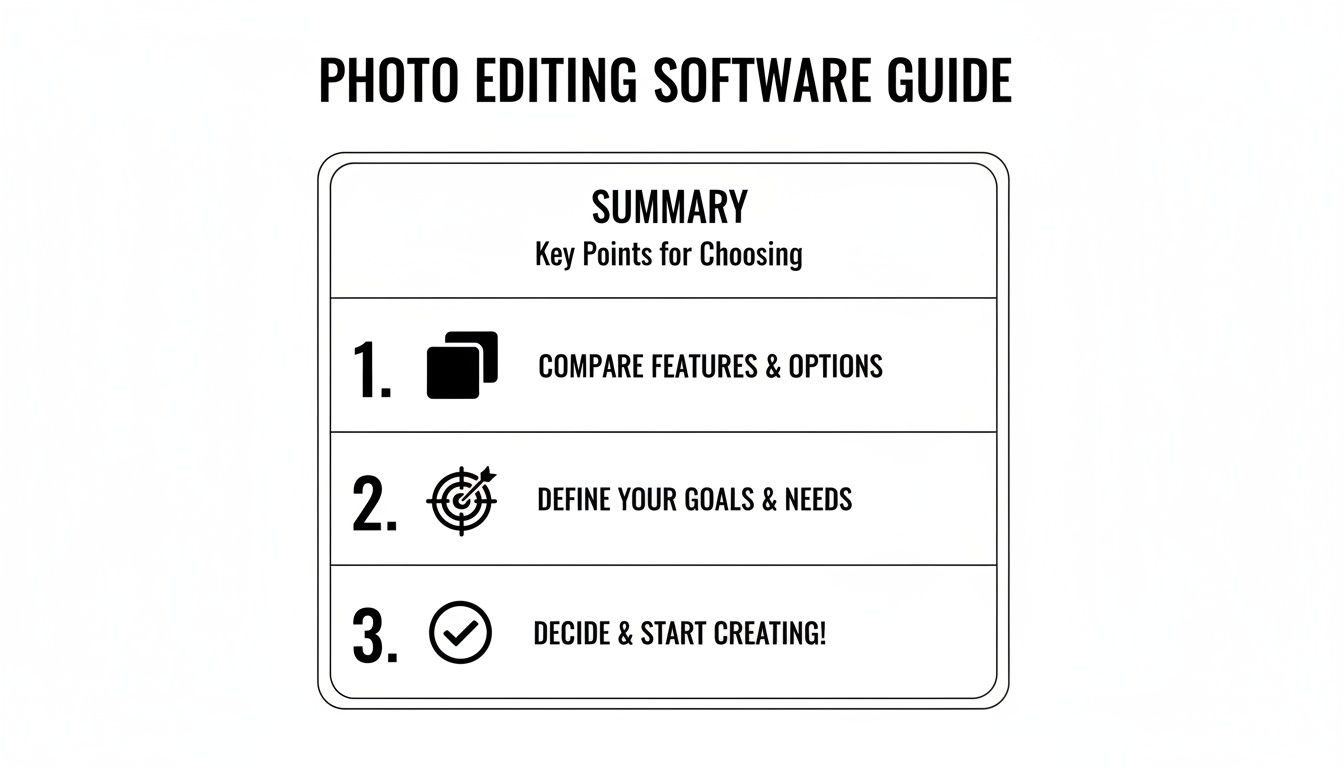
It really comes down to this: compare your options, define your needs, and make the call. That's the path to finding the perfect editing tool for you.
There's a reason Adobe Photoshop remains the undisputed heavyweight champion. Its real power lies in its incredible depth and pixel-level control, making it the essential tool for professionals who need absolute precision. For complex compositing, high-end retouching, or detailed product photo cutouts, Photoshop’s layering and masking systems are simply in a class of their own.
Of course, all that power comes with the steepest learning curve on our list. For a beginner, the sheer number of tools and panels can feel overwhelming. But for anyone willing to put in the time, Photoshop offers a creative ceiling that's practically limitless.
Key Differentiator: Photoshop’s non-destructive workflow is its secret sauce. Using layers, masks, and Smart Objects, you can make endless adjustments without ever damaging your original image. For professional work, that flexibility is non-negotiable.
Luminar Neo takes a totally different approach. It's built for speed and AI-driven automation rather than meticulous manual control. While it doesn't have the granular depth of Photoshop, its magic is in making complex edits incredibly fast and accessible. Features like one-click sky replacement, AI portrait enhancement, and intelligent object removal can literally save you hours of tedious work.
This makes Luminar Neo a fantastic choice for content creators, travel photographers, and hobbyists who want stunning results without getting lost in the technical weeds. It’s less about pushing individual pixels and more about getting a beautiful final image, fast.
For a deep dive into how this technology is being applied in specific fields, this best AI headshot generator comparison offers a great look at a focused AI application.
For anyone on a tight budget, GIMP (GNU Image Manipulation Program) is an impressive—and completely free—alternative to Photoshop. As an open-source project, it’s maintained by a community of developers and packs a surprisingly powerful punch. You get layers, masks, advanced color correction tools, and even support for third-party plugins.
The trade-off? GIMP's user interface is often seen as less polished and intuitive than its paid competitors. It can feel a bit clunky and definitely requires more patience to master. Still, for students, hobbyists, or anyone who just can't stomach a subscription fee, GIMP delivers professional-grade tools at zero cost.
When it comes to editing on your phone, Snapseed (made by Google) is a true standout. It strikes a perfect balance between power and simplicity. It’s ideal for on-the-go edits, packing professional-level tools like selective adjustments, healing brushes, and even RAW development into an intuitive, touch-friendly interface.
It won't replace a desktop program for huge, multi-layered projects, but it’s the perfect tool for quickly punching up photos for social media or making quality adjustments right from your camera roll. Snapseed is proof that you don't always need a big screen to do great work.
To really see how these tools stack up, here’s a side-by-side breakdown of the essential features, who they’re for, and how they perform. This table cuts through the noise and helps you see the best fit for your workflow at a glance.
| Software | Core Strength | Best For | Learning Curve | Pricing Model |
|---|---|---|---|---|
| Adobe Photoshop | Unmatched precision and control | Professionals, artists, tech enthusiasts | Very Steep | Subscription |
| Luminar Neo | AI-powered speed and automation | Content creators, hobbyists | Easy to Moderate | One-time purchase or Subscription |
| GIMP | Free, open-source power | Budget-conscious users, students | Steep | Free |
| Snapseed | Powerful mobile editing | Social media users, mobile photographers | Very Easy | Free |
This comparison clearly shows a divide in the market. Photoshop continues to dominate, holding about a third of the market share for a reason—its powerful toolset is built for creators who demand ultimate control. On the other end, free tools like GIMP challenge the premium model but often compromise on user experience.
Meanwhile, mobile apps like Snapseed own the on-the-go niche but lack the depth for heavy-duty projects. For budget shoppers on FindTopTrends, the good news is that the entry-level market in North America is growing at a 9% CAGR, meaning more accessible tools with solid features are constantly emerging. This gives you great options at every price point.
Let's be honest, the operating system you use—whether it's Windows, macOS, or your phone—has a huge impact on your editing experience. A beast of a photo editor will crawl on the wrong hardware, but a well-matched setup makes your workflow feel absolutely seamless. Getting this right is the first step to building an efficient creative process.
The old platform wars still cast a long shadow over the photo editing software world. Windows holds the crown with a 45% market share in 2024, mostly because it's just so versatile. It’s the go-to for everyone from tech geeks tweaking gadget photos to businesses polishing product shots. On the flip side, macOS is expected to grow steadily through 2033, pulling in creative pros who love its polished ecosystem—especially in North America where Apple users often swear by Lightroom's deep integration. For a deeper dive into these trends, check out the detailed photo editing software market report from Market.us.
When it comes to flexibility, nothing beats Windows. It offers the widest compatibility with both software and hardware, which is a massive advantage. This lets you build a custom editing machine that perfectly fits your performance needs and, just as importantly, your budget.
You can run a high-end rig with a top-of-the-line graphics card or make a more modest setup sing. Editors like GIMP and ON1 Photo RAW, for instance, run beautifully on Windows, giving budget-conscious photographers access to some seriously powerful tools. This makes it a fantastic choice for hobbyists and serious amateurs who want high performance without being locked into a single hardware brand.
For years, creative professionals have leaned on macOS for its legendary stability, spot-on color accuracy, and cohesive ecosystem. The tight-knit relationship between Apple's hardware and software often translates into more predictable, optimized performance, especially when you're pushing demanding apps like Adobe Photoshop and Capture One to their limits.
The real magic, though, is the workflow. Starting an edit on an iMac and then seamlessly picking it up on an iPad Pro with Photoshop for iPad is a game-changer for many. If you're a photographer who juggles multiple creative apps, the unified macOS environment can seriously slash your project turnaround times.
Key Insight: The performance gap between Windows and macOS isn't the chasm it used to be. Today, the choice is less about raw power and more about which ecosystem and workflow feel right for you.
Mobile platforms have completely changed the game, turning photo editing from a desk-bound chore into something you can do anywhere. Apps like Snapseed and Lightroom Mobile let you get incredible results right from your phone or tablet. They're perfect for social media creators and travel photographers. The convenience is amazing, but it's not without its trade-offs.
At the end of the day, the best platform is the one that works in harmony with your camera, computer, and creative ambitions. Once your edits are done, knowing how to export them is just as crucial. To make sure your images look fantastic everywhere they're shared, take a moment to understand the differences between JPEG vs PNG and which image format you should choose.
Features and specs on a page can only tell you so much. To really get a feel for a photo editor, you have to see how it performs when the rubber meets the road. Let's step away from the technical jargon and walk through a few common situations to see how each of these tools shines in a real-world workflow.
Seeing them in action will help you picture exactly how one might slot into your own creative process.

Let's say you run an online store and just wrapped a shoot for your new product line. Your mission is to create crisp, clean images with a pure white background that will pop on your website. This is home turf for Adobe Photoshop; it’s the undisputed king of this domain.
Here’s what that process looks like in Photoshop:
This is why the pros stick with Photoshop. It gives you the painstaking, layer-by-layer control needed to produce commercial-quality images that build trust and drive sales.
Now, imagine you’re back from a trip with a camera full of stunning landscapes. You’ve got a shot you love, but the sky is a bit flat and the colors feel muted. You want to make it epic, but you don’t have all afternoon to spend editing. This is the perfect job for Luminar Neo.
In just a few clicks, you can completely transform the image:
Key Takeaway: Luminar Neo is all about getting jaw-dropping results, fast. Its AI tools do the heavy lifting on tasks that would take ages to do manually, making it a dream for anyone who values speed and efficiency.
Let's switch gears to a more sentimental project. You’ve just scanned a precious family photo from decades ago. It's faded, cracked, and has that classic yellow tint from age. You want to restore it for a gift but don't have the budget for a pricey software subscription. This is where GIMP, the free and open-source powerhouse, comes to the rescue.
Here’s how you could bring that old memory back to life:
GIMP really proves its worth in scenarios like this. It might take a bit more manual effort than some of the paid tools, but it has all the core power you need for a complex restoration project without costing a dime. Of course, the better the original photo, the easier the restoration. A big part of any photo project is lighting, and for anyone starting out, learning about some essential photography lighting equipment for beginners can dramatically improve your source images, saving you a ton of editing time later.
Finally, a situation we’ve all been in: you snap a great portrait with your phone, but the lighting is just a little off. You want to make your friend pop before you share it on Instagram. This is exactly what mobile editors like Snapseed were made for.
You can take a photo from good to great in less than two minutes:
The best part? This all happens right on your phone, making the process incredibly fast and intuitive. Snapseed delivers powerful results that are perfect for the on-the-go nature of social media.
The price tag on a piece of photo editing software is easy to spot, but it rarely tells the whole story. A smart decision goes beyond the initial dollar amount and digs into the long-term value. Sure, a free tool saves you money upfront, but what if a subscription saves you hours of tedious work each week? That's where the real value lies.
Let’s break down the true cost of ownership across the three main pricing models you'll encounter.
We'll look at the subscription model, the one-time purchase, and the free-to-use options to help you figure out what makes the most sense for your wallet and your workflow.
When you think of subscriptions, Adobe's Creative Cloud Photography Plan immediately comes to mind. It bundles Photoshop and Lightroom together, and while the recurring monthly or annual fee can feel like a big commitment, it comes with some serious perks. You're always running the latest version, getting new features, bug fixes, and critical updates automatically.
For professionals and serious hobbyists, this is often a no-brainer. Your work relies on having the industry-standard toolkit, and the predictable cost is easy to factor into a business budget. Having both of these powerhouse programs working together seamlessly is a huge workflow advantage that, for many, easily justifies the ongoing payments.
Programs like Luminar Neo and ON1 Photo RAW fly the flag for the one-time purchase. You pay once, and that version of the software is yours to keep. Forever. This is a huge draw for anyone who hates recurring bills and prefers a clear, upfront cost. It feels solid, like buying a physical tool for your workshop.
The catch? "Owning it forever" applies to that specific version. When a major new release packed with exciting features drops—which usually happens annually—you'll need to pay an upgrade fee to get it. It’s typically less than buying the software from scratch, but it's an important factor to weigh in the total cost of ownership over time.
For many photographers, the one-time fee provides peace of mind. You get a powerful, feature-rich editor without the pressure of a monthly bill, making it a fantastic middle-ground for creators who want more than a free tool can offer but aren't ready for a full subscription commitment.
Then you have the completely free options, with GIMP being the most famous example. From a purely monetary standpoint, the value is unbeatable. You get an incredibly capable and surprisingly deep editor for absolutely nothing. It’s a fantastic resource for students, beginners, or anyone on a shoestring budget.
The trade-off, however, is paid in time and patience. Free tools often have a steeper learning curve, a less intuitive interface, and no dedicated customer support to help you out of a jam. You're on your own. But for a self-starter who doesn't mind diving into forums and watching tutorials, GIMP offers tremendous power without ever costing a dime.
Alright, let's cut through the noise. Choosing the right photo editor really boils down to what you do and how you like to work. There isn't a single "best" program out there—just the best tool for the specific job you have in front of you.
This is where we pull everything together and give you straight answers. I’ll match each program's real-world strengths to the people who will get the most out of them, so you can pick the software that actually helps you create, not one that gets in your way.
If you need absolute, uncompromising control, Adobe Photoshop is still king of the hill, and it's not even close. For commercial work, complex composites, and pixel-perfect edits, its deep feature set and industry-standard layering system are essential.
Yes, there's a steep learning curve. But for anyone who needs limitless creative power and seamless integration with tools like Lightroom, investing the time to learn Photoshop is a no-brainer. It’s built for those who demand precision.
For creators on a deadline who need to pump out gorgeous images fast, Luminar Neo is a game-changer. Its AI tools are genuinely impressive, turning tasks like sky replacement or portrait touch-ups into one-click affairs.
If your main goal is getting stunning, shareable photos for social media, a blog, or your travel portfolio without spending hours on edits, Luminar Neo is your workhorse. It delivers fantastic results in a fraction of the time.
Your time is valuable. For a creator juggling multiple projects, software that saves hours on tedious edits isn't just a tool—it's a business asset.
Looking for professional-grade power without the price tag? GIMP is your answer. It's completely free and open-source, yet it packs all the core features you need for serious editing—we're talking layers, masks, advanced filters, the whole deal.
It might not have the slick, polished feel of its paid rivals, but its capabilities are undeniable. For students, hobbyists, or anyone who needs a powerful editor on a zero-dollar budget, GIMP is an incredible resource.
When you're trying to pick the right photo editor, a few common questions always seem to pop up. We've compiled the answers to the questions we hear most often to help you nail down your final choice.
Honestly, it all comes down to what you want to achieve. Free software like GIMP is surprisingly capable—you get advanced tools like layers and masks that are more than enough for many hobbyists. The trade-off is often a clunkier interface and a steeper learning curve, and you'll miss out on the slick AI tools that paid options offer.
On the other hand, paid software like Adobe Photoshop or Luminar Neo is an investment in your workflow. You're paying for better performance, customer support when you need it, and a steady stream of new features. For anyone serious about their editing, that investment usually pays for itself in time saved and consistently better results.
This really varies from one app to the next. Mobile editors like Snapseed will run just fine on any modern smartphone. Basic desktop editors aren't too demanding either, usually getting by with 4GB of RAM and a simple dual-core processor.
But when you step up to professional-grade tools like Photoshop, your hardware really starts to matter. To keep things running smoothly, you should be looking at a system with at least 16GB of RAM, a modern multi-core CPU (think Intel i5 or AMD Ryzen 5), and a dedicated graphics card with 4GB+ of VRAM. A fast SSD is also non-negotiable. Before you buy anything, always double-check the official website for the latest specs.
A quick heads-up: AI-driven tools are resource hogs. Features like sky replacement or AI noise reduction put a heavy load on both your processor and graphics card. If you want these time-savers to work without a hitch, good hardware is a must.
AI has become a massive deal in photo editing. It's the engine behind tools that automate tedious tasks like cutting out subjects, swapping backgrounds, or retouching portraits. What used to take hours of painstaking work can now be done in a few seconds.
For newcomers, AI tools make sophisticated edits feel easy, letting you jump right in without getting bogged down by technical skills. For pros, they're a huge time-saver. While you don't need them for every single photo, AI is a powerful advantage and a key thing to look for in any photo editing software comparison.
Yes, you can, but it's not quite the same. The big players now have dedicated tablet versions of their desktop software. Adobe’s Photoshop for iPad, for instance, is incredibly powerful and syncs your work to the cloud, so you can switch between devices seamlessly.
Just keep in mind that it's not the full desktop program ported over; some niche tools or advanced functions might be missing. You can't just install the desktop ".exe" or ".dmg" file on an iPad, but the purpose-built tablet apps are getting closer to the real thing every year and are fantastic for editing on the move.
At FindTopTrends, we're all about helping you find the right tools for your creative projects. Check out our curated lists of top-rated tech and photography gear to build out your perfect kit. https://findtoptrends.com




