


No products in the cart.

Free Shipping Australia-Wide

5 star customer service

Quality Tested Products

The best everyday carry items are the ones that solve problems you actually run into every day. Think of it as your own personalized toolkit—the basics like your phone, wallet, and keys, plus a few other essentials like a solid pocket knife or a small flashlight that make you more prepared and self-reliant.
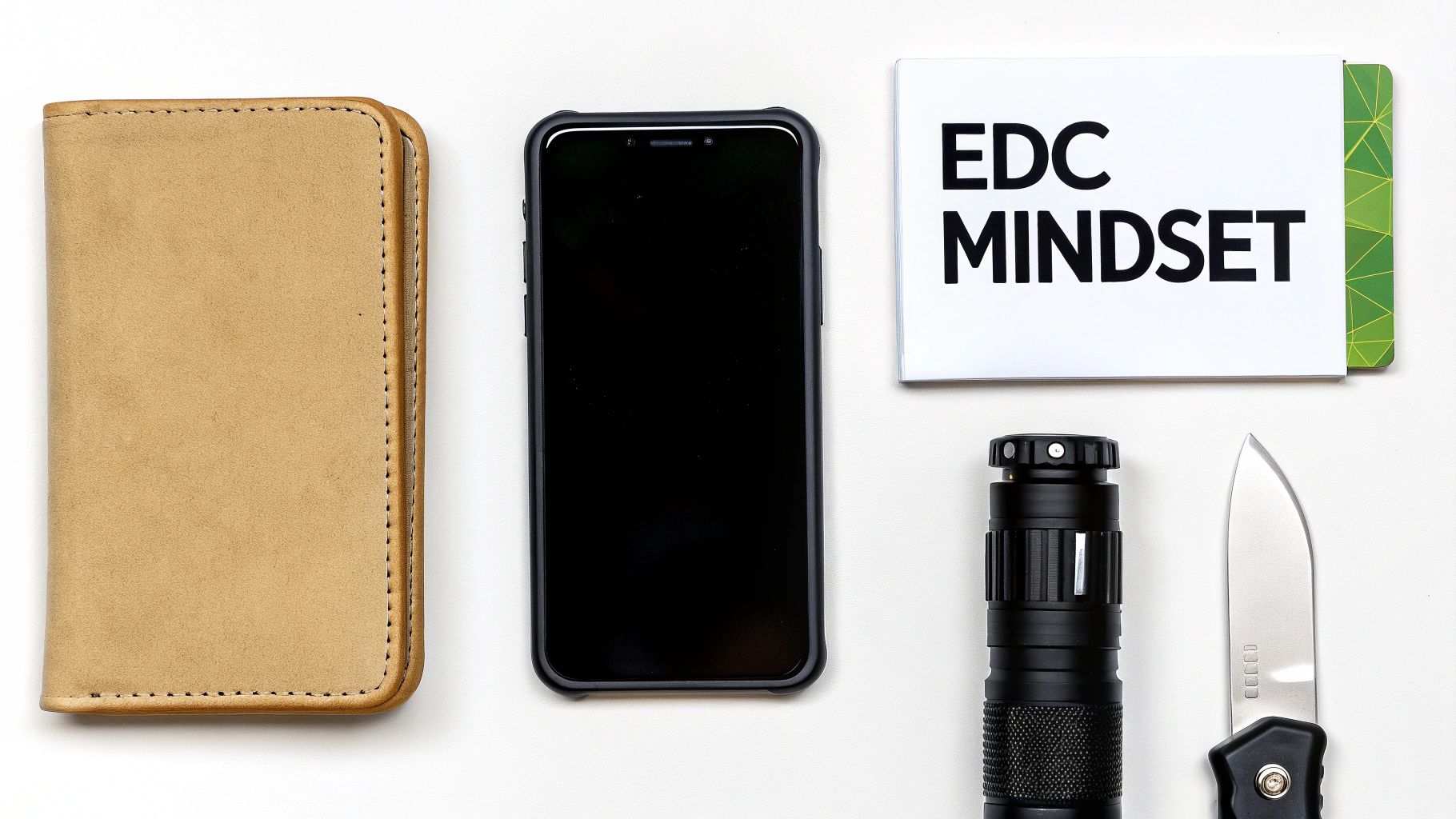
Let's break down what "Everyday Carry," or EDC, really means. It’s not just about stuffing your pockets with random gadgets. At its core, EDC is a practical philosophy built around utility, preparedness, and being ready for whatever the day throws at you. It’s about building a small, personalized "toolkit for life" that you barely notice until you need it.
The whole point is to consciously choose a handful of useful items that help you tackle common, everyday challenges without missing a beat. Instead of getting stuck, you have the right tool for the job, whether that’s opening a stubborn package, tightening a wobbly screw on your glasses, or just finding your way through a dim parking garage.
Here’s the secret: the real power of EDC isn't just in the gear itself, but in the mindset it cultivates. It’s about shifting from being reactive to proactive. When you start thinking ahead about the little snags you might hit during the day, you move with more confidence and a lot less frustration.
This philosophy of preparedness isn't one-size-fits-all; it scales to any lifestyle. A parent juggling a million little tasks, a student hustling across a busy campus, or an urban professional navigating the city—each person can build an EDC that gives them a real sense of control and capability.
“EDC is about making your life more efficient and enjoyable, and only you can decide what that means.”
Ultimately, your everyday carry is a system you design for yourself, by yourself. The goal is to figure out which tools add the most value to your unique daily routine.
We live in a world where it’s easy to depend on complex systems or other people for even the simplest fixes. Because of that, having a few basic, reliable tools on you is incredibly empowering. A well-chosen set of the best everyday carry items gives you the power to solve minor problems on the spot.
This simple habit of self-reliance pays off in a few big ways:
Building an EDC kit isn't some niche hobby for survivalists. It's a smart, practical approach for anyone who wants to make their daily life just a little bit smoother.
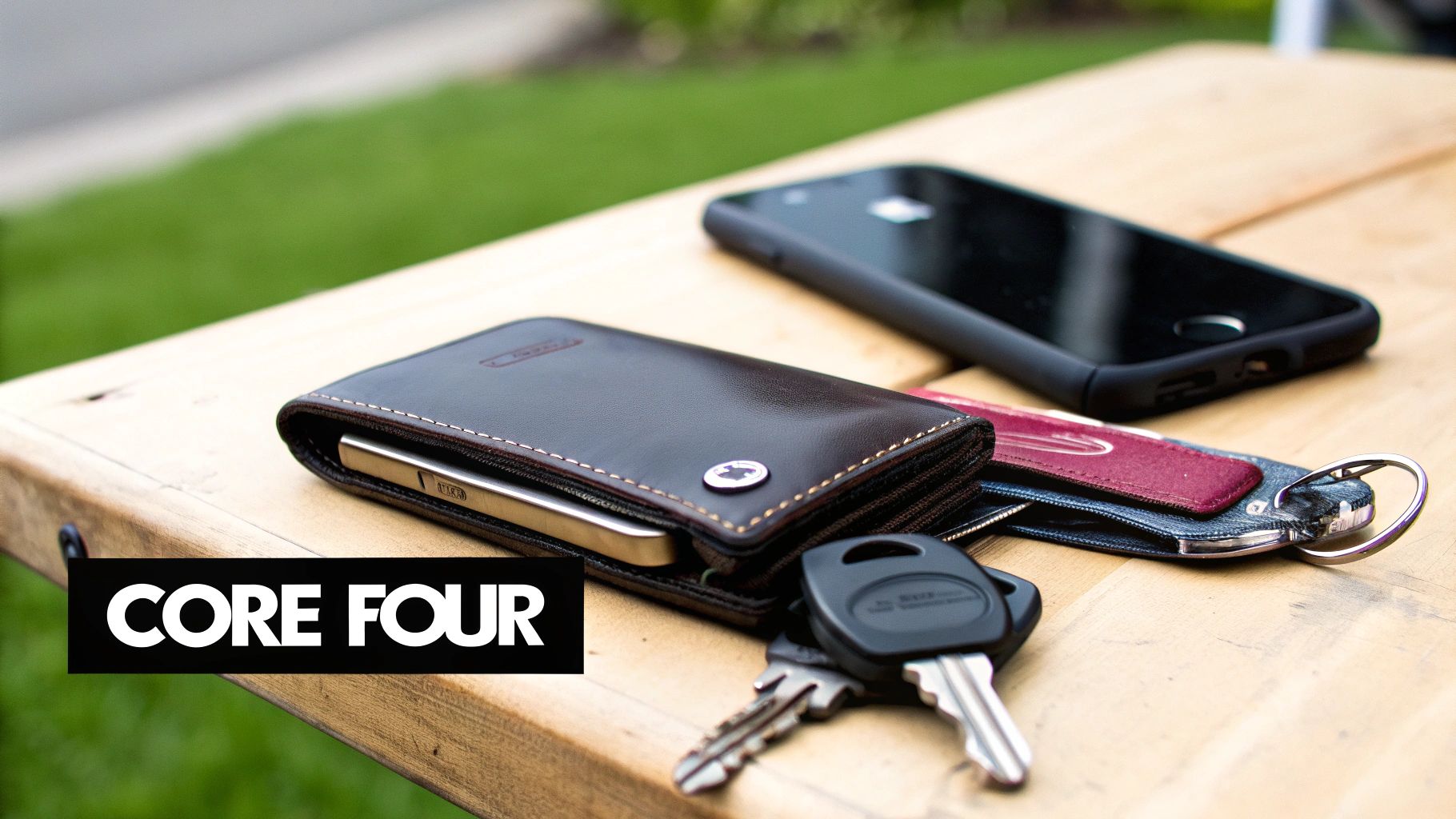
Before you start thinking about fancy gadgets and specialized tools, let's get back to basics. A truly effective everyday carry setup isn't about having the most gear—it's about having the right gear. And that starts with a solid, minimalist foundation.
Think of it as the "Core Four," the absolute essentials that get most of us through 99% of our daily lives. We all carry them, but the trick is to carry them with purpose. By making smart, intentional choices with these items, you can build a system that's organized, efficient, and ready for just about anything the day throws at you.
The first three of the Core Four are the non-negotiables of modern life: your phone, wallet, and keys. They seem obvious, but a few simple tweaks can turn a pocket-bulging mess into a sleek, streamlined system.
Here are a few small changes that make a huge difference:
Of course, no modern trinity is complete without a reliable timepiece. Check out these essential EDC watches that perfectly mix form and function.
To help visualize this foundational approach, here’s a quick look at the Core Four and the roles they play. These are the items that form the bedrock of any solid EDC kit.
| Item | Primary Function | Modern Upgrade Example |
|---|---|---|
| Phone | Communication, Navigation, Information | Durable Case (e.g., OtterBox, Mous) |
| Wallet | Identity, Payment, Access | Slim RFID-Blocking Wallet |
| Keys | Access to Home, Vehicle, Office | Key Organizer (e.g., KeyBar, Orbitkey) |
| Pocket Knife | Utility Cutting, Problem-Solving | Compact Folding Knife (e.g., Spyderco Para 3) |
As you can see, the goal isn't to reinvent the wheel but to optimize the tools you already rely on every single day.
The final piece of the puzzle is a good pocket knife. Now, for some people, this might sound a bit intense, but a knife is one of the most practical and versatile tools you can possibly carry. It’s the original multi-tool, perfect for a thousand little problems you run into every day.
There's a reason folding knives are so popular in the EDC world. In fact, the global knife market is expected to hit USD 3.55 billion by 2032, with folding knives owning a massive 23.0% market share because of how handy and portable they are. This isn't a trend; it's a testament to their utility.
A quality pocket knife isn’t about preparing for a disaster; it’s about effortlessly handling the small, constant demands of modern life. From opening packages and letters to cutting loose threads or slicing an apple for a snack, it's a tool you’ll find yourself reaching for more often than you’d expect.
While a blade is invaluable for tasks, you should also be ready for life's little nicks and scrapes. Having a few first aid kit supplies on hand is always a smart move. Together, these Core Four items—an optimized phone, wallet, keys, and a quality pocket knife—create the unshakable foundation for any everyday carry system you build from here.
Once you've got your Core Four sorted, you have a reliable setup for the predictable parts of your day. But life loves to throw curveballs. Now's the time to build on that foundation with a second tier of gear—the items that turn a good EDC into a great one.
Think of these as the problem-solvers. They’re the tools you’ll be incredibly glad you have when the unexpected happens, dramatically boosting your capability without weighing you down. We're moving beyond just personal items and into tools with a purpose: a proper flashlight, a versatile multi-tool, and the classic pen and notebook.
Let's be honest: your phone's LED flash is better than nothing, but it’s a poor substitute for a real flashlight. A dedicated light gives you a powerful, focused beam that can light up a whole room when the power goes out or help you see what’s going on under the hood of your car. Plus, it saves your phone’s battery for what it's actually for—making calls and sending texts.
It's no surprise that dedicated EDC flashlights have become so popular, with recent surveys showing a 35% jump in people adding them to their kits. This isn't just a trend; it's a practical response to reality. Blackouts hit roughly 1 in 10 households each year in developed countries, making a reliable light source a must-have. You can read more about the growth of the everyday carry flashlight market.
A dedicated flashlight isn't just for emergencies; it's a tool for convenience. Use it to look for a dropped item under a car seat, navigate an unlit path, or simply avoid draining your phone's precious battery life.
Adding a small, powerful light to your pocket is one of the smartest, most impactful upgrades you can make.
A good pocket knife is fantastic for cutting, but it's not much help when you need to tighten a loose screw or open a bottle. That's where the multi-tool comes in. It’s like having a tiny toolbox in your pocket, armed with pliers, screwdrivers, and other functions that a simple blade just can't handle.
Think about all the little things that pop up during the week:
You don't need a massive, clunky tool. A compact model like a Leatherman Squirt or Gerber Dime fits perfectly on a keychain, giving you a ton of utility for almost no extra bulk.
Even in our hyper-digital world, you just can't beat the reliability of a pen and paper. They never have a dead battery, they don't crash, and they certainly don't need a password. This simple pair is perfect for jotting down a sudden idea, sketching a quick diagram to explain something, or leaving a note for someone when your phone is out of juice.
Besides, carrying a pen is just plain useful for everyday tasks like signing receipts or filling out forms. If you're looking to add a quality writing instrument to your setup, it's worth checking out collections like Scriveiner's Everyday Carry Range. And for keeping your digital tools running, our guide on the best portable chargers for travel has you covered.
Adding these three items—a flashlight, a multi-tool, and a pen—is what elevates your carry. You go from having your personal effects to carrying a true problem-solving kit, ready for whatever the day decides to throw at you.
The best everyday carry kit isn't one you buy off a shelf—it's one you build for your actual life. A generic checklist can give you a starting point, but genuine preparedness comes from taking an honest look at your daily grind, your environment, and the real problems you're likely to face.
Think of it like packing for a trip. You wouldn't bring a parka to the beach. In the same way, the gear an urban commuter relies on is a world away from what an avid hiker needs. The goal is to match your tools to your life, creating a setup that feels like a natural extension of yourself.
This is all about starting with a solid foundation and expanding from there. You can see how this works visually:
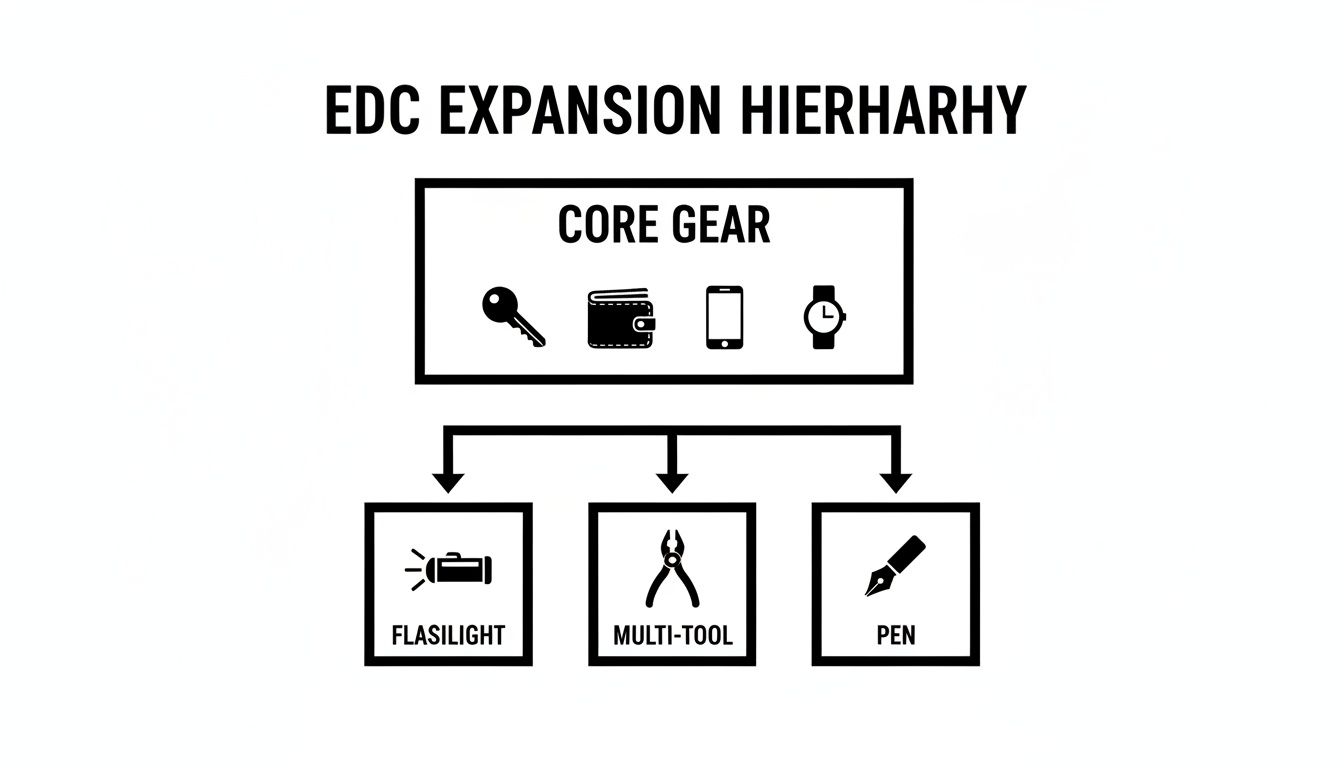
Once you have your core items dialed in, you can start adding gear that solves the specific problems you run into day after day.
To give you a better idea of how this works in the real world, let's look at how different people might build out their kits.
| Lifestyle Persona | Core Gear Focus | Example Items |
|---|---|---|
| Urban Commuter | Efficiency, discretion, and problem-solving in a dense environment. | Compact multi-tool (e.g., Leatherman Squirt PS4), slim power bank, keychain flashlight, minimalist wallet. |
| Outdoor Enthusiast | Durability, reliability, and self-sufficiency in natural environments. | Robust folding knife or fixed blade, high-lumen waterproof flashlight, comprehensive first-aid kit, fire starter. |
| Office Professional | Productivity, organization, and maintaining a polished appearance. | High-quality pen, tech pouch for cables/adapters, pocket notebook, sleek multi-tool. |
| Minimalist | Functionality over quantity, with multi-purpose items that disappear in a pocket. | Slim wallet/cardholder, keychain tool (e.g., pry bar/bottle opener), compact knife, smartphone. |
| Parent | Preparedness for messes, minor injuries, and keeping kids entertained. | Wet wipes, small first-aid kit (band-aids, antiseptic), small snack, multi-tool with scissors. |
As you can see, the "best" EDC is entirely dependent on the person carrying it. Now, let's dive deeper into a few of these common scenarios.
For anyone navigating the concrete jungle, whether on foot or by public transport, efficiency and discretion are king. Your EDC needs to solve city-specific problems without weighing you down or drawing a second glance. It's all about having a low-profile but highly useful set of tools.
Your focus should be on gear that gets you through the typical snags of urban life:
This kind of setup ensures you’re ready for the little frictions of city living.
When your daily routine involves more trails than sidewalks, your gear has to be tougher. Durability and raw function are way more important than being subtle. Your kit should be built to handle the elements and take on more demanding jobs.
Think about adding more rugged versions of your core EDC items:
For anyone who spends serious time in the wild, your EDC is your first line of defense. It's the gear that stops a minor inconvenience from turning into a major emergency.
If you're looking to build a more serious kit for bigger adventures, our wilderness survival gear list is a great blueprint for what to pack.
In a corporate or office setting, your EDC is all about maintaining efficiency, staying organized, and solving small workplace headaches. The gear should blend in, reflecting a prepared and polished mindset without looking out of place in a meeting.
Your kit should be focused on items that boost productivity and keep you looking sharp:
By tailoring your carry to your specific lifestyle, you stop just carrying stuff and start carrying solutions.
Putting together your own everyday carry kit should feel rewarding, not like you're draining your bank account. It’s easy to get lost admiring high-end gear with jaw-dropping price tags, but the reality is you can build an incredibly useful and reliable kit on just about any budget.
The secret is knowing what you're paying for and where your money has the biggest impact. Instead of chasing the most expensive thing on the market, the smart move is to find solid, dependable tools that solve your immediate problems. This gets you in the game right away and gives you a clear roadmap for upgrading later if you feel the need.
You don't need a fat wallet to get started with EDC. Plenty of entry-level items deliver fantastic performance for the money, making them perfect for anyone just figuring out their system or needing a solid backup. The name of the game here is value and reliability, not fancy materials.
The best tool is always the one you actually have on you. A well-chosen $40 knife that's in your pocket every single day is infinitely more useful than a $400 safe queen that you're too afraid to scratch.
Once you've carried your gear for a while and have a good sense of what you use constantly, you can start looking at the mid-range. This is where you really start to see major jumps in material quality and craftsmanship.
We're talking about knife steels with better edge retention, flashlights that are brighter and more durable, or pens machined from solid titanium or brass. For most EDC folks, this tier is the perfect balance of performance and price.
For instance, the demand for tactical knives as everyday tools is through the roof. The global market is expected to hit around $1,500 million by 2025, which just shows how many people are realizing the practical benefits of these durable, function-first designs. You can learn more about the tactical knife market trends to see how this space is growing.
Premium gear is the top of the mountain. This is where you find the "grail" items—the tools crafted from exotic materials like M390 steel, titanium, and carbon fiber. These pieces aren't just tools; they're functional art, built with incredible precision to last a lifetime.
Upgrading to this level makes sense when you’ve found a piece of gear you use day in and day out and simply want the absolute best version of it you can get. A premium knife isn't just for cutting. It's a piece of masterful engineering that you get to appreciate every time it's in your hand. This tier is less about pure utility and more about passion and a long-term investment in quality.
Jumping into the world of Everyday Carry naturally brings up a lot of questions. We see it all the time. From legal gray areas to the simple, practical problem of overloaded pockets, getting good answers is the key to building a setup that actually works for you. Let's tackle some of the most common questions we hear to help you get your gear dialed in.
The best advice I can give is to start small. Seriously. There's a huge temptation to go online and buy a dozen cool gadgets all at once, but that's a recipe for a drawer full of stuff you'll never use.
Instead, just stick with the "Core Four" we mentioned earlier: your phone, wallet, keys, and a simple, reliable pocket knife. Carry only those things for a couple of weeks. As you go about your days, pay attention to those little moments where you find yourself saying, "Man, I wish I had a..." Maybe a screw on your sunglasses came loose, or you needed a bit of light to find something you dropped under your car seat.
Let those real-life moments guide what you add next. This methodical approach is way easier on your wallet and ensures every single item you decide to carry has a proven purpose.
This is probably the most critical question to ask, and the answer is always the same: it depends entirely on where you live. Knife laws are a patchwork that can change dramatically from one state, county, or even city to the next. It is 100% your responsibility to know the laws for your hometown and anywhere you plan to travel.
Here's what you need to look up for your specific location:
A great, safe starting point in many (but not all!) places is a classic non-locking folding knife with a blade under three inches, like a Swiss Army Knife. But again, you have to do your homework and verify your local laws before you carry anything.
Ah, the classic "pocket bulge" problem. We've all been there. The key isn't to carry less, but to carry smarter by distributing the bulk and weight of your gear.
First, look for compact versions of your core items. A slim wallet instead of a bifold, a key organizer like a KeyBar to stop that jangling mess, and a smaller penlight-style flashlight can make a massive difference right away. Next, think about a pocket organizer. This is usually a small pouch with elastic loops that bundles your smaller items—like a pen, pry bar, and flashlight—into one neat little package.
Finally, don't be afraid to move some gear off your body. You don't have to carry everything in your pants pockets. A small sling bag is a fantastic way to keep your essentials handy without the clutter. Even a simple tech pouch that you toss in your work backpack can organize your gear and make it easy to grab when you need it.
Not at all. While it's easy to get lost admiring high-end gear made from titanium and super-steels, there are tons of fantastic, budget-friendly options that are perfectly reliable for daily use. When you're just starting, function is so much more important than the brand name or price tag.
Remember, a well-chosen $30 knife that you actually carry and use every day is infinitely more valuable than a $300 "safe queen" that never leaves the box. Start with what you can afford, and you can always upgrade down the road if you find you need something more specialized.
Ready to discover the best everyday carry items that fit your specific needs and budget? Check out the hand-picked collections over at FindTopTrends and start building a kit that’s perfect for you. Find everything you need at https://findtoptrends.com.




